The Big Question: Is there a technological solution to the problem of global warming?
Why are we asking this now?
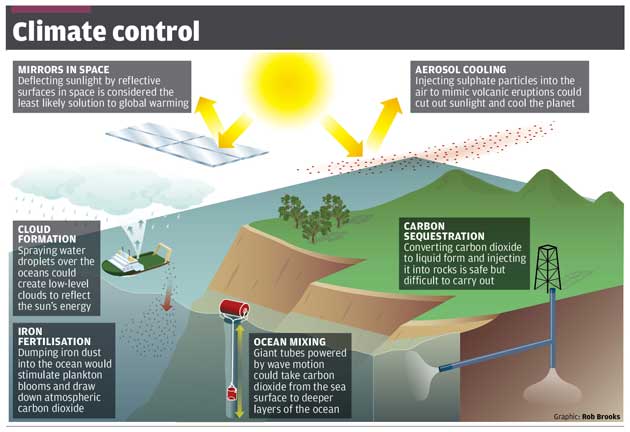
For two reasons. A German research ship, the Polarstern, is steaming towards a region off the coast of Argentina in the South Atlantic, where it intends to release six tonnes of iron sulphate over an area of 115 square miles. The aim is to study the impact of this "iron fertilisation" on the blooms of plankton that absorb carbon dioxide from the sea and, ultimately, the atmosphere. Some scientists believe this could offer a way of boosting a natural carbon "sink", where carbon is stored or sequestered for a long time. The second reason is a study published yesterday in the journal Nature which backs up this idea of a geo-engineered solution to global warming with hard, scientific observations.
What are these latest observations?
A team at the National Oceanography Centre in Southampton studied two areas of the Southern Ocean around the Crozet Islands and Plateau, about 1,400 miles south-east of South Africa. One region is rich in iron, because of the run-off from the volcanic islands, whereas the other is deficient in iron. The researchers found that the iron-rich region also has between two and three times as much carbon sequestered in seafloor sediments and the deep ocean beneath the plankton blooms that form at the sea surface each summer. These sediments have built up over thousands of years since the last ice age. The scientists point out that this supports the idea that iron-rich seas result in greater amounts of carbon being sequestered in deep layers, because atmospheric carbon dioxide is drawn into the sea by the vast blooms of plankton at the surface.
How will fertilisation help fight global warming?
The increase in average global temperatures over the past century or two is now widely accepted as being linked with the increase in carbon dioxide levels in the atmosphere caused by the burning of fossil fuels such as coal and oil. About half of the man-made carbon dioxide released since the Industrial Revolution has been absorbed by the natural carbon "sink" of the ocean. Scientists believe one way of augmenting this natural sink is to boost concentrations of iron, which is known to be the limiting factor that inhibits the absorption of carbon dioxide by plankton. Fertilising the sea with iron, the limiting mineral in seawater, is known to stimulate phytoplankton blooms. Phytoplankton, the microscopic plants at the base of the marine food chain, convert sunlight into chemical energy using the raw material of carbon dioxide dissolved in seawater. The more they grow, the more carbon they use and the more carbon dioxide from the atmosphere ends up being dissolved at the sea surface.
How will we know if it works?
The key to the success of iron fertilisation is showing that much of the carbon trapped in the cells of dead plankton ends up falling to deeper layers of the ocean and on to the seafloor, where it will be trapped for a least 100 years – and so be taken out of the more immediate carbon cycle. Some studies have suggested that, although iron fertilisation can cause blooms to form, they are quickly eaten up by other marine organisms and digested in a way that releases carbon dioxide back into the atmosphere. The latest study, however, implies that, in the natural situation, iron-rich water does indeed lead to long-term sequestration of carbon. This is why iron fertilisation is being seen as a possible technical fix to the problem of global warming.
Are there any other fixes?
Several, but only a few are being taken seriously. For instance, the Nobel prize-winner Paul Crutzen, of the Max Planck Institute in Germany, has suggested it would be possible to inject sulphate particles into the atmosphere to mimic the effects of a volcanic eruption. These particles could act as a reflective surface for incoming sunlight, producing a discernible cooling effect on Earth. For example, the eruption of Mount Pinatubo, on the Philippine island of Luzon, in 1991 released vast amounts of sulphate particles into the global atmosphere, with the result that the Earth cooled by about 0.5C for the year or two following the eruption. Mr Crutzen suggested that, in extremis, it could be possible to mimic this effect by releasing artificial sulphate particles, a process that which could easily be reversed if necessary. But some have questioned possible side-effects, such as acid rain.
Are there any other viable ideas?
Other scientists have suggested doing something similar by creating low clouds over the ocean by spraying water droplets into the air from ships. The formation of these clouds would have a cooling effect and the process could be quickly turned off if necessary. Another theory is to stimulate the mixing of the ocean with long, floating, vertical pipes that take surface water down to deeper levels using wave energy. This would result in carbon dioxide dissolved in surface layers being taken down to deeper layers and deposited there for long periods. James Lovelock, the author of the Gaia hypothesis, is known to favour this idea. One of the more extreme suggestions for the geo-engineering of the climate is to put mirrors in space to deflect incoming sunlight – a technical fix too far for most scientists who are investigating this area of research. Apart from the expense and the practical implications of parking such a complicated set of mirrors is space, people will want to know who would have control such an important technical structure?
Is anyone taking these ideas seriously?
It is fair to say that most experts would, until recently, have discounted such suggestions to counter global warming. However, there is growing concern that international attempts to curb rising levels of carbon dioxide could fail. Since the signing of the Kyoto agreement a decade ago, carbon dioxide concentrations have risen faster than even the worst-case scenarios that the Intergovernmental Panel on Climate Change suggested. Some scientists are now saying we should have a back-up, or "plan B".
Is there a consensus about a 'plan B'?
A survey of climate experts carried out by The Independent at the end of last year found that many now believe that a "plan B" is necessary if global temperatures continue to rise. Just over half – 54 per cent – of the 80 international specialists who responded to our survey said the situation was now so dire that we must consider the artificial manipulation of the global climate to counter the effects of man-made emissions of greenhouse gases.
So where can we go from here?
The Royal Society has set up a working committee to study the feasibility of geo-engineering and its report is due to be published this summer. A number of research projects, such as the one being conducted aboard the Polarstern, are under way and their results will be published in the scientific literature. The opponents argue that the Earth's climate system is far too complex to be interfered with in this way, but others argue that we may end up having no alternative if carbon dioxide concentrations continue to rise, along with global temperatures. There may come a point when we have no alternative but to try geo-engineering.
Should we fight climate change with iron dust and solar screens?
Yes...
* Carbon dioxide levels are rising so fast we may have no alternative if we are to maintain a habitable world
* Natural carbon sinks that absorb carbon dioxide are weakening, so we need to may need to boost them
* We are already engaged in a massive climate experiment by pumping greenhouse gases into the atmosphere
No...
* The risks of uncontrolled side-effects are too great
* Geo-engineering is a dangerous distraction from the goal of curbing man-made greenhouse gas emissions
* We caused one environmental disaster with global warming and we have no right to risk causing another with geo-engineering
View all comments that have been posted about this article.
Offensive or abusive comments will be removed and your IP logged and may be used to prevent further submission. In submitting a comment to the site, you agree to be bound by the Independent Minds Terms of Service.
- Print Article
- Email Article
-
Click here for copyright permissions
Copyright 2009 Independent News and Media Limited


Reduce your global impact.
Comments
Lance
The struggle for oil is not the struggle we are losing
[Article extract]
The issue here is excessive consumption - and this is a moral issue. ...
Excessive consumption is a moral issue, not a scientific issue, not a technological issue, not even an economic or financial problem. There is no scientific solution to a moral problem - trying to find one is called a “category error” and is a serious and fundamental error in thought.
Science and technology have already given us answers - they have told us how to make cars with vastly lower fuel consumption, and cheaper than conventional cars - but you can’t buy one, because there is more profit in conventional high-consumption cars. Science has shown us alternative energy sources - but we didn’t pursue them. Science has given us energy conservation technologies - but they didn’t make anyone any money. The list goes on…
Science cannot save us - that is something we have to do for ourselves - it is a decision and a choice. It is a moral choice.
There is no scientific solution to irresponsible behaviour. There is no scientific solution to people’s refusal to accept the need to act responsibly, to respect other people, and to avoid causing harm to others.
There is no scientific solution to people’s refusal to recognise their role in their own problems and the problems they cause for others.
Politicians could have established higher energy efficiency standards in the 1970's, funded research and reduced regulatory burdens for prototype energy projects (clean coal, tide/wave, nuclear, wind , solar, etc) and the people would have blissfully lived with the results.
It is accepted by proponents of MMGW that global warming started in 1940's, a starting point that hase seen of 6 fold increase in the use of hydrocarbons.
Blaming the Victorians for MMGW is completely bonkers.
Anyway, the point, the real issue, is that there is no such thing as MMGW. A recent flurry of papers submitted for publication have confirmed that there is no Greenhouse signature. This research shows that previous attempts to 'fix' the data in order to support the climate models are flawed and are in significant error.
There is no way round this problem - No Greenhouse Signature - No MMGW - Climate Models are false.
"using state-of-the-art observational datasets and results from a large archive of computer model simulations, a consortium of scientists from 12 different institutions has resolved a long-standing conundrum in climate science - the apparent discrepancy between simulated and observed temperature trends in the tropics. Research published by this group indicates that there is no fundamental discrepancy between modeled and observed tropical temperature trends when one accounts for: 1) the (currently large) uncertainties in observations; 2) the statistical uncertainties in estimating trends from observations. These results refute a recent claim that the model and the observed tropical temperature trends "disagree to a statistically significant extent". This claim was based on the application of a flawed statistical test and the use of older observational datasets"
in other words, the so-called 'missing signature' shows nothing either way.
Nobody knows what they are talking about and the trust is gone.
Man has many virtues but one of them is not the ability to understand deep complicated systems that are apparently stable but can tip over into chaos with the flick of a man made switch.
The rules of unintended consequences and Murphy's Laws will always predominate.
Not that I claim to be an expert on the matter. :-)
http://y2u.co.uk/Humour/Quotes/Murphys_
Look at: http://terrapreta.bioenergylists.org/ta
There are many other sites dealing with the subject.
In the seventies, scientist were promoting geo-engineering even then, but it was to warm up the planet.
From the book “Omega – Murder of the Eco-system and the Suicide of Man , Paul K Anderson, 1971, Controlling the Planet's Climate, J. 0. Fletcher (Rand corporation). The language hasn't changed much but it was global cooling they were worried about.
"The largest scale enterprise that has been discussed is that of transforming the Arctic into an ice-free ocean. Three basic approaches have been proposed:
(a)influencing the surface reflectivity of the ice to cause more absorption of solar heat;
(b)large-scale modification of Arctic cloud conditions by seeding;
(c)increasing the inflow of warm Atlantic water into the Arctic Ocean.
The Soviet engineer, Borisov, has been the most active proponent of the much-publicized Bering Strait dam. The basic idea is to increase the inflow of warm Atlantic water by stopping or even reversing the present northward flow of colder Pacific water through the Bering Strait. The proposed dam would be 50 miles long and 150 feet high.
Other ideas included deflecting the Gulf Stream, creating a massive sea in Siberia to absorb heat. Fortunately the weather continued its natural cycle and got warmer again. It is currently doing the reverse and getting cooler again. Let's hope someone can stop these idiots before too much damage is done.
There are an increasing number of scientists, some from the UN IPCC who are now expressing scepticism regarding that Panel's claims of catastrophe due to anthropogenic global warming (AGW). Only yesterday, retired senior NASA atmospheric scientist Dr John S Theon, one time supervisor of Dr James Hansen, NASA's most vocal AGW alarmist, admitted his scepticism of the science of AGW and was very critical of Hansen, saying that he had embarrassed NASA with his alarmist pronouncements.
Recently Dr Joanne Simpson, the first woman to receive a PhD in meteorology left NASA and declared that as she was no longer constrained by the Agency or was receiving public funding, she was also an AGW sceptic.
The whole concept of a consensus of scientists supporting AGW is falling apart. Now just today we learn that the International Institute of Forecasters has published a paper claiming to have shown that there is no scientific basis for forecasting climate.
The experiments described above are dangerous bearing in mind the frailty of the AGW science. Surely plankton feeds many aquatic species so to destroy any might be ecologically unsound.
http://www.climateaudit.org/?p=4991
These two submissions conclude that you cannot 'fix' climate data to support climate models.
http://kestencgreen.com/naiveclimate.pd
This paper concludes that "for all practical purposes, global mean temperatures do not seem to be predictable."
http://jennifermarohasy.com/blog/2009/0
This blog highlights that all IPCC climate models are non-scientific, they were found to have 'violated' 72 scientific principles of forecasting.
All current IPCC climate models are flawed, and even if they could be revised, or fixed, they still cannot be used to predict the future climate.
Conclusions:
1. Using climate models to predict a future climate is a complete waste of time and money. They don't work.
2. Using climate models to drive public policy is utter folly.
3. Using climate models to re-engineer the planet's climate is completely bonkers. It is unscientific.
As geoengineering becomes increasingly viable (and respectable), I suspect the global community is going to have to think long and hard about the ethics of taking--and not taking--action
http://2020science.org/2009/01/28/geoen
I bet the BBC did not broadcast either the Theon story or the IIoF paper.
But for the timebeing I think we need to focus on other problems. The world powers are chronically unable to communicate with each other. There is this nasty little problem with demand and supply of resources. We have an economical system that stinks like hell.
And as individuals, yes, we fall pathetically short of being perfect. Rather, also we stink like hell. And when at the same time our leaders show time after time they are not up to the job, well, then, what hope do we have!?
As a first initiative, in order to establish what the basis would be for a future, viable world, I think we should start making wish-lists!
1) Abolish ALL religion!
2) Supply and demand should follow the law of absolute reciprocity (auch, no more free market, that hurts US, doens't it...!?)
3) No private individual should ever own more material possessions than a specific limit (to be established scientifically)
4) Politics and business need to be merged, but are undercast democratic principles
5) Institutions like the UN (or anything similar, replacing it) should be given the power to overrule individual countries with any means necessary.
OK, yes, I am drunk and dreaming...
For the foreseeable future we need to tolerate being ruled by people who are lethally incompetent, disgustingly greedy and incapable of letting their reasoning be governed by basic rules of logic.
My guess is, no, humanity will not survive. Humanity has gone insane. We have been given all the necessary means to create a rather perfect world for ourselves. Science has all the necessary tools to improve on nature. But as long as insanity rules amongst our leaders, there is no hope whatsoever.
The idea that there is no consensus is a joke, reading to much propaganda from the usual anti global warming campaigners.
Like these guys, Inhofe and Morano,
www.realclimate.org/index.php/archives/2
Theon retired from NASA in 1994, so i'm sure he's well up to date on current climate modelling methodology. In comment 5 on the link above you'll find remarks regarding theon.
The links that Callum provided contain only one scientific paper, not accpeted yet, that deals only with the troposhere from reading the abstract, i'm not qualified to dissect it - neither are most people here i assume - its interesting though, that its available at this stage of the process of review - i don't make mine available that early.
To say there is no scientific consensus is rubbish, a recent study showed 97% of climate scientists accept the theory. The scientists who are usually trotted out as anti MMGW are not, in the majority, climate scientists - so they have little intellectual basis to dispute it, just supposition and conjecture (and perhaps in some cases a few quid).
This is the causal part of MMGW. According to the MMGW hypothesis it is here that greenhouse gases do their business in heating up the planet. There should a Greenhouse Signature, one that is clearly indentifiable and measureable.
After 30 years of looking no one has found it. It is simply not there.
There have been recent attempts to 'fix' the tropospheric data to fit the models - new statistical methodologies - new ways to measure atmospheric temperatures. The latest research shows that all these attempts are flawed and in significant error.
The conclusion is clear; No Greenhouse Signature - No MMGW.
Worst still for proponents of MMGW is that recent research shows that all IPCC models are fundamentally flawed - they are unscientific in basis and it now transpires that models cannot be used to predict future climate.
If science can show me the Greenhouse Signature I would be seriously worried. The fact is that after 30 years of looking no one has found it. The conclusion is simple - it simply is not there.
We need to change how we produce (including children) and consume.
We need to change how we live and who we are, otherwise the future will just keep getting worse.
The rest is just excuses.
Like the ramblings of the drunk who is going to give up drinking tomorrow.....
The notion that a raft of techo-fixes can be implemented so that global "growth" - a.k.a. global greed - can carry on without let or hindrance, is an integral part of the essentially autistic neoliberal fantasy.
Brown often likes to forecast that the world economy "will double in the next twenty years" presumably bringing the same debt-driven consumerist utopia to all corners of the globe.
The fact that the planet is not going to provide the resources necessary for such growth, and that countries such as the Congo and Nigeria - to name but two - are going to find their environments trashed by efforts to make it possible, is of no concern to me, sat infront of my HDTV - vodka in hand - watching a group of over-paid young males kick a ball about, in between kicking each other, and punctuated by frequent discussions regarding the referee's parentage.
If I get bored an trawl through the channels until I find the one featuring Ms Paris Hilton,or whichever vapid 'celebrity' is icon of the week in Murdoch's version of the Enlightenment.
THIS NEEDS MORE COMPUTER MODELS RUNNING BEFORE THEY GO OFF HALF COCKED AND REALLY CAUSE A CATASTROPHE!
We know that there is no such thing as MMGW, it is a flawed environmentalist construct; it might be that the modern environmentalist movement actually makes things worse.
It could be that environmentalism, like smoking, is bad for your health.
It concerns a leak from a decontamination plant into the river Blackwater from 1990 until 2004.
It was discovered during preperations for the closure.
Prosecutors blame it on poor design and no regular inspection or maintenance.
The trial continues.
Following Sizewells latest discharge it appears as if once again nuclear industry maintenance schedules and risk assesments are not worth the paper they are written on.
Following the whitewash and cover up at Sizewell could everyone please look for this one and try and get national press coverage.
No cover up at Bradwell Nuclear Power.
Dr. Pachauri, head of the Intergovernmental Panel on Climate Change has said that the simplest, most effective solution to global warming is for all people to BE VEGETARIAN, or at least, eat much less meat.
So please help to save our precious planet, by adopting a noble and compassionate plant based diet.
For more details, please see www.suprememastertv.com
I agree that we are largely not in control of the thermostat.
"The issue is, we must cut our emissions now for the long term -"
If emissions means pollution, I agree. Cut back on NOx, SOx , Mercury, particulates, various chemicals, etc. Note I didn't list CO2, since it is NOT a pollutant at even 10 times current levels, so the focus on CO2 is misguided from a pollution perspective. Technologies to reduce pollutants have come a long way and have much more promise than technologies to extract CO2. Let me ask, why you don't want the water vapor emissions reduced also? Water vapor causes 95% of the greenhouse warming effect. Does that mean it is a pollutant?
"- there really isn't a plan B to this where there is room for a viable long-term technological fix.""
Let's say that CO2 emissions will cause catastrophe in 100 years. There is a strong case to be made that future technologies developed over the next 50-100 years will devise a solution. If there is no current technological solution, it may be better to develop policies to mitigate any effects of sea level rise or precipitation changes with the idea that spending money on these would be better spent, until such time as researchers find a solution. Also, that wouldn't plunge the world into an energy cost depression.
70% of US grain is used as animal feed.
90% of deforestation is due to clearing for agriculture.
Eat less meat, or better still, go completely veggie to save the planet!
Yes, we need to study ways to alleviate our impact on the ecosystems life depends on, all life.
If our impact, as it now seems, influences disturbances to the eco-equilibrium, the least we can do is to try and evolve to the point of reasonable control.
We should probably be careful in our studies and approaches to such vast, integrated, planetary systems meant to naturally self regulate over long cyclic periodicity.
We are already toying with the Hadron Collider at Geneva, expecting to generate micro-black-holes, hoping the physics are rightly understood in that we suppose they will evaporate shortly.
We may, as shortly, learn that some MBH,s have effectively settled at the center of the planet..!
So, yes indeed, it is about time that such risks are at least taken in full scientific appreciation of the risks involved.
The same should be our approach to dealing with man made negative disruptions to our biotope.
Revise habits and work towards solutions to our tendency to often act irresponsibly.
All this to be preferably established as far away from opportunistic politics as reasonably possible.