The big thaw: Greenland ice cover is melting away
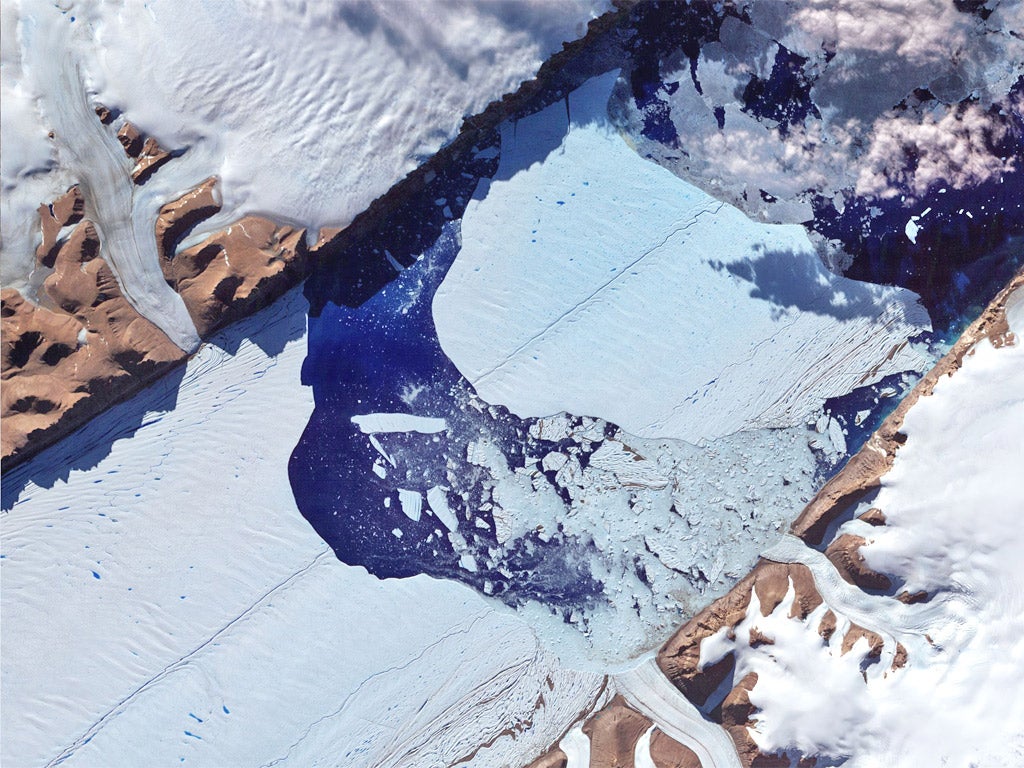
The vast ice sheet of Greenland, which holds enough water to raise global sea levels by 7.2 metres, underwent a remarkable transformation for a few days this month when scientists observed an unprecedented melting of its frozen surface.
Click HERE to view graphic
For the first time since satellites began recording changes to Greenland from space more than 30 years ago, scientists observed surface melting across almost the entire ice sheet – the second largest body of ice after Antarctica.
At this time of the year, about half of the surface of the ice sheet usually experiences some kind of surface melting as summer day-time temperatures rise above freezing point.
However, scientists at the US National Aeronautics and Space Administration (Nasa) were amazed to discover that on 11 and 12 July surface melting had extended across 97 per cent of the ice sheet – the most widespread melting they have witnessed.
The observation comes just weeks after an iceberg twice the size of Manhattan broke away from the Petermann glacier in northern Greenland and other scientists recorded a rapid loss of floating sea ice further north in the Arctic basin.
The phenomenon in Greenland was so unusual and unexpected that researchers at Nasa’s Jet Propulsion Laboratory (JPL) in Pasadena, California initially could not believe what they were seeing and so quickly sought verification from colleagues elsewhere.
“This was so extraordinary that at first I questioned the result: was this real or was it due to a data error?” said Son Nghiem, whose job at JPL was to analyse radar data from the Indian Space Research Organisation’s Oceansat-2 satellite.
Dorothy Hall at Nasa’s Goddard Space Flight Centre in Greenbelt, Maryland, soon supplied the verification in the form of temperature data from two other Nasa satellites. She confirmed unusually high temperatures over the entire ice sheet, which at 1.7m square kilometres is three times the size of Texas, or more than 16 times the size of England.
Thomas Mote, a climatologist at the University of Georgia, then came up with a meteorological explanation for the highly unusual observation. A ridge of warm air, called a heat dome, has formed over Greenland.
Dr Mote said that it was in fact the latest of a series of ridges that had dominated Greenland’s weather since the end of May. “Each successive ridge has been stronger than the previous one,” he said.
What was so unusual was the extent of the melting. It was even taking place near the highest point in Greenland, around Summit Station which is 3.2 km (2 miles) above sea level, which hardly ever melts.
In fact, according to ice cores taken from the region, the Summit of the Greenland ice sheet has not experienced melting of this kind since 1889, according to Lora Koenig, a Nasa glaciologist at Goddard.
“Ice cores from Summit show that melting events of this type occur once every 150 years on average. With the last one happening in 1889, this event is right on time,” Dr Koenig said.
So the unprecedented melting monitored by satellites might just be a natural event, or it could indicate more serious climate change. “If we continue to observe melting events like this in the coming years, it will be worrisome,” Dr Koenig said.
The Greenland ice sheet is 2,400 km long, 1,100 km wide, and up to 3km thick at its highest point. The current ice sheet is believed to be 110,000 years old, but there may have been ice sheets on Greenland for 18 million years or more.
Join our commenting forum
Join thought-provoking conversations, follow other Independent readers and see their replies
Comments
Bookmark popover
Removed from bookmarks