The green betrayal
Green lobby turns on Government over failure to curb air and road travel
It is the Great Green Betrayal. With environmental issues becoming ever more critical, the green policies of Gordon Brown's government are standing still or even going backwards, it became clear last night. On the day of a major warning that time is running out to solve the problems caused by climate change, it emerged that Britain's own green policies are stalled or backsliding in three crucial areas.
First, environmental taxation, which could help curb greenhouse gas emissions and much other pollution, is actually falling rather than rising – and falling substantially, a powerful all-party group of MPs revealed.
Second, the Government has no plans to intervene in the aviation sector to cut rapidly growing emissions, Ruth Kelly, the Transport Secretary, made clear.
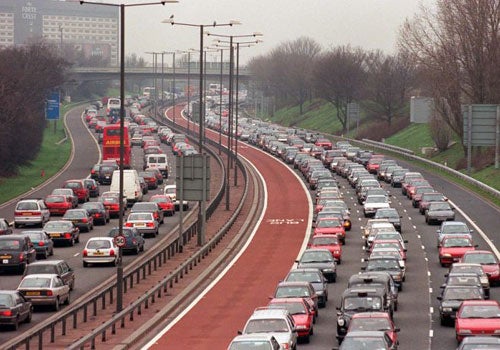
And third, national road pricing as a means of curbing traffic and cutting down emissions from cars is similarly not on the agenda, Ms Kelly disclosed.
It all made for a picture of a government which talks a lot but does little to help the environment – and it came on a day when the Organisation for Economic Co-operation and Development (OECD) gave a formal warning that the "window of opportunity" to tackle the world's global warming problem will not be open for long. Green groups reacted fiercely to the Government's apparent lack of drive to tackle the issues, piling pressure on the Chancellor, Alistair Darling, to produce a radical green-friendly Budget next week.
"The Government is simply failing to take the decisive decisions necessary to secure a safe future for our children in the coming decades," said John Sauven, executive director of Greenpeace UK. "Considering all the fine words that have come from them on the importance of acting on climate change, this is a huge betrayal."
The OECD's Environmental Outlook to 2030 said that, without concerted and immediate global action, countries will suffer significant negative impacts of climate change, loss of biodiversity, water scarcity and threats to human health from pollution and chemicals. By 2030, it said, half of the world's population will live in areas suffering from severe water stress – where people are using 40 per cent of the total available – ranging from Africa to south-east England. And, without action to stop them, global greenhouse gases will grow by 37 per cent from current levels.
Yet, as the OECD report was being issued in Paris, the MPs of the Commons Environmental Audit Committee (EAC) released their own verdict on Britain's green policies, savaging the Government and ministers for not doing enough. In its report on the 2007 pre-Budget report and Comprehensive Spending Review, the committee attacked Labour for failing to meet the challenge of climate change.
Revealing that environmental taxes had dropped from a peak of 9.7 per cent of all taxes in 1999 to 7.3 per cent in 2006, the committee demanded a big increase in green taxes from Mr Darling's first Budget. Indeed, in lambasting what they saw as an inadequate British response to the threat posed by global warming, the MPs focused on the Treasury as their main target.
It had, said Tim Yeo, the committee's chairman, failed to respond to environmental challenges "with the scale and urgency" recommended by Lord Stern's ground-breaking review, 18 months ago, of the economic impacts of climate change. Mr Yeo said it had demonstrated "a lack of ambition and imagination" on green taxation, adding: "The Treasury must be bolder in raising green taxes once again. It should sell these tax rises to the public by linking them to increased spending on the environment and reductions in other taxes."
The MPs said that there should be a "significant increase" in all rates of taxation on flights, and that in the forthcoming Budget the Treasury must not defer its planned rises in fuel duty. The committee said environmental issues were being "ghettoised", with departments lacking clear targets on reducing emissions, and the Government must do more to bring the environment into the mainstream.
Ms Kelly also came in for strong criticism after her disclosure of future inaction on two fronts – road pricing and curbing emissions from aircraft. The Transport Secretary ruled out a national road-pricing scheme as a means to curb traffic growth and cut down greenhouse gas emissions – her officials said it would be "many years down the line". Instead, she indicated that motorways would be broadened by allowing drivers to use the hard shoulder. Earlier, she had similarly indicated that a government curb on carbon emissions from aviation in the UK, which are set to soar, was not on the agenda. If Britain acted unilaterally to reduce flights, airlines from other countries would step in and take advantage, she said.
But campaigners attacked this response. "Ruth Kelly seems to be living in a parallel universe," said John Stewart, chair of Hacan, the main group campaigning against future expansion at Heathrow airport. "With protests happening all around her, she seems determined to plough on with her policies of aggressive airport expansion regardless."
Friends of the Earth's transport campaigner, Tony Bosworth, said: "Ruth Kelly's plans for extra motorway lanes are not the answer to Britain's transport problems. Real choice and real solutions to congestion and transport's contribution to climate change can be achieved by improving alternatives to car use and reducing the need to travel."
The Government's failure to produce a joined-up transport policy also came under fire from the Environmental Audit Committee. While welcoming the Government's decision to reform Air Passenger Duty (APD) from a tax per passenger to a levy per flight, the report said the doubling of APD rates from February 2007 had only restored for most flights the rate of tax Labour had inherited. In addition to the different short-haul and long-haul tax bands now introduced, the MPs called for a third, higher, rate for "very long haul" flights.
"Above all, it is vital that all rates of aviation tax are significantly increased, so as to stabilise demand and resulting emissions," the report said.
The committee said that with a 12 per cent increase in carbon emissions in road transport between 1997 and 2006 in England, the forthcoming Budget would be "a test of the Treasury's environmental credibility: it must not defer its planned rises in fuel duty". Despite rises in the price of crude oil pushing up fuel prices, the demand for road fuel was still strong, the EAC said.
The report also urged the Treasury to spend more to encourage carbon capture and storage schemes which aim to trap the emissions from fossil-fuelled power stations.
Join our commenting forum
Join thought-provoking conversations, follow other Independent readers and see their replies
Comments
Bookmark popover
Removed from bookmarks