The planet's future: Climate change 'will cause civilisation to collapse'
Authoritative new study sets out a grim vision of shortages and violence – but amid all the gloom, there is some hope too
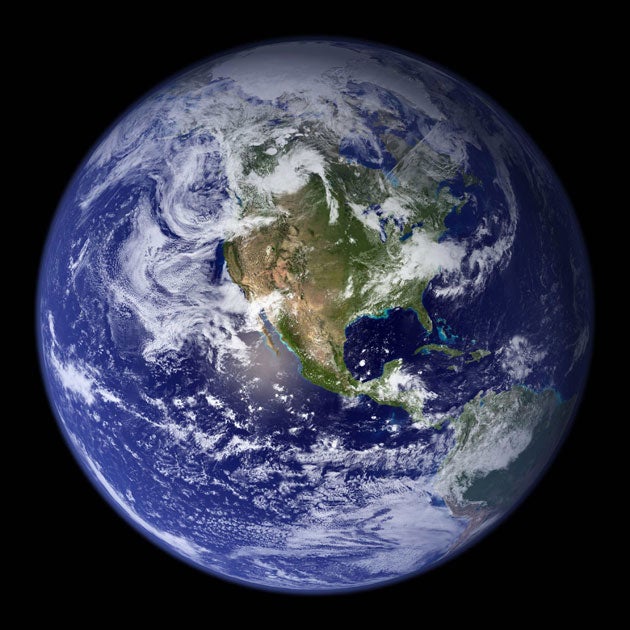
An effort on the scale of the Apollo mission that sent men to the Moon is needed if humanity is to have a fighting chance of surviving the ravages of climate change. The stakes are high, as, without sustainable growth, "billions of people will be condemned to poverty and much of civilisation will collapse".
This is the stark warning from the biggest single report to look at the future of the planet – obtained by The Independent on Sunday ahead of its official publication next month. Backed by a diverse range of leading organisations such as Unesco, the World Bank, the US army and the Rockefeller Foundation, the 2009 State of the Future report runs to 6,700 pages and draws on contributions from 2,700 experts around the globe. Its findings are described by Ban Ki-moon, Secretary-General of the UN, as providing "invaluable insights into the future for the United Nations, its member states, and civil society".
The impact of the global recession is a key theme, with researchers warning that global clean energy, food availability, poverty and the growth of democracy around the world are at "risk of getting worse due to the recession". The report adds: "Too many greedy and deceitful decisions led to a world recession and demonstrated the international interdependence of economics and ethics."
Although the future has been looking better for most of the world over the past 20 years, the global recession has lowered the State of the Future Index for the next 10 years. Half the world could face violence and unrest due to severe unemployment combined with scarce water, food and energy supplies and the cumulative effects of climate change.
And the authors of the report, produced by the Millennium Project – a think-tank formerly part of the World Federation of the United Nations Associations – set out a number of emerging environmental security issues. "The scope and scale of the future effects of climate change – ranging from changes in weather patterns to loss of livelihoods and disappearing states – has unprecedented implications for political and social stability."
But the authors suggest the threats could also provide the potential for a positive future for all. "The good news is that the global financial crisis and climate change planning may be helping humanity to move from its often selfish, self-centred adolescence to a more globally responsible adulthood... Many perceive the current economic disaster as an opportunity to invest in the next generation of greener technologies, to rethink economic and development assumptions, and to put the world on course for a better future."
Scientific and technological progress continues to accelerate. IBM promises a computer at 20,000 trillion calculations per second by 2011, which is estimated to be the speed of the human brain. And nanomedicine may one day rebuild damaged cells atom by atom, using nanobots the size of blood cells. But technological progress carries its own risks. "Globalisation and advanced technology allow fewer people to do more damage and in less time, so that possibly one day a single individual may be able to make and deploy a weapon of mass destruction."
The report also praises the web, which it singles out as "the most powerful force for globalisation, democratisation, economic growth, and education in history". Technological advances are cited as "giving birth to an interdependent humanity that can create and implement global strategies to improve the prospects for humanity".
The immediate problems are rising food and energy prices, shortages of water and increasing migrations "due to political, environmental and economic conditions", which could plunge half the world into social instability and violence. And organised crime is flourishing, with a global income estimated at $3 trillion – twice the military budgets of all countries in the world combined.
The effects of climate change are worsening – by 2025 there could be three billion people without adequate water as the population rises still further. And massive urbanisation, increased encroachment on animal territory, and concentrated livestock production could trigger new pandemics.
Although government and business leaders are responding more seriously to the global environmental situation, it continues to get worse, according to the report. It calls on governments to work to 10-year plans to tackle growing threats to human survival, targeting particularly the US and China, which need to apply the sort of effort and resources that put men on the Moon.
"This is not only important for the environment; it is also a strategy to increase the likelihood of international peace. Without some agreement, it will be difficult to get the kind of global coherence needed to address climate change seriously."
While the world has the resources to address its challenges, coherence and direction have been lacking. Recent meetings of the US and China, as well as of Nato and Russia, and the birth of the G20 plus the continued work of the G8 promise to improve global strategic collaboration, but "it remains to be seen if this spirit of co-operation can continue and if decisions will be made on the scale necessary to really address the global challenges discussed in this report".
Although the scale of the effects of climate change are unprecedented, the causes are generally known, and the consequences can largely be forecast. The report says, "coordination for effective and adequate action is yet incipient, and environmental problems worsen faster than response or preventive policies are being adopted".
Jerome Glenn, director of the Millennium Project and one of the report's authors, said: "There are answers to our global challenges, but decisions are still not being made on the scale necessary to address them. Three great transitions would help both the world economy and its natural environment – to shift as much as possible from freshwater agriculture to saltwater agriculture; produce healthier meat without the need to grow animals; and replace gasoline cars with electric cars."
Join our commenting forum
Join thought-provoking conversations, follow other Independent readers and see their replies
Comments
Bookmark popover
Removed from bookmarks