The world's first really green oil deal
Ecuador's $3.6bn scheme to save its rainforest from exploitation could point the way to sparing other threatened landscapes
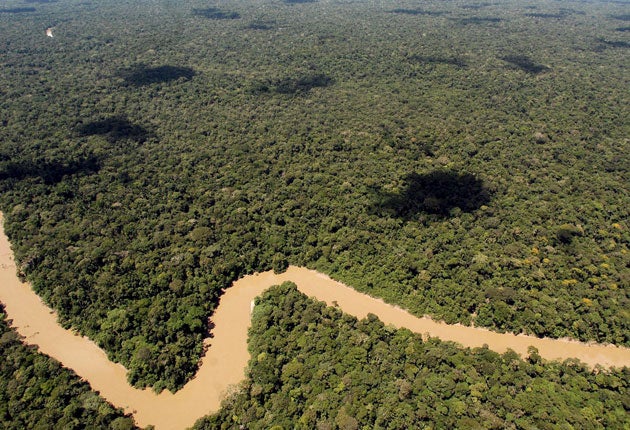
The world's first genuinely green energy deal is about to be sealed. In a plan which could be a blueprint for saving large tracts of the planet from exploitation, a greater value is being put on a pristine wilderness than on the oil that lies beneath.
While the world's industrialised countries are building complex carbon markets to enable them to carry on polluting, Ecuador has come up with a much simpler idea for mitigating climate change: leave the oil underground. It is promising to lock up as much as a fifth of its oil reserves indefinitely, providing rich nations pay out at least half the market value of the oil – some $3.6bn – as compensation.
The trail-blazing proposal was first floated in 2007, but it took a step towards reality last week when the UN Development Programme signed an agreement with the Ecuadorean government to be the independent administrator for the project's trust fund. The accord makes Ecuador the only country in the world offering to leave lucrative oil reserves untapped in an attempt to slow climate change.
Crucially, the oil in question – some 846 million barrels of crude – lies beneath the Yasuni National Park, one of the most bio-diverse swathes of rainforest on the planet. Located in the heart of the Ecuadorean Amazon, one hectare contains more tree species than the whole of the US and Canada combined. It is also home to 105 amphibian species – the UK has six – more than 500 birds, 200 mammals and countless insects and plants. Declared a world biosphere reserve by Unesco in 1989, the park is also the ancestral land of two of the world's last remaining uncontacted indigenous tribes, the Tagaeri and the Taromenane.
The plan, backed by Greenpeace and even the oil-producing Opec countries – applies to a 675sq mile area of Yasuni known as the ITT block after the three oil-fields that lie beneath it. Locking up the oil would not only protect the rainforest and the indigenous tribes, but it would also stop at least 407 million metric tonnes of CO2 being released into the atmosphere, according to Carlos Larrea, the initiative's technical adviser. "That's more than the total annual emissions of France or Brazil," he said.
In return, Ecuador is asking for $3.6bn – roughly half the expected revenue if the oil was extracted and sold at current prices – to be invested in renewable energy developments to help the country further cut its carbon emissions.
If it works, the scheme could be rolled out to countries such as Colombia, Peru and the Philippines which face similarly stark choices between protecting globally significant ecosystems and oil. "Ecuador began exporting oil in 1972, and oil now accounts for over 60 per cent of exports," Mr Larrea said. "Locking away 20 per cent of our oil reserves is a bold decision but we can't do it without international support."
Yet, after three years, securing anything more concrete than praise has proved elusive. At the end of last year, President Rafael Correa embarked on an international tour, including the UK, France, Sweden and Canada, to drum up support for the proposal before December's climate change summit in Copenhagen. But none has offered a firm cash commitment.
The Yasuni-ITT committee was originally poised to sign the agreement at the summit, but Mr Correa, unhappy with the terms, baulked at the 11th hour. His actions, and subsequent statements, led to several resignations from the Yasuni-ITT board. But a new board was assembled, with some original members, and the contentious points in the agreement have been ironed out.
Despite the setbacks, Germany remains a supporter and is likely to contribute around $50m, although no figures are confirmed. Signing up an independent body such as the UN to oversee the trust fund was a key German criterion, along with the support of at least one other country. With the trust fund in place, Mr Larrea is confident the final obstacle will be removed. "Spain and Belgium have expressed support, as have a number of other European countries. We're very optimistic."
Contributions to the fund would be spread over at least 10 years and countries would be issued with Yasuni Guarantee Certificates (CGYs in Spanish) to the value of the non-emitted CO2 their contribution has secured. Should any future Ecuadorean government break the commitment and drill for oil, the certificates entitle their holders to their money back with interest.
From next month, individuals and private companies will also be able to donate via the Yasuni-ITT website. "We hope individuals and environmentally aware companies all over the world will be excited by what we're doing and want to contribute as a gesture of solidarity," Mr Larrea said. "Supporters will be symbolically 'buying' their barrel of oil with the guarantee it will stay underground." Such international "crowd funding" would create an intimidating network of public opposition should any future government try to break the pact.
The $3.6bn will be invested in renewable energy to reduce the country's oil dependency and cut carbon emissions. These investments are expected to generate annual returns of about 7 per cent, which will go into a second pot to fund environmental and social development projects, such as reforestation, social programmes for indigenous groups and eco-tourism. Projects will be decided by a steering committee of representatives from the Ecuadorean government, the donor countries and a nominated public representative.
Reducing illegal logging is the top priority, according to Mr Larrea. Ecuador has one of the highest rates of deforestation in South America, despite protected areas covering over a quarter of the country. Matt Finer of the environmental organisation Save America's Forests has called the Ecuadorean Amazon "a complicated and confusing array of overlapping protected areas, indigenous reserves and crude oil concessions", testament to the way conservation has regularly been sidelined by oil interests. Legal loopholes have permitted oil concessions within national park boundaries and even where areas are protected, they are woefully understaffed.
Ecuador's northern Amazon bears the scars of decades of reckless oil extraction. One of the biggest environmental lawsuits has been raging for 17 years between the oil giant Chevron and 30,000 Ecuadoreans whose land and water are contaminated by oil spills and toxic open waste pits. If found liable, Chevron faces damages of more than $27bn.
However, groundbreaking changes to the constitution in 2008 mean Ecuador is the only country in the world to recognise the rights of nature and ecosystems to survive and flourish, permitting any Ecuadorean citizen to sue on nature's behalf if these rights are infringed.
Understandably, the Ecuadorean government isn't prepared to wait for ever for international co-operation: "If by December 2011, Ecuador doesn't receive at least $100m, the government has the right to call off the proposal," said Bisrat Aklilu, the executive co-coordinator of the UN's multi-donor trust fund office that will administer the Yasuni fund. "The government will repay contributors the face value of their contribution and then make up their own minds about whether to drill."
For some, the plan amounts to little more than blackmail, with Mr Correa holding the Amazon to ransom; if Ecuador can get funding for Yasuni, what's to stop other countries cashing in? Saudi Arabia made possibly the most audacious bid for financial support yet this week, claiming compensation for the expected loss of oil revenue should climate change agreements result in a drop in production.
Against a backdrop of public outrage at the Gulf of Mexico oil spill, the argument for "post-oil" economies seems stronger than ever. Maria Espinosa, Ecuador's Heritage Minister, agrees. "Ten years from now projects like this will be the rule, not the exception," she said last week.
Join our commenting forum
Join thought-provoking conversations, follow other Independent readers and see their replies
Comments
Bookmark popover
Removed from bookmarks