UN averts climate collapse by 'noting' new deal
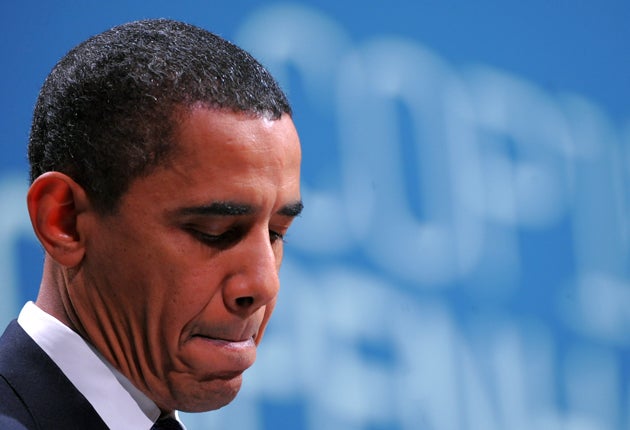
UN climate talks avoided a total collapse today by skirting bitter opposition from several nations to a deal championed by the US President Barack Obama and five emerging economies including China.
"Finally we sealed a deal," UN Secretary-General Ban Ki-moon said. "The 'Copenhagen Accord' may not be everything everyone had hoped for, but this decision...is an important beginning."
But a decision at marathon 193-nation talks merely took note of the new accord, a non-binding deal for combating global warming led by the United States, China, India, Brazil and South Africa.
The 193 nations stopped far from a full endorsement of the plan, which sets a target of limiting global warming to a maximum 2 degree Celsius rise over pre-industrial times and holds out the prospect of $100 billion (£60bn) in annual aid from 2020 for developing nations.
The plan does not specify greenhouse gas cuts needed to achieve the 2 Celsius goal that is seen as a threshold for dangerous changes such as more floods, droughts, mudslides, sandstorms and rising seas.
In a stormy overnight session, the talks came to the brink of collapse after Sudan, Nicaragua, Cuba, Venezuela and Bolivia lined up to denounce the US-led plan after about 120 world leaders left after a summit yesterday.
UN talks are meant to be agreed by unanimity. Under a compromise to avoid collapse, the deal would list the countries that were in favour of the deal and those against.
The outcome may yield the initiative in forming world climate policy to the United States and China, the world's top two emitters of greenhouse gases, and underscored shortcomings in the chaotic UN process.
An all-night plenary session, chaired by Danish Prime Minister Lars Lokke Rasmussen, hit a low point when a Sudanese delegate said the plan in Africa would be like the Holocaust.
The document "is a solution based on the same very values, in our opinion, that channelled six million people in Europe into furnaces," said Sudan's Lumumba Stanislaus Di-aping.
"The reference to the Holocaust is, in this context, absolutely despicable," said Anders Turesson, chief negotiator of Sweden.
Other nations including European Union states, Japan, a representative of the African Union and the Alliance of Small Island States (AOSIS) urged delegates to adopt the plan as a UN blueprint for action to combat climate change.
"We have a real danger of (UN climate) talks going the same way as WTO (trade) talks and other multilateral talks," Maldives President Mohamed Nasheed said, urging delegates to back the plan to prevent the process dragging on for years.
Many nations said the deal fell far short of UN ambitions for Copenhagen, meant as a turning point to push the world economy towards renewable energies such as hydro, solar and wind power and away from fossil fuels.
Before leaving, Obama said the deal was a starting point.
"This progress did not come easily and we know this progress alone is not enough," he said after talks with China's Premier Wen Jiabao and leaders of India, South Africa and Brazil.
"We've come a long way but we have much further to go," he said of the deal.
"The meeting has had a positive result, everyone should be happy," said Xie Zhenhua, head of China's climate delegation.
China had resisted international monitoring of its emissions curbs and the final wording took into account Chinese concerns, speaking of the need to protect sovereignty.
European nations were lukewarm to a deal that cut out some goals mentioned previously in draft texts, such as a target of halving world greenhouse gas emissions by 2050.
Many European nations want Obama to offer deeper US cuts in greenhouse gas emissions by 2020. But Obama was unable to, partly because carbon capping legislation is stalled in the US Senate.
The deal sets an end-January 2010 deadline for all nations to submit plans for curbs on emissions to the United Nations. A separate text proposes an end-2010 deadline for reporting back on - but dropped a plan to insist on a legally binding treaty.
Join our commenting forum
Join thought-provoking conversations, follow other Independent readers and see their replies
Comments
Bookmark popover
Removed from bookmarks