Britain's green shame
Jonathon Porritt steps down from Blair's sustainability commission with UK still second-worst greenhouse gas emitter in Europe
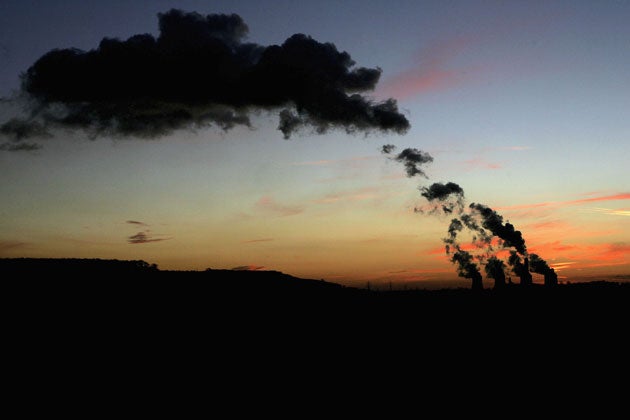
getty images
The embarrassing report comes just days after Gordon Brown's proposals for a £60bn international fund to help poorer countries deal with climate change were announced
When it comes to environmental sustainability, the prognosis is grim: Britain is "winning battles, but still losing the war".
The UK is failing to hit a raft of key targets on sustainable living, according to a new report to be published this week. In its critical analysis, released on Wednesday, the Sustainable Development Commission (SDC) warns that progress on a number of green targets has been "undermined by stasis or even reversion". Jonathon Porritt, outgoing SDC chair and one-time "green guru" to Tony Blair, claims sustainability plays second fiddle to the drive for consumption-driven economic growth. "The thing that stands out is the very limited progress we've made on reducing inequity in our society... it's a startling indictment of this Government that more people will be living in fuel poverty at the time of next election than were living in fuel poverty in 1997," he said.
The "review of progress on sustainable development" details how the "Securing the Future" strategy launched by Tony Blair in 2005 has failed in a number of areas. It says Britain remains the EU's second-largest emitter of greenhouse gases and is not on track to meet its target of a 20 per cent reduction in CO2 emissions by 2010.
Britain remains well behind most European countries on supplying renewable energy, which accounts for less than 2 per cent of overall energy consumption, according to the report, which also predicts the proportion of energy produced by renewables in 2020 will be just 5 per cent – far short of the EU target of 20 per cent. And while recycling is on the increase, there is a long way to go to meet the 40 per cent target by 2010, with the UK heavily reliant on landfill, says the report.
Mr Porritt, who steps down next month, admitted: "I feel some disappointment inevitably because I would have wanted to see faster progress," and cites a new energy White Paper as something "they could, and should, have done four or five years ago".
The embarrassing report comes just days after Gordon Brown's proposals for a £60bn international fund to help poorer countries deal with climate change were announced. The Prime Minister is also arguing for aviation and maritime emissions to be included in global climate-change talks taking place in Copenhagen in December.
The Government's record on sustainability also came under attack from politicians and pressure groups last night. Greg Clark, Tory spokesman on energy and climate change, said: "This is a time when we need action rather than spin."
And Mike Childs of Friends of the Earth said of the Government: "They've produced strategies and had press conferences but there hasn't been conviction... that sustainable development is of critical importance."
In a statement, the Department for Environment, Food and Rural Affairs said: "We're grateful to the SDC for the work they've put into this report. We look forward to its publication... and we will consider its content carefully."
Greenhouse gas emissions
Government target
Twenty per cent cut in CO2 emissions by 2010, and an 80 per cent reduction by 2050.
What the report says
Britain remains the second-largest emitter of greenhouse gases in Europe. In 2007, CO2 emissions were 8.5 per cent below 1990 levels.
Verdict
Britain is not on track to meet its target on emissions. An apparent decrease becomes a significant increase once emissions embedded in trade and travel are taken into account.
Energy production
Government target
Britain to supply 10 per cent renewable energy by 2010. Twenty per cent of EU energy production from renewables by 2020.
What the report says
In 2007, the percentage of final energy consumption from renewable sources was less than 2 per cent. Projections suggest that this will increase to 5 per cent by 2020.
Verdict
Britain is one of the poorest performers in Europe in supplying energy from renewables and is not on track to meet national and EU targets.
Existing homes
Government target
To eliminate fuel poverty in all households by 2016.
What the report says
Cavity wall insulation is one of the most cost-effective measures to reduce carbon, yet 8.5 million UK households do not have this. In 2006, there were approximately 3.5 million UK households (14 per cent) in fuel poverty, an increase of 1 million since 2005. Some 2.75 million of these were classed as 'vulnerable' households.
Verdict
Despite some improvements, significant energy efficiency improvements are required to meet climate-change targets.
Healthy and safe mobility
Government target
To encourage cycling and walking and reduce dependence on cars.
Halve the number of children killed or seriously injured on Britain's roads by 2010.
What the report says
Between 1986 and 2003, the average number of trips by foot fell by 30 per cent. There has been a 52 per cent fall in children killed or seriously injured on roads.
Verdict
Road traffic volume has risen by 20 per cent since 1990, and the frequency of car journeys in the UK outranks walking, cycling and public transport.
Health
Government target
Halt increase in childhood obesity in under-11s by 2010.
Reduce adult smoking rates to 21 per cent.
Reduce health inequalities by 10 per cent by 2010.
What the report says
Almost 40 per cent of the population is expected to be obese by 2020.
Average smoking rates have fallen to 22 per cent.
In Scotland, life expectancy in deprived areas is around 10 years lower than the general population.
Verdict
Britain has the highest rate of childhood obesity in the EU.
We are not on target to meet the 2010 goal of reducing inequalities.
Sustainable communities
Government target
Eradicate child poverty by 2020.
Reduce the proportion of children living in workless households by 5 per cent between 2005 and 2008.
What the report says
Between 1997 and 2007 the number of children in workless households decreased from 19 to 16 per cent. One in five children still live in poverty.
Verdict
Some progress has been made on reducing income inequalities, but the gap between the richest and poorest is increasing. The UK is not on track to meet its child poverty target.
Local economies
Government target
Job and business creation with benefits for the community, and town centres that are economically viable and attractive.
Eighty per cent overall employment rate.
What the report says
There are more than 55,000 social enterprises in Britain generating more than £27bn in turnover. Over the past decade Britain has had high rates of employment but this fell to 74 per cent in December 2008.
Verdict
The economic downturn has caused increases in unemployment. Unemployment is not distributed evenly across the UK, and basic and intermediate skills need improving.
Domestic waste
Government target
Reduce household residual waste by 29 per cent in 2010.
Recycle or compost 40 per cent of household waste by 2010.
What the report says
In England, total household waste fell by 2 per cent between 2006/07 and 2007/08. The national household recycling rate has reached 34.5 per cent but is short of the 40 per cent 2010 target. The UK is also still heavily reliant on landfill.
Verdict
Households are recycling more of their waste, but most of that which is not recycled still goes to landfill. A third of the food we buy goes to waste.
Biodiversity
Government target
To halt biodiversity loss by 2010. To deliver 95 per cent of Sites of Special Scientific Interest (SSSI) into 'favourable' or 'recovering' condition by 2010.
What the report says
Eighty per cent of SSSIs are in 'favourable' or 'recovering' condition. Sustainable development issues, including biodiversity, risk being sidelined by Rural Development Agencies, due to an overriding focus on economic growth.
Verdict
Britain is not on target to halt biodiversity loss by 2010. Protected area arrangements appear to be working but the lack of cross-government action means non-protected areas are particularly vulnerable.
Air quality
Government target
The EU Air Quality Directive sets standards for major pollutants, including levels of particulates, nitrogen dioxide, and ozone.
What the report says
Overall emissions of nitrogen oxides, particulates and sulphur dioxide have been steadily decreasing since 1990. Despite this, air pollution in 2005 was estimated to reduce life expectancy by seven to eight months and cost up to £20.2bn per annum.
Verdict
Despite decreases in overall emissions of air pollutants, 20 cities fail to meet EU legislation for particulates, and the UK is at risk of missing targets for nitrogen dioxide levels.
View all comments that have been posted about this article.
Offensive or abusive comments will be removed and your IP logged and may be used to prevent further submission. In submitting a comment to the site, you agree to be bound by the Independent Minds Terms of Service.
- Print Article
- Email Article
-
Click here for copyright permissions
Copyright 2009 Independent News and Media Limited


Reduce your global impact.
Comments
Where does this figure come from? Who measures it and how?
Or is it yet another made-up statistic from yet another control freak quango seeking yet more central control of our micro-managed lives?
Figures are provided by the companies selling food, as well as local surveys into waste sent to trash (spend a week working a trash collector).
Check your local library for information, or your council, or the internet, whichever you trust. You could also check your own waste.
Thankfully, these truths are at last beginning to penetrate the thick skulls of those in government. Thus we have the electric car initiative. Using batteries on charge to replace the fossil-fuelled standby plant is superficially attractive because you could store the gust energy. However, if you focus on the detail, there is a sting in the tail. The marginal efficiency near full charge is very much lower than for the full charge cycle. For lead-acid it's 55% and I would expect similar for Ni-MeH. It's why batteries heat up when near full charge.
Special battery designs are needed for such applications whereas car batteries are optimised for power delivery. So, to use them as standby could double the cost of already very expensive energy. Furthermore, they have a limited lifetime [300-500 charge cycles] so they would wear out extremely rapidly. It would be yet another stealth tax, this time benefiting the car manufacturers, the monopoly battery suppliers.
To bleat on about fuel poverty when you are intent on making it unaffordable except by the rich is the worst of hypocrisy. Why doesn't our government employ competent professional engineers to filter out these stupid ideas before we start paying for them? Far better to build nuclear plant.
This either betrays an elementary lock of understanding of electricity generation, or indicates a deliberate lie is being told.
In the course of a year no form of electricity generation produces 100% of its theoretical output. The ratio between what a generator would theoretically produce if operated at full output and its actual output is called the capacity (or load) factor.
"Different types of generators operate at a range of capacity factors - during 2004, gas power stations had a capacity factor of around 60 per cent, nuclear 71 per cent, hydro 37 per cent, pumped hydro 10 per cent, and coal 62 per cent. Meanwhile, the overall average capacity factor (or load factor) for the UK electricity network is around 55 per cent.
"Clearly this does not mean that the UK electricity network only operates for 55 per cent of the time, and that the remaining 45 per cent of the time no electricity is generated! What this figure means is that all the generators connected to the network produce in a year a little over one-half of their theoretical maximum output."
http://www.shetland-news.co.uk/opin
These days the capacity factor of nuclear is lower than in 2004. 59.6% in 2007
http://stats.berr.gov.uk/energystats/du
The idea that we should look at the Danes also indicates one of two things. The first commercial wind farm in the UK opened in December 1991, so we have plenty of information on how wind farms work in the UK.
It's very interesting to hear about his contribution to the debate
http://www.conspiracyarchive.com/Bl
We have been pushed into this by advertising and "education" and allowed ourselves to be pushed into it. Whilst our "leaders" are taking away our freedoms and sucking us bit by bit into a Communist EU, we are trying to crawl up the corporate ladder or for those at the bottom simply trying to make ends meet.
However, there are signs that this is already changing. I see more and more people who are beginning to ask questions and wonder why it is that we always have boom and bust and the banksters always get bailed out. Why dont the politicians want to have referendums on Europe? Why do we have all this modern technology yet are working longer ours than ever and being taxed more than ever and more in debt than ever? Who is gaining from all of this? Those manipulating us to a world government.
Due to government "green stealth tax " the average family will pay 10% more for their energy pushing millions of people into fuel poverty.
Why ?
Global warming is scare mongering for the gullible.
An opportunity for the opportunist .
I don't buy it.
Thats all.
The trouble is that the established politically supported scientists of the IPCC have discouraged, no, even banned open debate. In fact those scientists who have spoken out have often been sidelined or subjected to ad hominem attacks. This example of eco fascism has surfaced very recently where a world class expert on polar bears, Dr Mitchell Taylor, was refused entry to a conference by the Polar Bear Support Group because he pointed out that out of the numerous groups of polar bears in the Arctic all were increasing in numbers bar two groups and their losses were due to local native issues not global warming. This disgusting behaviour by so called environmental scientists is so similar to the Nazi practice in the 1930s that it should be legally challenged. Taylor has had thirty years of research experience but because he has the affront to tell the truth rather than keep to the politicians party line he is banned from promoting his work. Al Gore in the mean time fraudulently spouts rubbish about polar bears drowning due to melting sea ice hoping to pocket millions due to carbon taxes.
Now we have our own scientifically ignorant Prime Minister and his equally ignorant side kick E Miliband boasting about giving sixty billion to under developed countries to help the natives reduce their carbon footprint. I bet this goes down a bomb to the poor starving wretches watching lucrative biofuel crops take the place of growing much needed food.
Even the US NOAA have forecast a probable twenty to thirty years cooling phase so politicians should be worrying more about keeping the power stations working than fictional forecasts of the population frying in desert conditions by 2100.
Come on Cameron, be the first politician to tell Miliband and the greenies that the Emperor is really naked!
Ah, the old "global warming stopped in 1998" myth. That is rebutted at http://www.grist.org/article/global-war
"'Global warming stopped in 1998' - Only if you flagrantly cherry pick
Objection: Global temperatures have been trending down since 1998. Global warming is over.
"Answer: At the time, 1998 was a record high year in both the CRU and the NASA GISS analyses. In fact, it blew away the previous record by .2 degrees C. (That previous record went all the way back to 1997, by the way!)
"According to NASA, it was elevated far above the trend line because 1998 was the year of the strongest El Nino of the century. Choosing that year as a starting point is a classic cherry pick and demonstrates why it is necessary to remove chaotic year-to year-variability (aka: weather) by smoothing out the data."
Ah, the old "consensus is collusion" myth. This is rebutted at http://www.grist.org/article/consen
"'Consensus is collusion' - Is climate science maturing, or should we reach for our tinfoil hats?
"Objection: More and more, climate models share all the same assumptions -- so of course they all agree! And every year, fewer scientists dare speak out against the findings of the IPCC, thanks to the pressure to conform.
"Answer: The growing confluence of model results and the increasingly similar physical representations of the climate system from model to model may well look like sharing code or tweaking 'til things look alike. But it is also perfectly consistent with better and better understanding of the underlying problem, an understanding that is shared via scientific journals and research. This understanding is coming fast as we gather more and more historical and current data, all of which provides more testing material for model refinement.
"Viewing the increasing agreement among climate models and climate scientists as collusion instead of consensus is a rather conspiratorial take on the normal course of scientific investigation. I suppose that fewer and fewer scientists disagreeing with the status quo is indeed consistent with some kind of widespread and insidious suppression of ideas, but you know, it is also consistent with having the right answer."
UNTIL WE REDUCE TRAFFIC, FACTORY EMMISIONS AND GENERAL APATHY IN THIS COUNTRY WE WILL NEVER HIT A TARGET FOR ANYTHING.
LUCKILY A GROUP OF US HAVE ALREADY STARTED TO GROW OUR OWN FRUIT AND VEG ORGANICALLY (BECASUE THE PRODUCTION OF FERTILISERS AND WEED KILLER ARE ONE OF THE LARGEST CARBON FOOTPRINTS), BAKING OUR OWN BREAD, INSTALLING SOLAR PANELS FOR WATER HEATING, PHOTOVOLTAIC PANELS FOR ELECTRICITY AND WILL HAVE A SMALL DOMESTIC WIND TURBINE TO BACK UP THE PHOTOVOLTAIC PANELS, WE ARE ALSO HAVING CAVITY WALL INSULATION, THERMAL LININGS PUT INTO ALL THE CURTAINS IN THE HOUSE. WE AREN'T RICH BUT WE HAVE SEEN THE WRITING ON THE WALL, ENERGY BILLS ARE GOING TO SOAR AND QUITE SOON, PEOPLE, APART FROM THE VERY RICH WILL NOT BE ABLE TO HEAT THIER HOMES OR COOK MEALS, THIS WILL HIT THE PEOPLE ALREADY LIVING IN POVERTY VERY HARD.
GREEN ENERGY PRODUCTION SHOULD BE AVAILABLE TO ALL, AND GRANTS SHOULD BE PUT IN PLACE THAT WILL REALLY PAVE THE WAY FOR PEOPLE TO BECOME SELF-SUFFICIENT IN ENERGY AT LEAST BY HAVING INSTALLED THIER OWN PANELS AND OR WIND TURBINES.
LETS SEE SOME ACTION ON ALL FRONTS WE CAN ALL MAKE CHANGES IN OUR LIVES TO AID THIS, WE CAN'T WAIT FOR THE GOVERNMENT TO MAKE UP IT MIND TO DO NOTHING AGAIN.
At least here in Japan there is a real effort to recycle (google Kamikatsu for the recycling ideal) and most people welcome any recycling policies proposed.
However, I can see the NIMBYs in the home counties etc balking at the idea of actually separating the stuff they throw out - Everyone should recycle but *other* (poorer) people should actually do it.
Same with renewable energy - wind and wave power causes a *blot* on the landscape - I'm sure they said the same in the Netherlands about windmills there - also these sources don't provide enough profit or jobs!
Is that too much to ask?
http://www.globalclimatescam.com/
http://www.youtube.com/watch?v=Ft8LfE7A
There is no restriction on the building of out of town shopping areas, which means everyone must drive to buy a loaf of bread; local shops would improve health (walking) and reduce CO2, as well as traffic, packaging wast (no more 2 for 1 offers and throwing it away at home) .
Where are the figures to show that out of town shopping areas reduce greenhouse emissions, rather than them just being an economy of scale for the major stores?
Schools and hospitals are being built on larger scales, increasing user travel and thereby traffic and pollution.
Where are the figures showing that this reduces pollution?
The healthy life campaign, whilst not encouraging people to drive to the gym, does not create a system where people can exercise locally (have a look at how many town sporting facilities have easy pedestrian access, rather than a dual carriage way).
The big problem is that everyone in the UK needs a car and once they have it, they might as well use it. Where is the work to reduce car use? Bearing in mind that most journeys are less than 15 miles, why has the government targeted long journeys, rather than improving short distance facilities?
London is overcrowded and faces dangerous consequences of climate change but the drive is to put more people in the area, with expensive housing, no water, a new underground cross-rail that will fail in the heat; all this will force more people to commute to the SE, increasing pollution.
New developments are still often built for the benefit of the car (transport interchanges with car parks, town parking costing less than the bus fare).
Transport projects are designed to improve flow into major conurbations, which are already overcrowded, with streets too narrow to support the flow. This follows the 'big is best' mentality that the UK has adopted.
Essex University built student housing on its SSSI.
Time to work on creating integrated towns and villages, where people can live, play and work.
One useful start would be to look at some of those made redundant in the current slump, there are a lot of managers and skilled staff that could contribute to those sectors that are advertising for 'experience in this sector' jobs.
http://www.telegraph.co.uk/news/newstop