It sounds like a recipe for environmental catastrophe: 42,000 bags of cement, 10,000 planks and a fleet of tractors being airlifted deep into the Amazon rainforest to establish whether a remote and unspoiled region of northern Peru can be turned into Latin America's next great oilfield.
It could also spell human tragedy. That, at least, is the claim before Lima's constitutional court, where a British energy company will this week stand accused of orchestrating an exploration project that will "ethnically cleanse" two of the world's last remaining uncontacted tribes.
Perenco, a London-based oil and gas firm, is being sued by Peru's 350,000-strong native Indian community over plans to bring its chainsaws, incinerators and heavy-lifting equipment into "Lot 67," a vast, secluded area of the Marañon basin near Peru's border with Ecuador.
The company wants to establish whether the region has exploitable oil reserves. But rooting around in the area may also result in the Pananujuri and Taromenane tribes, who are said to inhabit the jungle's deepest reaches, coming into contact with outsiders for the first time.
That would represent a humanitarian disaster. So-called "first contact" with tribes that have never encountered the outside world typically kills 50-80 per cent of their population, since they have no immunity to diseases that are perfectly common elsewhere.
With this in mind, Perenco's presence recently prompted protests in the towns of Peru's north-eastern region. Now Aidesep, an alliance of the country's indigenous tribes, has filed a lawsuit attempting to get Perenco's exploration licence revoked.
"Perenco's proposed exploration is unconstitutional," said Stephen Corry of Survival International, a human rights organisation working with Aidesep. "It amounts to taking away tribespeople's land. It destroys their ecosystem, pollutes their rivers, and drives away the game they rely on for food.
"Most of all, of course, it will kill them. These tribes have never been exposed to things like cold and flu, and their immune systems won't be able to cope. History shows that contact as slight as exchanging a shirt, or a few objects, with outsiders can decimate entire communities."
Lima's constitutional court will consider Aidesep's lawsuit this week. Its ruling is expected to hinge largely on the question of whether the Pananujuri and Taromenane tribes actually exist. Despite strong anecdotal evidence, including sightings of spears, footprints and what appear to be dwellings in the region, their presence has never been definitively proven. Perenco denies that any uncontacted tribes exist. To back up its claims, the firm has commissioned researchers to survey the region.
"There have been a number of surveys conducted and there has been no evidence of uncontacted tribes on Lot 67," a spokesman for the firm said. "Perenco is proud of its track record of responsible activity and is pleased to be supporting the local communities in the areas it operates."
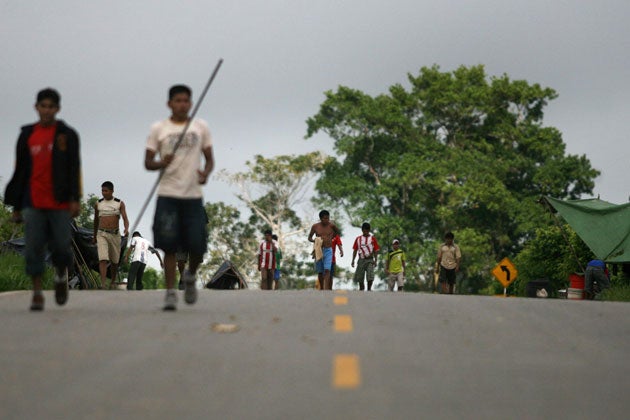
The court case puts Perenco at the centre of a heated debate. For months, Peru's indigenous communities have been protesting against government plans to open their homelands to energy and mining companies.
The row burst on to the international radar in June, with a massacre that became known as "the Amazon's Tiananmen". Dozens were killed and hundreds wounded when Peruvian police fired on tribespeople demonstrating near the town of Bagua Grande.
That spiralled into a political crisis for President Alan Garcia, who claims the proposed development will revolutionise Peru's economy, combat poverty and turn the country into a major oil exporter. This week, the UN entered the fray, calling on the government to allow an international investigation into the Bagua Grande killings.
Join our commenting forum
Join thought-provoking conversations, follow other Independent readers and see their replies
Comments