Eco-towns: The new town that got back to nature
There are deer in the woods, geese on the lakes and flowers in the meadows – shouldn't all eco-towns be built like this? Adharanand Finn reports on how developers created the perfect family habitat
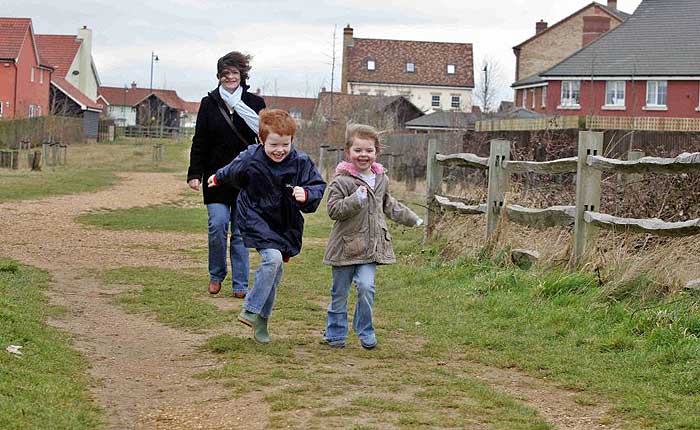
When Rachael and Simon Mortimer first went to look around the newly built Cambourne development in Cambridgeshire three years ago, what impressed them most was the network of cycle paths and the number of families they saw using them.
"We're a family that likes to be outdoors," says Rachael, who has three young children, "and we were looking to move somewhere where we had the freedom to be able to get out and about without needing the car."
The footpaths and cycle lanes in Cambourne are certainly well-used, with the majority of the children in the area walking to school every day. The most impressive thing about the development, however, emerges when you pause on one of these many pathways and remain still. For among the woodlands and on the lakes, this new town boasts a huge abundance of wildlife.
Cambourne was built on rural farmland in the 1990s. It has more than 5,000 houses, a Morrisons, a library, two primary schools, a doctor's surgery and all the other amenities expected of a thriving residential community. No one has branded Cambourne an eco-town – these houses do not boast the highest possible energy efficiency or solar cells and wind turbines. But having nature on your doorstep is something that ecologists will rate as highly as any families. And on this criterion, Cambourne has set the agenda: there is now more wildlife here than before the developers moved in.
This month, the Government will announce the names of 12 to 15 sites shortlisted to become eco-towns. From the line-up, 10 will be built. The protests will be familiar to all by now: residents of nearby towns have drawn attention to the strain on local roads, schools and hospitals. But the national network of Wildlife Trusts is concerned about a more specific problem: the annihilation of valuable habitats.
The Wildlife Trusts' chief executive, Stephanie Hilborne, recently let fly at the Government's plans, saying the proposals made "a mockery" of the term "eco-town". "The Wildlife Trusts welcome the idea of eco-towns but, to be truly sustainable, they need to be about much more than simply building zero-carbon homes," she said.
Brian Eversham, conservation director for the Wildlife Trust of Bedfordshire, Cambridgeshire, Northamptonshire and Peterborough, which has its offices in Cambourne, says that Cambourne is proof that new developments can work around wildlife. His walk to work is alive with birdsong. "There are blackbirds, song thrushes, robins, wrens, mistle thrushes, blue tits and great tits, goldfinches and greenfinches all singing away, and occasionally a male great spotted woodpecker drumming. It's a lovely way to start the day, and I think many local residents enjoy the same experience."
Rachael Mortimer agrees. She says she has noticed there are a lot of birds, and she has even seen a few deer. But most of the wildlife lives happily and shyly away from view of its human neighbours. Among the species thriving most successfully are water voles, skylarks, great crested newts, dragonflies and even badgers.
The miracle of Cambourne is relatively easily explained. As well as houses and a business park, the development incorporates natural features such as wetlands, wooded areas and meadows into its design. These provide more wildlife habitats than the fields of oilseed rape that were there before. And, crucially, these habitats are all linked together by wildlife corridors.
Eversham explains that the "wildlife highways", as he calls them, are key to the long-term success of green spaces in places such as Cambourne, and are vital for helping wildlife adapt to climate change in the future.
"Without linkages, each patch of woodland, each meadow, each pond or lake is isolated and has to be self-sufficient," he says. "If a particular plant or animal has a bad breeding season – which is very likely, given the changing weather patterns associated with global warming – it could knock out a population, and the species will never make it back to the habitat."
Over time, he explains, each "island" of habitat will gradually but inevitably lose its wildlife, no matter how good the habitat is, or how well managed. In a well-connected landscape, however, the full range of wildlife can wander around and refind lost habitats. It is a principle Terry Farrell and Partners employed in its master-planning process when the development was first conceived.
The existing natural features were mapped out with the help of the Wildlife Trusts, including three areas of existing woodland, six ponds and a number of old hedges and watercourses. These were then linked together with footpaths, cycleways and with larger areas of new meadows, woodlands and wetlands. Only when this green infrastructure was in place did the masterplan allocate areas for housing and for the business park. The result has not only seen wildlife flourish in the area, but has found residents willing to enjoy it.
"At the weekend you'll see families walking to the supermarket through the woods and meadows," says Eversham. There are not many housing developments that can make that claim.
The whole project has been so successful that the Wildlife Trusts are holding it up as an example of how the needs of the local ecology can be incorporated into new developments.
While the Government's Eco-towns Prospectus, its "vision" for the proposed developments, talks a lot about renewable energy, zero-carbon buildings, and support for local communities and local businesses, there is very little mention of protecting the local wildlife.
"This could be disastrous," says the Wildlife Trusts' planning manager Fiona Mahon, "leading to the destruction of habitats as well as natural drainage systems, which can in turn cause problems with flooding."
The Government defends its proposals, and calls the criticism "scaremongering". A spokesman for the Department for Communities and Local Government points to what he calls a "rigorous process for the selection of bids".
"They [the proposals] must meet tough tests proving they make best use of brownfield land, safeguard local wildlife and habitat areas and provide low- and zero-carbon technologies and good public-transport systems," he says. "There will be extensive consultation with green groups and residents before any decisions are made." However, with the shortlisted towns due to be announced within the next few weeks, this has yet to happen.
The developers, too, insist there is nothing to worry about. The Co-operative Group, whose Pennbury eco-town proposal in Leicestershire is being strongly opposed by a local campaign group with the backing of senior academic figures, denies the accusations levelled at it. Its argument is similar to the Government's, that nothing will be given the go-ahead without proper consultation.
A spokesman for the Co-operative Group says that if its bid is shortlisted, it will be required to draw up a formal planning application "with supporting environmental impact assessment for consideration through the normal planning process. We would certainly seek to consult the Wildlife Trusts at that stage."
He adds that since the eco-town concept is based around the environment and sustainability, "biodiversity will come under very close scrutiny".
This may be so, but there does seem to be a perverse logic about the Government selecting the 10 towns before any consultations have taken place. This is what worries the Wildlife Trusts.
Mahon acknowledges that the plans will have to go through the standard planning process, including consulting local and special-interest groups, but she says that this should be done before the shortlist is selected.
"If the Government has already selected and announced the proposals, and it is providing funding for them, then there will be a lot of pressure on the planners to pass them," she says.
The Campaign to Protect Rural England agrees with this line of argument, pointing out that once the Government has put its seal of approval on projects, it will be difficult for local authorities to object to them or to justify taking expensive legal action to fight the plans.
The secrecy surrounding the selection process for the eco-towns, some of which may involve the building of up to 20,000 houses, has done little to allay these fears, and instead has meant local opposition groups have grown up where virtually every proposed site is suspected. The logic of their concerns is easy to understand – that any development on greenfield sites can only be bad for the local environment. One banner at a recent demonstration about a proposed eco-town development in Warwickshire, on the edge of the Cotswolds, read: "6,000 homes on greenbelt = eco disaster".
Cambourne is a living example of how this doesn't have to be the case. But without proper consultation and planning, the champions of Cambourne, the Wildlife Trusts, are worried that the Government's eco-towns may well become eco-disasters, especially for the local wildlife.
Where to live with wildlife
By Toby Green
Stapleford Park, Cambourne, Cambridgeshire
Price: £479,995
Agent: Savills (01223 347 000)
One of a set of traditional new-builds in this innovative development, this particular property has four bedrooms and features a conservatory which opens out on to a beautiful garden. Properties at this development range from one- to five-bedroom homes, all with a garage, and are constructed by luxury home developer, Charles Church.
Lower Mill Estate, Nr Cirencester, Gloucestershire
Price: £695,000
Agent: Lower Mill Estate (01285 869 489)
This four-bedroom "Cube House" is part of the Lower Mill development, a collection of new homes set in the middle of a 450-acre nature reserve containing over 600 different species of wildlife. The developers have vowed to leave two-thirds of it free from building. Each home has integrated recycling facilities.
Join our commenting forum
Join thought-provoking conversations, follow other Independent readers and see their replies
Comments
Bookmark popover
Removed from bookmarks