Seeds of discontent: the 'miracle' crop that has failed to deliver
A new 'ethical' biofuel is damaging the impoverished people it was supposed to help
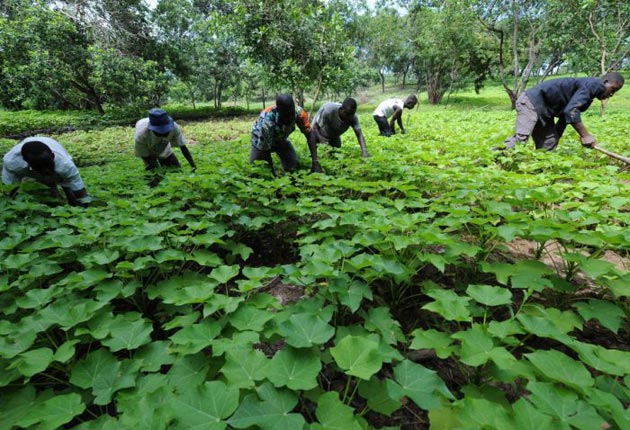
A "miracle" plant, once thought to be as the answer to producing renewable biofuels on a vast scale, is driving thousands of farmers in the developing world into food poverty, a damning report concludes today.
Five years ago jatropha was hailed by investors and scientists as a breakthrough in the battle to find a biofuel alternative to fossil fuels that would not further impoverish developing countries by diverting resources away from food production.
Jatropha was said to be resistant to drought and pests and able could grow on land that was unsuitable for food production. But researchers have found that it has increased poverty in countries including India and Tanzania.
Millions of the plants have been grown in anticipation of rich returns, only for growers to be hit by poor yields, conflict over land and a lack of infrastructure to process the oil-rich seeds.
Oil giant BP, which planned to spend almost £32m on a joint venture to set up jatropha plantations, has now pulled out and the charity ActionAid today warns that jatropha needs to be cultivated on prime food-growing land to produce significant yields.
According to one estimate, up to one million hectares of jatropha – an area equivalent to Devon and Cornwall combined – are being cultivated around the globe, despite little evidence that it can produce enough oil to make the crop commercially sustainable.
Meredith Alexander, head of trade at Actionaid and co-author of its "Meals per Gallon" report, said: "Jatropha is a real gold-rush crop, and the same amount of common sense that applies in a gold rush has been applied to the jatropha rush.
"Jatropha was the subject of an explosion of fabulous propaganda. But this was an untried crop at commercial levels and the many thousands of marginal farmers who have gone into production have been experimented on with disastrous results. They are simply not getting the income they were promised and now cannot afford food for their families," she said.
A native of central America, Jatropha curcus was brought to Europe in the 16th century and subsequently spread across Africa and Asia. Until recently, its few uses included a malaria treatment and an indigestion remedy.
But despite jatropha's much-lauded ability to grow where food crops cannot flourish, campaigners say there is evidence that commercially viable yields can only be obtained in fertile soil.
In India, forecasted annual yields of three to five tonnes of seeds per hectare have been scaled back to 1.8 to two tonnes. The Overseas Development Institute, a leading international development think-tank, has stated that "as the mainstay of people's livelihoods, jatropha looks distinctly marginal".
ActionAid said its researchers found repeated cases of farmers being left with jatropha crops they could not sell and land previously used to grow food crops being taken over by sub-contractors who then employed locals on wages that could not compete with rises in the price of foodstuffs partially caused by biofuel production.
Raju Sona, a farmer in north-east India who gave up land that usually produces vegetables to grow jatropha, said: "No one will buy jatropha. People said if you have a plantation then surely you have a good market. But we didn't see such a market. I threw the seeds away."
A number of British companies are continuing to market jatropha as a "highly ethical and green" investment. One fund offers investors three packages for prices ranging from £7,500 to £15,600 in a brochure entitled "Money really does grow on trees". That company says it has funded the planting of 32 million jatropha shrubs worldwide through a London-based provider called Carbon Credited Farming (CCF) Plc.
Jeff Reeves, head of global operations for CCF, which estimates it will have 300 million jatropha shrubs planted on 120,000 acres worldwide by the end of 2010, admitted that there had been problems establishing the crop.
He told The Ecologist magazine: "In many cases it is government policy and people that are to blame, rather than jatropha itself. Well-managed, jatropha ... can work. But there have been countries where poor management has meant this is not the case."
D1 Oils, a London-based biofuels company which has invested heavily in jatropha, said insisted it was too early to write off the crop as a long-term biofuel source. But its former co-investor, BP, disagreed. A spokesman said: "As other [renewable fuel] technologies came up, we looked again at whether jatropha was going to be the best biofuel source that could be scaled up. There were problems with it. We have decided to look elsewhere."
* Some of this research appeared in the Ecologist
Join our commenting forum
Join thought-provoking conversations, follow other Independent readers and see their replies
Comments
Bookmark popover
Removed from bookmarks