Texas forces firms to open up on 'fracking'
For years, the industry in the US has refused to declare what toxic chemicals it uses during fracking, a policy that has bred public mistrust and accusations of pollution
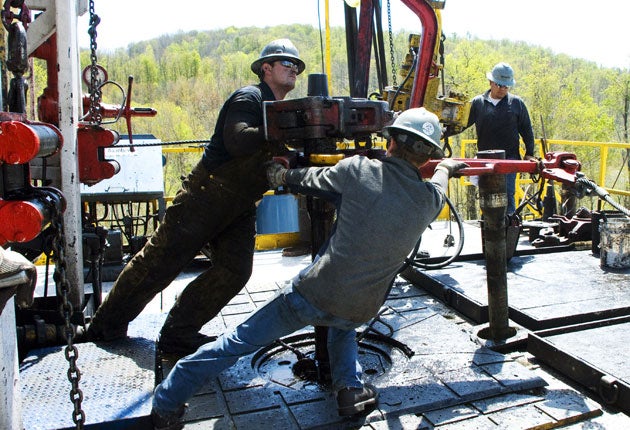
As the spiritual home of big oil, Texas may fairly be seen to be to environmentalism what its official food, chilli con carne, is to vegetarianism.
But that hasn't stopped the state becoming the first corner of America to require energy firms to disclose information about the chemicals they are pumping into the ground in order to release natural gas during the hugely controversial process of "hydraulic fracking".
The Lone Star state's Governor, Rick Perry, quietly signed a law last week which forces gas companies to publish a list of the 600 or so substances they add to a mixture of water and sand during the process. This mixture then gets fired deep underground at high pressure to release deposits of gas locked up in formations of shale and other rocks.
For years, the industry in the US has refused to declare what toxic chemicals it uses during fracking, saying that to do so would amount to revealing trade secrets. But that policy has bred public mistrust, with the industry accused of contaminating local water supplies and creating other environmental hazards.
The film GasLand, which was nominated for this year's Best Documentary Oscar, showed a homeowner in Weld County, Colorado, holding a cigarette lighter over his kitchen sink. When he turned on the tap, flammable gas emerged from it. The homeowner blamed the phenomenon on nearby fracking projects. Gas companies have always insisted their process has only a minimal impact. They argue that its risks are a small price to pay for a potential energy boom which could dramatically reduce US dependence on foreign oil.
However, since they have refused to name the exact chemicals being used, that claim has until now been taken with a pinch of salt. Governor Perry's new law is designed to reduce mistrust, since it will require firms to submit the substances being used on individual projects to a database, which will then be published on the website fracfocus.org. It is supported by the energy industry, which apparently has come to the see that its PR will in future be better served by transparency.
The increased levels of disclosure are broadly welcomed by environmental groups. But some are critical of an exemption which allows certain pieces of information deemed "commercially sensitive" to be withheld. They are also suspicious of the fact that the rules were devised in collaboration with fracking companies.
Governor Perry, a long-standing friend of the oil industry, is currently considering a bid for the Republican presidential nomination. Though he primarily appeals to the party's most conservative supporters, the new fracking law may demonstrate that he is also a figure whom centrists can do business with.
No other states have laws which require disclosure of fracking chemicals (though some have non-binding guidelines to that effect). That means America still has some way to go until it is brought in line with the European Union, where regulators require fracking companies to disclose the exact type, volume and concentration of all chemicals used.
Cuadrilla Resources, which has been controversially using the process to drill for gas in Lancashire, recently revealed that it principally uses four or five chemicals. Its CEO, Mark Miller, told MPs that they include hydrochloric acid or muriatic acid, to open up rock perforations, and polyacrylamide, a non-toxic friction reducer. A biocide is also used to treat water.
Although Cuadrilla stressed that the chemicals make up just a tiny proportion of the liquids used in fracking, the British public remains wary of the process. The firm recently bowed to pressure to suspend drilling amid allegations that it had caused a series of minor tremors off the coast of Blackpool.
Join our commenting forum
Join thought-provoking conversations, follow other Independent readers and see their replies
Comments