The world's rubbish dump: a tip that stretches from Hawaii to Japan
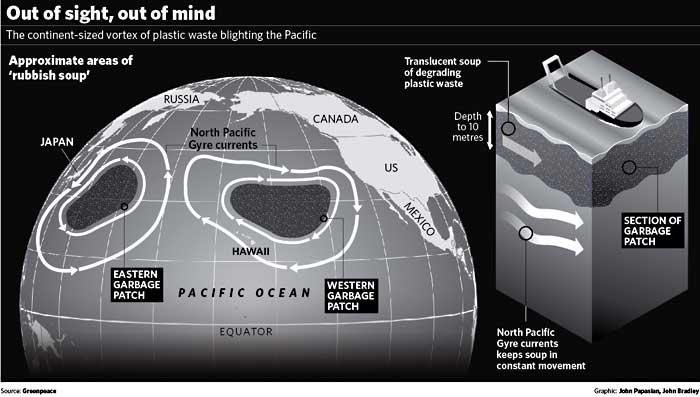
A "plastic soup" of waste floating in the Pacific Ocean is growing at an alarming rate and now covers an area twice the size of the continental United States, scientists have said.
The vast expanse of debris – in effect the world's largest rubbish dump – is held in place by swirling underwater currents. This drifting "soup" stretches from about 500 nautical miles off the Californian coast, across the northern Pacific, past Hawaii and almost as far as Japan.
Charles Moore, an American oceanographer who discovered the "Great Pacific Garbage Patch" or "trash vortex", believes that about 100 million tons of flotsam are circulating in the region. Marcus Eriksen, a research director of the US-based Algalita Marine Research Foundation, which Mr Moore founded, said yesterday: "The original idea that people had was that it was an island of plastic garbage that you could almost walk on. It is not quite like that. It is almost like a plastic soup. It is endless for an area that is maybe twice the size as continental United States."
Curtis Ebbesmeyer, an oceanographer and leading authority on flotsam, has tracked the build-up of plastics in the seas for more than 15 years and compares the trash vortex to a living entity: "It moves around like a big animal without a leash." When that animal comes close to land, as it does at the Hawaiian archipelago, the results are dramatic. "The garbage patch barfs, and you get a beach covered with this confetti of plastic," he added.
The "soup" is actually two linked areas, either side of the islands of Hawaii, known as the Western and Eastern Pacific Garbage Patches. About one-fifth of the junk – which includes everything from footballs and kayaks to Lego blocks and carrier bags – is thrown off ships or oil platforms. The rest comes from land.
Mr Moore, a former sailor, came across the sea of waste by chance in 1997, while taking a short cut home from a Los Angeles to Hawaii yacht race. He had steered his craft into the "North Pacific gyre" – a vortex where the ocean circulates slowly because of little wind and extreme high pressure systems. Usually sailors avoid it.
He was astonished to find himself surrounded by rubbish, day after day, thousands of miles from land. "Every time I came on deck, there was trash floating by," he said in an interview. "How could we have fouled such a huge area? How could this go on for a week?"
Mr Moore, the heir to a family fortune from the oil industry, subsequently sold his business interests and became an environmental activist. He warned yesterday that unless consumers cut back on their use of disposable plastics, the plastic stew would double in size over the next decade.
Professor David Karl, an oceanographer at the University of Hawaii, said more research was needed to establish the size and nature of the plastic soup but that there was "no reason to doubt" Algalita's findings.
"After all, the plastic trash is going somewhere and it is about time we get a full accounting of the distribution of plastic in the marine ecosystem and especially its fate and impact on marine ecosystems."
Professor Karl is co-ordinating an expedition with Algalita in search of the garbage patch later this year and believes the expanse of junk actually represents a new habitat. Historically, rubbish that ends up in oceanic gyres has biodegraded. But modern plastics are so durable that objects half-a-century old have been found in the north Pacific dump. "Every little piece of plastic manufactured in the past 50 years that made it into the ocean is still out there somewhere," said Tony Andrady, a chemist with the US-based Research Triangle Institute.
Mr Moore said that because the sea of rubbish is translucent and lies just below the water's surface, it is not detectable in satellite photographs. "You only see it from the bows of ships," he said.
According to the UN Environment Programme, plastic debris causes the deaths of more than a million seabirds every year, as well as more than 100,000 marine mammals. Syringes, cigarette lighters and toothbrushes have been found inside the stomachs of dead seabirds, which mistake them for food.
Plastic is believed to constitute 90 per cent of all rubbish floating in the oceans. The UN Environment Programme estimated in 2006 that every square mile of ocean contains 46,000 pieces of floating plastic,
Dr Eriksen said the slowly rotating mass of rubbish-laden water poses a risk to human health, too. Hundreds of millions of tiny plastic pellets, or nurdles – the raw materials for the plastic industry – are lost or spilled every year, working their way into the sea. These pollutants act as chemical sponges attracting man-made chemicals such as hydrocarbons and the pesticide DDT. They then enter the food chain. "What goes into the ocean goes into these animals and onto your dinner plate. It's that simple," said Dr Eriksen.
Join our commenting forum
Join thought-provoking conversations, follow other Independent readers and see their replies
Comments
Bookmark popover
Removed from bookmarks