Who says it's green to burn woodchips?
Woodchip power stations are set for a boom. But conservationists are increasingly challenging their green credentials. Special report by Graham Mole
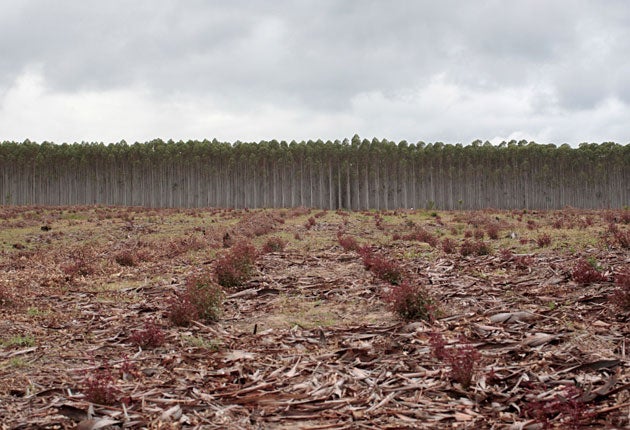
One of the most cherished articles of faith of the green movement – that wood-fuelled power stations can help save the planet – is being increasingly challenged by campaigners and conservationists around the world.
Electricity generated by burning woodchips is on the verge of a global boom. America is planning 102 power stations fuelled by woodchips in the next few years. Europe is reported to be planning a similar, if yet unquantified, expansion. And in Britain, the next three years will see wood-fuelled power station capacity increase sevenfold, requiring, according to the campaign group Biofuelwatch, so much timber that it would need an area 12 times the size of Liechtenstein to grow it.
The power companies say the source will be "sustainable forests", but campaigners and ecologists claim that untold damage will be caused by the burgeoning market for wood. They say that, although traders in the developing world are being tempted to grub up and sell native forests, the chief danger is in the creation of monoculture plantations, where single species of trees are grown in straight rows and little wildlife can establish a home for itself.
They also challenge the "green" assumptions behind woodchip power, claiming that, far from fighting climate change, transporting large amounts of bulk wood across oceans and then burning it will increase carbon discharges by 50 per cent more than would have been caused by burning a fossil fuel like coal.
The power companies dispute the campaigners' science, and most also insist the wood will come from "sustainable sources", as approved and certified by the Forestry Stewardship Council. This non-government body said: "The FSC does not support the conversion of natural forests into plantations." But it added: "Certification may be granted if the forest manager... can demonstrate that they were not responsible for the conversion."
Such flexibility is now drawing fire. A recent article in The Ecologist, headlined "Can we trust the FSC?", read: "The World Rainforest Movement reports that by 2008 the FSC had certified 8.6 million hectares of industrial tree plantations 'despite ample evidence regarding the social and environmental unsustainability of large-scale monoculture tree plantations'... Jutta Kill, climate campaigner at the Forests and European Union Resource Network, says, 'There is a long continuum between an intact forest and short rotation monoculture tree plantation on the other end. It is preposterous to claim these are the same.'"
The FSC claims, however, that "properly managed plantations are essential to stop the destruction of natural forests".
The issue may yet prove just to be a panicky reaction to a radical expansion of wood energy, or it may be a portent of a deep problem. If so, it will echo the evolution of biofuels, initially embraced as a universal blessing before it was realised that native forests were being grubbed up to grow palm oil, and that US farmers would switch from food cereals to fuel cereals, thus causing a world food shortage.
Some campaigners are in no doubt. Almuth Ernsting from Biofuelwatch said: "It's almost unbelievable that we're creating vast areas of monoculture, mile after mile, just to be cut down as fast as they grow, to be shipped thousands of miles to be burned just for people's electricity. It just doesn't make sense. What about all the habitat that gets destroyed along the way?"
Simone Lovera, of the Global Forest Coalition in Paraguay, said: "Europe is going to cook the world's tropical forests to fight climate change; it's crazy." She said her group had obtained a report stating that Brazil is gearing up to meet the European woodchip demand, not by cutting down forests, but by expanding tree plantations by 27 million hectares, mostly of exotic species such as eucalyptus.
Last week, at the UN-sponsored World Forestry Congress in Buenos Aires, the agronomist engineer Hector Ginzo, an adviser to the Kyoto Protocol, stressed that plantations could not be classified as sustainable. He said UN rules "would never allow a plantation of eucalyptus or other fast-growing trees for use as pulp or wood to be considered a sustainable forestry project, because that kind of production favours monoculture forests and the carbon capture is lost when the trees are cut down".
The Global Forest Coalition said that, in South America, tree plantations have had devastating effects on people and the environment, and have nothing like the biodiversity or ecological function of natural forests, whether they are first or even second growth. These plantations, it said, are "green deserts" because of the amount of water they consume, and because of the lack of native wildlife.
Isaac Rojas, co-ordinator of the forest and biodiversity programme at Friends of the Earth International, said: "All over the world, plantations destroy the lands and livelihoods of local communities and indigenous peoples, as well as biodiversity and water resources. They also store less carbon than natural forests."
FoE International and the coalition now want the UN's Committee on Forestry to stop promoting plantations and to urge governments immediately to halt the conversion of forests into biofuel plantations. A UN report issued in March noted that the expansion of large-scale monocultures of oil palm, soy and other crops for agrofuel production has been a major factor in the failure to halt deforestation. It added: "The potential for large-scale commercial production of cellulosic biofuel will have unprecedented impacts on the forest sector."
Janet Larsen, director of research at the Earth Policy Institute, said: "Shipping chips like this is just not the answer. We have been warning about this for some time now. Wind turbines and solar power make much more sense. You need to source biomass from relatively small areas around power plants. Here in the US you can drive for an hour and never see more than one species of tree. We used to have far more natural forest than we have now."
She said the institute had now discovered land in Laos being bought by China to turn into plantations.
The Global Forest Coalition said an examination of international trading companies has revealed a new and growing global industry in wood for energy. UK campaigners at Biofuelwatch said that wood chips and pellets are now being imported from South America, the US, Canada, Portugal, South Africa and Russia, among others. The Independent on Sunday was offered 100,000 tons of tropical hardwood and softwood a month by a firm in Ghana, and a British firm is negotiating over supplies from Indonesia, home to some of the world's richest rainforests.
In Europe, small-scale woodchip power plants make use of locally harvested timber and wood waste. In the UK, a government strategy paper on waste said that recovering energy from the two million tonnes of the waste wood available could both generate electricity and save over a million tonnes of CO2 emissions. But such sources will not be able to feed the industry's huge need for wood in convenient bulk deliveries over the next few years. Worldwide, production of wood pellets is set to double in the next five years from the present 10 million tonnes to 20 million.
In recent months, British power companies have said they will build at least six new generation plants to produce 1,200 megawatts of energy, most by burning woodchips. The country's demand for wood will increase more than sevenfold. MGT Power, which is creating a new waste-to-energy plant at Ince in Cheshire and a new woodchip-fired power plant at Teesport near Middlesbrough, then another in North Shields, will be using chips from North and South America. It said it will use crops planted specifically for use as fuel, examples being eucalyptus, pine, willow and poplar. A company statement insisted that it "will never procure fuels that contribute to the loss of areas of protected habitat or areas of high ecological value".
One of the new plants – the world's largest – is now being built at Port Talbot in South Wales, and by 2012 it will supply over half Wales's one million homes, and, claim its owners, Prenergy, displace 3.5 million tons of CO2 emissions a year that would have been produced by older power stations.
The fuel will arrive by sea, largely but not exclusively from America. A company statement said: "Prenergy is committed to obtaining its feedstock from a range of overseas sources." This, it added, would "take advantage of a variety of species with rapid growth rates, and lower delivered moisture content due to rapid post-harvesting drying achievable in more southerly latitudes". The company said its studies had shown that the carbon emitted during shipping of the woodchip represents only about 2 per cent of the total carbon being transported. Other plants are planned for Drax, Anglesey and Teesside, which together will burn 20-30 million tons of wood a year.
Biofuelwatch said: "The land area needed to grow the biomass to power a station the size of Port Talbot ranges from 130,000 to half a million hectares of productive land – an area three times the size of Liechtenstein."
The power firms claim that generating electricity by burning wood emits an equal or lesser amount of CO2 than the quantity absorbed by the trees through photosynthesis in forests.
The claim, however, has been robustly denied by Rachel Smolker, a research scientist who works with the Global Justice Ecology Project in the US. She said: "Burning wood is called carbon-neutral, but it's not."
She says that research by the Massachusetts Environmental Energy Alliance, a US environmental group, indicates that burning trees for energy produces 1.5 times as much carbon as coal and three to four times more than natural gas. She added: "Climate change is a huge problem, but some of the plans for fighting it are even more dangerous."
Join our commenting forum
Join thought-provoking conversations, follow other Independent readers and see their replies
Comments
Bookmark popover
Removed from bookmarks