John Sauven: 'I want to claim the arctic region for all of mankind'
The Monday Interview: As his campaign group turns 40, Greenpeace director John Sauven tells Michael McCarthy how he plans to save the Pole from big oil
It is such a novel and imaginative idea, and John Sauven mentions it so casually, that it takes a few moments for it to sink in: his organisation wants to build a wall around the North Pole.
Not a literal wall of course, on the floating sea ice of the Arctic Ocean, but a legal wall, an international prohibition which will prevent the countries surrounding the Arctic from claiming the top of the world for themselves, in order to exploit the mineral riches which lie under its seabed.
It's a novel notion because throughout human history – until now – the Pole's very inaccessibility has been its protection. But the melting of the Arctic ice, as the global climate warms, is opening up the great frozen wilderness, the world's most untouched ecosystem; indeed, this week a new record minimum for the ice is likely to be reached, surpassing even the record low of September 2007, which was such a plunge downwards it astonished polar scientists.
The average September minimum extent of the ice, from 1979 to 2000, was just over seven million square kilometres; this week it is likely to reach a new low of about 4.2 million km2, a 40 per cent drop in a decade. Vast areas of the Arctic are ice-free this week; the long-fabled Northwest Passage is open, and this week you can sail from the Atlantic to the Pacific without going through the Panama Canal or round Cape Horn.
It means that climate change is having its most unmistakable effect so far on the fabric of the Earth. Yet it also means that gluttonous eyes are being cast on the Arctic for what it holds, not least its 160bn barrels of oil, both by the "supermajor" oil companies such as Shell and Exxon Mobil, and the countries by which the Arctic Ocean is surrounded – Canada, Russia, the US, Norway and Denmark (via Greenland).
They are looking to extend their territorial waters and consequent sovereignty of the seabed out to 90 degrees North: four years ago the Russians planted a flag on the North Pole seabed, and last month Denmark signalled it would make a formal territorial claim to it by 2014 at the latest.
"And what we want do," says John Sauven, who is executive director of Greenpeace UK, "is say that this area, which is currently not national territory, this area of sea ice around the North Pole, should be a 'global commons', collectively owned by humanity under the auspices of the United Nations.
"It has huge symbolic importance as a pristine ecosystem. Yet the oil companies and the surrounding nations are saying, this might be at the ends of the earth, but we're just going to go in and carve it up.
"The Arctic sums up the complete and utter madness, the bankruptcy of their strategy. They will go to these extreme lengths to dig up the last bit of fossil fuels because they cannot be bothered to deal with energy efficiency and find alternatives, and they're prepared to suffer all the consequences, the impacts on wildlife and the fact that you can't do anything about them. It's insanity."
So now Greenpeace, Mr Sauven says, is planning a global campaign to make the North Pole off-limits. Internalionalised. No development. No oil drilling. No territorial claims.
Coming from any other body this might seem hopelessly optimistic or idealistic, it might seem to be entirely pie-in-the sky; yet coming from Greenpeace, the environment group which perhaps more than any other has made a difference across the world, it sounds rational – and even achievable.
The organisation is 40 this week. It was on 15 September 1971 that a group of American and Canadian anti-nuclear activists set sail in an old fishing boat from Vancouver on Canada's Pacific seaboard for Amchitka, one of the Aleutian Islands off the coast of Alaska,where the US was planning to hold a massive underground atomic weapons test.
They called themselves the Don't Make A Wave Committee (as they feared that a nuclear explosion in a geologically unstable region might set off an earthquake and a subsequent tsunami), and the boat in which they sailed, originally called the Phyllis Cormack, had been rechristened Greenpeace for the voyage, to reflect the environmental and pacifist background of the committee members.
They didn't get to Amchitka – they were halted and turned back by the US coastguard – but their expedition captured the imagination of North America, and prompted the transformation of the Don't Make A Wave Committee into the Greenpeace Foundation, which grew into what it is today: the most visible, the most active and the most headline-making of all the world's green pressure groups.
Consider: in the 40 years since that first voyage, Greenpeace has helped to end French as well as US nuclear testing in the Pacific; it has helped to end commercial whaling; it has helped to end the practice of dumping toxic waste at sea; it has helped to bring about the phase-out of CFCs, industrial chemicals which were destroying the ozone layer; it has helped to prevent the establishment of a GM crops industry in Europe; and it has helped to save threatened forests across the world, from the Great Bear temperate rainforest in north-west Canada, to the tropical rainforests of Indonesia and the Amazon itself.
It has done so by its own form of protest, by being present (often at considerable personal risk) at the sharp end of all these situations, and making the world aware: it is the idea of "bearing witness", from the Quaker background of some its founders. It makes for unforgettable images: young people in an inflatable, trying to get between a whale and the whaler trying to harpoon it; activists draping banners from the top of a 300ft power station chimney.
"Yes, the most important thing about us is that we are an action-led organisation," says Mr Sauven, 57, who might best be described as a lanky thinker (he's 6ft 3 and a former publishing executive who came for a temporary job 20 years ago, and stayed). "This isn't about round tables, it's not about writing reports, it's not about endless policy discussions and so on and so forth, it's about people who are actually prepared to stand up for what they believe in."
Yet for all the spectacular actions, perhaps the key to Greenpeace's success and to its widespread public acceptance has been another element of its Quaker heritage: it is resolutely non-violent. If Greenpeace protesters are struck, they do not strike back. "Absolutely, we don't hit back," Mr Sauven says. "Everybody who's involved is trained in non-violent direct action and it's a founding principle, it's our core value. I think the use of violence is always very divisive, and I think that it also makes reconciliation at the end of the day very hard."
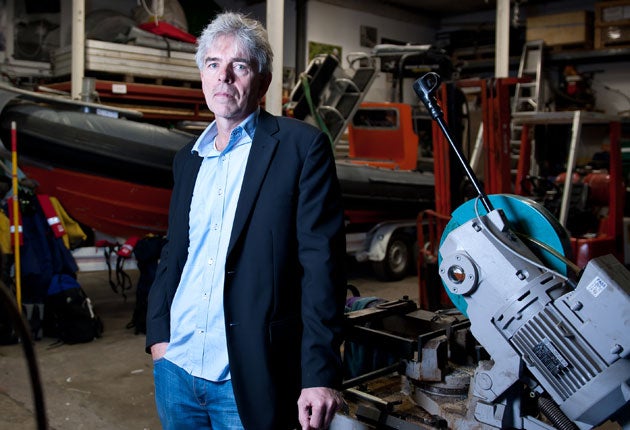
We are talking in the warehouse-cum-workshop of Greenpeace UK in north London, a wondrous cavern full of exotic kit, boats and ropes and wet suits and dry suits and also a polar bear – a full-sized, frighteningly life-like replica (named Paula Bear) which two people can get into, like a pantomime horse.
Paula was used in a demonstration this summer outside the Edinburgh headquarters of Cairn Energy, the company which is leading the way in Arctic oil drilling, and she perfectly symbolises Greenpeace's growing concern with protecting the Far North.
"The Arctic is an iconic part of the global commons, rather like the Amazon for the rainforest," Mr Sauven says. "Is it just to be a grab by these huge corporations to extract the resources, which will have a calamitous impact on the world?
"I think we have to draw a line in the sand."
A life in brief
* John Sauven, executive director of Greenpeace UK since 2008, was born in Ealing, west London, on 6 September 1954. Educated at St Benedict's School, Ealing; University of Cardiff (BSc Econ)
* Worked in publishing and for human rights organisations (including editing CND magazine, Sanity). Joined Greenpeace temporarily in 1991 while waiting for a place at teacher training college.
* Rainforest campaigner, 1995: major campaigns included helping to save the Great Bear Rainforest in Canada from commercial logging, and stopping the deforestation of the Amazon by companies planting soya beans.
* Lives in Crouch End, north London, and is married to Janet Conbery, a campaigner at the charity Action Aid. He has two sons, aged 15 and 19.
Join our commenting forum
Join thought-provoking conversations, follow other Independent readers and see their replies
Comments