Let them eat spuds: potatoes - the world's new staple?
As the Bangladeshi army is ordered to march on potatoes rather than rice, Andrew Buncombe investigates whether the humble tuber, so popular in the West, can really help alleviate the global food crisis
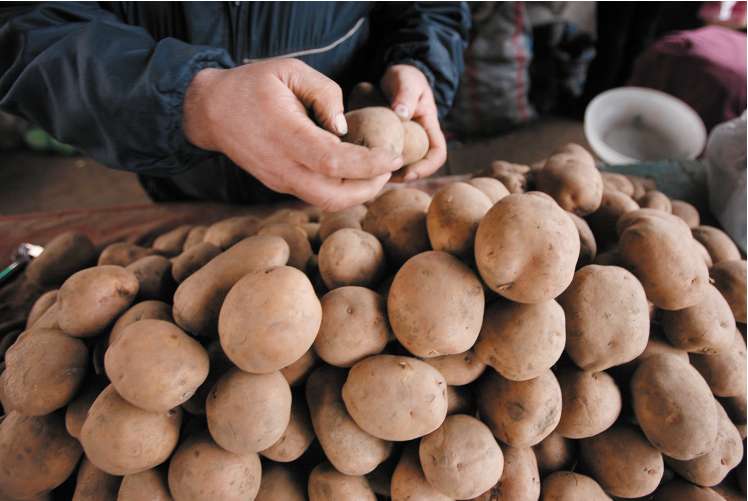
When the order came down from the top brass of Bangladesh's armed forces it sounded like a joke. Some of the soldiers and sailors who were told that from now on their daily rations would include increased servings of potatoes almost certainly did not take it seriously either.
But in a country where rice is overwhelmingly the staple dish, this was no laughing matter. With Bangladesh and the rest of Asia gripped by a rice crisis that has sent governments into panic, last Friday's announcement by the military that it was turning to the potato to supplement its troops' rations was for real. "The daily food menu now includes 125g of potato for each soldier irrespective of ranks," it said.
But it is not just in Bangladesh that the humble spud is being turned to for help. With world food prices soaring and with riots breaking out everywhere from Egypt to Indonesia, experts believe that increased use of potatoes could provide at least part of the solution. Easy to grow, quick to mature, requiring little water and with yields two to four times greater than that of wheat or rice, the potato is being cultivated more in an effort to ensure food security, agronomists say.
Such are the hopes being placed on the tuber that the UN named 2008 the International Year of the Potato. "As concern grows over the risk of food shortages and instability in dozens of low-income countries, global attention is turning to an age-old crop that could help ease the strain of food price inflation," said the world body.
"It is ideally suited to places where land is limited and labour is abundant, conditions that characterise much of the developing world. The potato produces more nutritious food more quickly, on less land, and in harsher climates than any other major crop."
The emergence of the potato as a potential solution to global hunger comes amid mounting concern about the increased cost of food around the world. The price of rice, wheat and cereals has soared in recent months, as a result of the increasing price of oil, rising demand and uncertain supplies. Many countries have been forced to take special measures to protect their food suppplies. India, for instance, recently banned the export of rice except for its premium basmati.
The UN secretary general, Ban Ki-moon, expressed his own concern about the mounting food prices at globalisation talks in Africa this weekend, saying they posed "a threat to the stability of many developing countries". Meanwhile, the UN's food envoy, Jean Ziegler, went much further, saying they were leading to a "silent mass murder" that he blamed on the West.
Mr Ziegler said that growth in biofuels, speculation on the commodities markets and European Union export subsidies meant the West was to blame for the problem. "Hunger has not been down to fate for a long time – just as Marx thought. It is rather that a murderer is behind every victim. This is silent mass murder," he told the Austrian newspaper, Kurier am Sonntag.
"We have a herd of market traders, speculators and financial bandits who have turned wild and constructed a world of inequality and horror. We have to put a stop to this."
Against such a stark backdrop, the global challenge being presented to the potato by its champions could hardly be tougher. And yet, already the potato is quietly going about its business, often in places that one might not normally associate with it. Indeed, around the world it is the third most-produced crop for human consumption, after rice and wheat.
Take China. Already the world's largest producer of potatoes, the country has set aside large areas of additional agricultural land in an effort to increase their cultivation. India has told food experts it wants to double potato production in the next five to 10 years while Kazakhstan, Turkmenistan and Tajikistan are also working to increase the area under cultivation for potatoes. Belarus currently leads the world in potato consumption, with each inhabitant eating an average of 376lb a year.
In the north-east Indian state of Nagaland, which borders Burma, local authorities are working with NGOs to develop quick-maturing potatoes that can be grown between the region's two rice harvests. It is seen as an additional source of food rather than a replacement and the NGOs are working with the communities to educate people about the benefits of the potato and how to grow it. (Could the chip butty become a Nagaland delicacy?)
In Peru, where the potato was first cultivated, a doubling in the price of wheat in the past year has led to the launch of a government programme to encourage bakers to use potato flour rather than wheat flour to make bread. As part of the scheme, potato bread is being given to schoolchildren, soldiers and even prisoners in a hope that it will catch on. At the moment, there is a shortage of mills that are able to make potato flour.
"We have to change people's eating habits," Ismael Benavides, Peru's agriculture minister, told Reuters. "People got addicted to wheat when it was cheap."
Meanwhile, in Latvia, a sharp increase in the price of bread in the first two months of the year saw sales fall by up to 15 per cent. To make up for the Latvians' shortfall in calories, sales of potatoes increased by around 20 per cent during the same period.
The potato was first cultivated 7,000 years ago high in the Andes close to Lake Titicaca. There are at least 5,000 varieties of potato, of which more than 3,000 are found in the mountains. Ranging in colour from plaster-board white through yellow to aubergine purple, the tuber retains huge practical and cultural significance in South America.
It was taken to Europe by the Spanish, who apparently first encountered it in 1532. Documentary evidence suggests that by 1573, potatoes were already being sold in the markets in Seville. It arrived in India some time afterwards, possibly brought by the Portuguese who seized Goa. Known in Hindi as aloo it is the basis of a number of famous Indian dishes, such as the potato and cauliflower curry aloo gobi.
Experts say the potato has great nutritional value. It is a source of complex carbohydrates which release their energy slowly and have just 5 per cent of the fat content of wheat. They have more protein than corn and nearly double the amount of calcium. They also contain iron, potassium, zinc and vitamin C, and were eaten by sailors in previous centuries as a guard against scurvy.
And yet, for all its nutritional wonders and easy-to-grow charms, the potato seems to suffer from an image problem. It may have to do with the awfulness of the Irish famine, when the crop failed as a result of potato blight and perhaps a million people starved, their fate and suffering exacerbated by the continued export of other foods to England. Perhaps, too, it is linked to the early aversion Europeans had to the potato; when it was first brought back from the New World it was used mainly as a feed for cattle.
"The thing is that in the West we take the potato for granted," said Paul Stapleton, a spokesman for the International Potato Centre, a non-profit group based in Peru that has been working with governments around the world to develop faster-maturing strains of potato. "We just go to the supermarket and buy a bag or else we'll have fish and chips on a Friday night on the way back from the pub."
Speaking yesterday from Lima, Mr Stapleton said he believed potatoes could help solve not just the current food crisis but also the challenges of feeding a world with a population that is growing by 600 million people every 10 years. "It can help with the current crisis and with the population that is coming," he said. "There are no more areas to plant rice or wheat. What is going to happen as the population increases? Either we are going to increase yields of what we are already growing or use marginal land. The potato is perfect for that."
Analysts say that while the price of other foods has increased sharply, one factor that has helped potatoes remain affordable for the world's poorer people is that it is not a global commodity that attracts the sort of professional investment that was so damned by the UN's food envoy, Mr Ziegler. Around 17 per cent of the 600 million tons of wheat produced every year are traded internationally compared to just 5 per cent of potatoes. As a result, potato prices are driven mainly by local tastes rather than international demand, they say.
In such circumstances, the scientists in Lima believe it is in the developing world that the potato will reach new heights. From Kenya and Uganda to Nepal and Bangladesh, they envisage increased cultivation of potatoes and a situation where farmers will grow them either as cash crops to sell in the market or else to feed their families. "The countries themselves are looking at the potato as a good option for both food security and also income generation," said the centre's director, Pamela Anderson.
Confronted by such a challenge, could this really be the time of the potato?
The root of civilisation
The potato was first cultivated 7,000 years ago by the Incas in Peru and the name is thought to have derived from the Indian word batata. The Incas revered them and buried them with their dead. Spanish conquistadors in search of gold discovered the vegetables in Peru in 1532. They used them on their ships to prevent scurvy. It was not long before farmers in the Basque region began to grow them and the potato spread across Europe throughout the 16th and 17th centuries. It wasn't a smooth path, however. Most people knew more of the potato's disadvantages – the crop hails from the same family as deadly nightshade – than they did of its considerable benefits. The Orthodox Church in Russia rejected it outright as it was not mentioned in the Bible. Potatoes arrived in England towards the end of the 16th century. Although popular legend has it that Sir Walter Raleigh introduced the crop to England, it is more likely that English pirates stole it as booty from Spanish ships. The nutritious vegetable caused a population explosion in Europe, especially in Ireland. But the failure of the Irish crop in 1845 led to a devastating famine. In 1995, the potato became the first vegetable to be grown in space.
By Claire Ellicott
Join our commenting forum
Join thought-provoking conversations, follow other Independent readers and see their replies
Comments
Bookmark popover
Removed from bookmarks