Acidic seas threaten coral and mussels
Impact of rising carbon dioxide levels far worse than previously thought
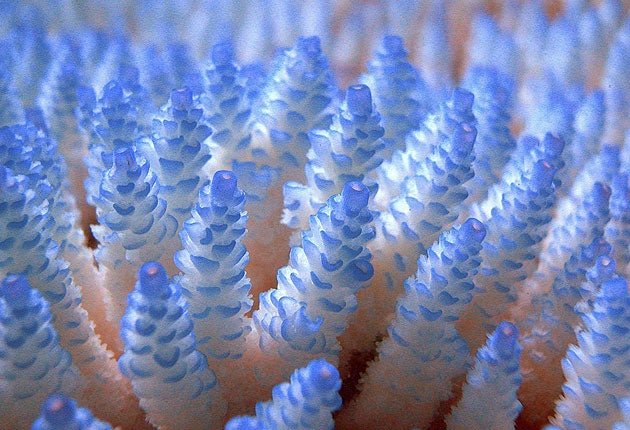
Rising carbon dioxide levels are increasing acidity in the oceans 10 times faster than scientists thought, posing a greater threat to shell-forming creatures such as coral and mussels.
An eight-year project in the Pacific has found that rising marine acid levels will challenge many organisms, because their shell-making chemistry is critically dependent on a less acidic, more alkaline environment. The study monitored seawater pH levels at the north-east Pacific island of Tatoosh off Washington state in the United States.
Timothy Wootton, from Chicago University, said scientists found that acidity levels increased at more than 10 times the rate predicted by computer models designed to study the link between atmospheric concentrations of carbon dioxide and ocean acidity.
Atmospheric carbon dioxide levels have increased by about 100 parts per million since the start of the industrial revolution and are now at their highest point in at least 650,000 years.
About a third of man-made carbon dioxide emissions has dissolved into the oceans. As carbon dioxide dissolves in seawater, it forms carbonic acid, which lowers the ocean's alkalinity and pH level, making it more acidic.
The Intergovernmental Panel on Climate Change (IPCC) predicted last year that most coral reefs would disappear by the century's end because of rising temperatures and ocean acidity.
However, this latest study, published in the journal Proceedings of the National Academy of Sciences, suggests that the rate of ocean acidification may be far higher than the rate used by the IPCC scientists in their assessment of future prospects for shell-forming marine creatures such as corals.
Professor Wootton said: "An alarming surprise is how rapidly pH has declined over the study period ... These data point to the urgency of obtaining a globally extensive set of ocean pH data through time, and suggest that our understanding of ocean pH may be incomplete.
"The results showed that variation on ocean pH through time was most strongly associated with increasing atmospheric carbon dioxide, which supports the prediction that increasing release of CO2 to the atmosphere leads to ocean acidification."
The study was unusual in that it looked at acidity in the ocean's intertidal region, inhabited by shell-forming creatures such as barnacles and mussels. Professor Wootton said there was a shortage of data on ocean acidification, especially in non-tropical regions, which this study addressed.
"Our study reveals the strongest negative impacts of declining pH are on several species of particular importance – large calcifying mussels and goose barnacles. This finding illustrates several reasons why the effects of declining ocean pH are of general concern, as these species create critical habitats for other coastal species, are important players in coastal nutrient processing, and reflect the more general risks to shellfish harvesting."
Join our commenting forum
Join thought-provoking conversations, follow other Independent readers and see their replies
Comments
Bookmark popover
Removed from bookmarks