Nature

Rain (AM and PM) 3° London Hi 9°C / Lo 6°C

Beached whales must be killed, say marine experts

Rescue attempts to refloat animals 'causes unnecessary suffering and rarely works'
By Steve Connor, science editor

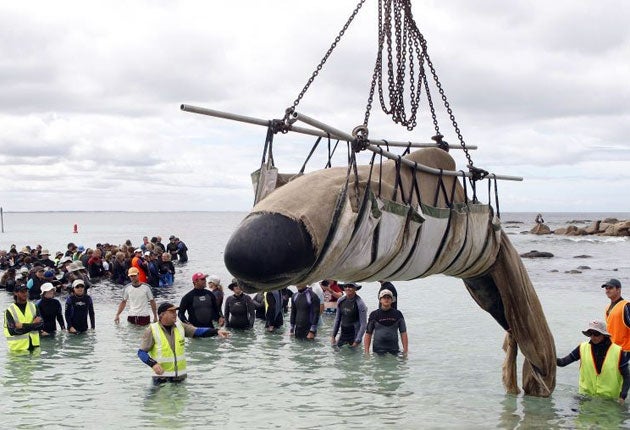
Rescuers try to refloat a long-finned pilot whale from Hamelin Bay, near Perth, Australia, yesterday. More than 70 whales and dolphins died on Monday after being stranded in the bay

AFP/Getty

Rescuers try to refloat a long-finned pilot whale from Hamelin Bay, near Perth, Australia, yesterday. More than 70 whales and dolphins died on Monday after being stranded in the bay

Stranded whales on British beaches will be killed by lethal injection rather than being made to suffer as a result of doomed attempts to refloat them into the safety of deep water, marine experts said yesterday. Attempts to refloat stranded whales will be made only in exceptional circumstances, where there is a high chance of success. Research has shown that most beached whales in Britain have fatal damage to their internal organs.

The new policy will apply only to species such as the sperm, beaked and northern bottlenose whales, which normally live and feed in deep water. Dolphins and porpoises, which tend to be involved in "mass strandings", will not be put down unless they are found to be seriously ill, the experts said.

The new policy has the support of the Royal Society for the Protection of Animals (RSPCA) and the Marine Animals Rescue Coalition, which unanimously agreed to the decision after hearing evidence from scientists involved in a study of dozens of stranded whales over a four-year period.

Between 2002 and 2006, 30 sperm whales and 24 beaked whales were recorded as stranded on British beaches. None survived and blood tests showed they had kidney failure brought on by severe dehydration and damage to their internal organs caused by the pressure of their own weight, unsupported by water. One of the most famous cases of a stranded whale that died during a rescue attempt was the female northern bottlenose whale that swam up the river Thames as far as Battersea during January 2006. The six-tonne creature died from dehydration and exhaustion soon after being loaded on to a rescue barge.

Tests by Paul Jepson, an expert on whales and dolphins at the Zoological Society of London, found that the whale's renal failure was caused by the release of an oxygen-carrying muscle protein called myoglobin that had seeped into the blood from the damaged tissues of its crushed muscles. Tests on other whales came to similar conclusions.

"It's only recently that we've actually got blood samples from these larger whales," Dr Jepson said. "The Thames whale was one of the first ones. All the blood samples we've taken have shown the same picture of dehydration, kidney damage and severe muscle damage. Every stranded whale should ideally have a vet in assistance. We have a choice either to refloat them as quickly as possible or euthanise them by lethal injection, and that, usually, is the best decision.

"We really don't have any evidence to the contrary. We don't have a single case of an apparent success that we can point to, so the evidence [in favour of euthanasia] is very compelling." Adam Grogan, a senior scientific officer at the RSPCA, said that whales are used to living in deep water where they feed on squid and other food items, their only source of drinking water. Even if refloated, it is highly unlikely that beached whales would be able to swim back to their normal habitat.

"The findings show that when these whales are outside of their normal range, they become dehydrated as a result of not being able to feed, and quickly begin to deteriorate," Dr Grogan said. "They then become stranded, which damages their muscles and leads eventually to kidney failure."

The scientists believe stranded whales with renal failure are suffering pain and that the most humane way of dealing with them is to inject them with a powerful opioid drug rather than prolonging their misery with attempts to refloat them back into the sea.

"If I had a dog or a cat with this kind of kidney picture on the results we had then I'd think that the animal would be feeling pretty awful," Dr Jepson said. "Added to that is the stress of being stranded and dehydrated; these animals are suffering."

Post a Comment

View all comments that have been posted about this article.

Offensive or abusive comments will be removed and your IP logged and may be used to prevent further submission. In submitting a comment to the site, you agree to be bound by the Independent Minds Terms of Service.

Comments

Gordon Brown must be put out of his misery
[info]neil_mcgowan wrote:
Wednesday, 25 March 2009 at 02:21 am (UTC)
This obese beached blob has no future to look forward to.

He and the school of spineless jellyfish (Smith, Miliband, "Lord" Mandy of Custard-Pye, Straw) must be humanely destroyed... for their own good, and the good of the country.
Save the whales!...from misguided kindness and ignorance.
[info]iceclass wrote:
Wednesday, 25 March 2009 at 03:09 am (UTC)
Eat more whale!
Re: Save the whales!...from misguided kindness and ignorance.
[info]byebyebushboy wrote:
Thursday, 26 March 2009 at 06:57 am (UTC)
Save the whales, Eat Me!!!!!!!!!!!!!!!!!!!!!!!!
Failure to accept our liability for damage we cause is unacceptable
[info]chuckkw wrote:
Wednesday, 25 March 2009 at 07:28 am (UTC)
The proposed irresponsibility of refusing to make restitution for the damage we cause is unacceptable.

Likely the whales search for food and navigation is disrupted by humans, through the effects of: illness due to pollution; unprecedented habitat movement due to global warming; boating shipping and navy sonar disrupting navigation.

Perhaps we disrupt the whales directly. Perhaps we disrupt them by disrupting their food.

We are the cause of the problem; therefore we should rectify it.

We should transport the whales back to where their food is.

If specialist boats and crews are required, we humans should provide them.

If the offending companies and industries can ever be identified, and if the suffering of whales is not reasonably avoidable, they should refund taxpayers the cost of the rescues. Otherwise they should refund the cost of the rescues plus pay heavy fines.
Put an end to suffering
[info]frigalo wrote:
Wednesday, 25 March 2009 at 07:55 am (UTC)
Is it not total hypocrisy that Government resists euthanasia for humans who wish to die yet they are only too willing to allow other species to be put out of their misery?
Whales
[info]mikelcumslard wrote:
Wednesday, 25 March 2009 at 09:38 am (UTC)
SAVE THE WHALES, SAVE THE WHALES. We as a nation should protect these wonderful and magnificent creatures. Also I would like to raise awareness for the nearly extinct Choads of India.
Reflections on "saving" Whales
[info]mstocker wrote:
Friday, 24 July 2009 at 02:48 am (UTC)
This well written article highlights one of the tragic ironies of well-meaning citizens attempting to push stranded whales back out to sea. My speculative belief is that stranded marine mammals actually know what they are doing, and that human intervention to "save" them actually only modifies their "death trip."

If they are emotionally sentient to human sympathies, perhaps they are comforted by the efforts of humans to tend to their death. But if they have chosen to beach themselves as a final response to their failed abilities to adapt to their environment, then moving them back to the ocean may be a profound harassment.

For example: Perhaps they have been deafened by some noise and are thus incapable of hunting or perceiving their predators. Moving them out into the sea under these circumstances dooms them to starve and subjects them to predation - while being unable to sense their predators. This would scare the hell out of me, and I would prefer dying a fast, controlled death on the beach.

Whales are also not designed to bear the effects of gravity on their bodies, so once they arrive on a beach their internal organs have been exposed to extreme and likely damaging gravity pressures. Moving them out into the sea with squished or failed internal organs also exposes them to similar risks of not being able to metabolize or adapt to an environment without their full compliment of organs. This might subject them to a slow and painful drowning - and exposure to predators of even parasites, with no strength to resist.

I would probably have a better feeling the for human desire to "save" these creatures if there were records of the "saved" animals showing up later to live another year. As far as I know there is no record of these saved animals surviving.

I often find human responses to strandings - even while "caring" - often a bit myopic. This includes the "informed" responses of stakeholders and biologists, who may attribute a mass stranding to the animals "getting confused in shallow waters" for example.

This explanation often comes up around common mass strandings of pilot whales in Tasmania, or mass strandings of other species anywhere. This assumption is akin to having a bunch of people simultaneously "fall" off a bridge because they get confused about where the railing is.

Marine mammals know their habitat quite well. There have been shallow beaches around the world for the 30 million years these animals have been in the sea. I can say with reasonable conviction that these animlas know where the shaoow and troiubeling beaches are. As we experience more strandings - as a product of human population distributions and increased human interactions with marine mammals, we are also developing a broader understanding of stranding causes.

We are finding that many strandings caused by human agency are preventable. Focusing on preventing strandings is much preferable to trying to push the beasts back into the sea after they have decided that they are done with it.

For more on ocean conservation and noise impacts see: http://ocr.org/blog

Article Archive

Day In a Page

Sun | Mon | Tue | Wed | Thu | Fri | Sat

Select date