Birdwatchers flock for for the punk puffin
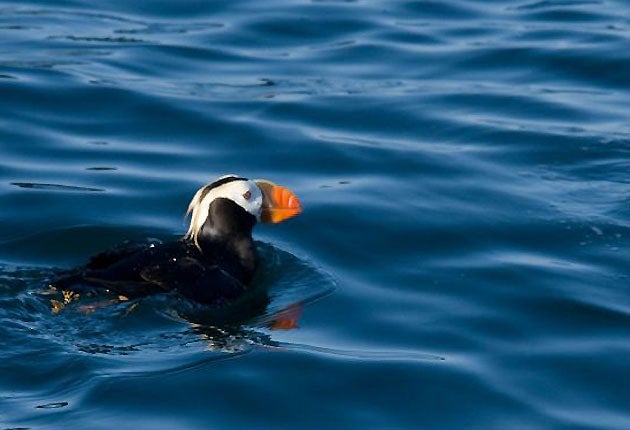
One man ran straight off a football pitch. Two more drove 300 miles through the night while dozens of others simply dashed out of their offices with binoculars in hand. All had the same thing in mind – catching the first ever glimpse in Britain of a seabird with an eccentric hairstyle, an outsized beak and a very, very poor sense of direction.
The Oare Marshes were today alive with telescope-wielding birdlovers who had travelled to an isolated corner of the north Kent coast in the hope of sighting an extremely rare and lost Tufted Puffin.
Although closely related to the familiar European puffin, its elaborately-coiffed cousin had never before been seen in Britain, chiefly because it normally resides some 4,500 miles away in the north Pacific, sandwiched between the frozen plains of Siberia and the ice floes of Alaska.
But British birdwatching history changed at 10.50am on Wednesday this week when Murray Wright, a regular visitor to the Oare Marshes, a nature reserve on the edge of Faversham, stared down his binoculars and saw a single Fratercula cirrhata floating in the choppy waters of the Swale Estuary. Measuring about 35cm in length, the seabird with the trademark multi-coloured bill of its species is instantly recognisable because of the two yellow feather tufts that protrude from the side of its head in the summer months. Its Latin name means “tufted little brother”.
Mr Wright, an avid birdwatcher from nearby Herne Bay, initially thought the strange visitor was a European puffin, a rarity itself in Kent, and managed to photograph the bird after realising what it was. He said: “Luckily it dropped onto the water at about 75 yards away and then it was all too obvious, but incredible to believe, that it was an adult tufted puffin in summer plumage.
“I’ve seen the species in the wild in Siberia, so the ID wasn’t a problem. Panic then ensued, but I managed to take a few record shots, despite shaking uncontrollably. I still am.”
Within hours, a group of 50 “twitchers” – the hardcore elite of the ornithological world – had descended on the windswept reserve from all corners of Britain in the hope of ticking off a true avian rarity after being alerted via a frenzied network of text messages and emails. A message on one twitcher website read: “TUFTED PUFFIN, yes, TUFTED PUFFIN, in NORTH KENT.”
Kevin Duvall, the warden on the marshland for the Kent Wildlife Trust, said: “By the time I got here on Wednesday afternoon there were cars lining the road and a long line of people stood on the seawall looking for the puffin. We had to open up a second car park.
“There was a real sense of excitement. We had two guys who had come from Middlesbrough, others from Southampton and Norwich. It’s not very often that you find yourself on the spot where birding history has been made.”
Although the feathered celebrity – predictably nicknamed “Tufty” by his pursuers - has not been seen since it flew off shortly before lunchtime on Wednesday headed westwards, the sighting was still drawing dozens of visitors to Oare Marshes 72 hours later.
Ryan Murphy, 33, a local authority surveyor from Brighton, and a committed twitcher, was yesterday on his second visit to Kent try to spot the puffin, despite sharing the opinion of experts that the puffin has flown elsewhere. He said: “I got the alert on Wednesday when I was playing football. A friend showed me the text and I left straight away. It’s the sort of thing that you dream of – a British first. I’ve come back for one more go but I think he’s gone for now. That is going to be one confused puffin.”
While awaiting a reappearance, ornithologists were debating just how the vagrant could have drifted some 4,500 miles away from its home waters in the Pacific, where colonies can be found as far south as California. The Tufted Puffin has only ever been seen once before in Europe when it was sighted in Sweden in 1994.
Although some suggested the Kent puffin, which was in good physical shape, could have been an escaped bird from a private collection, the most widely-accepted theory was that Tufty is one of a small number of avian pioneers who have used the de-icing of the Northwest Passage through the Arctic Canada this summer to reach a new continent.
The puffin, which is abundant in its homeland, is the latest example of a handful of north Pacific species, including the Glaucous-Winged Gull, which have been sighted in the Atlantic in recent months.
Graham Madge, spokesman for the RSPB, said: “This could well be an effect of climate change. The Tufted Puffin needs to feed on water so it is unlikely to have flown across North America to get here. It is more likely that it crossed the Northwest Passage and somehow found its way here. It is an incredible journey and certainly the ornithological highlight of the year.”
The increase in the popularity of birdwatching, which is now a hobby for an estimated five million Britons, including about 20,000 hardcore twitchers, means that rare visitors to these shores are being spotted with increasing regularity. The RSPB estimates there are now three or four British “firsts” each year.
In the meantime, there is evidence that the elusive and disoriented Tufty may have to take up permanent residence in his accidental adoptive home.
Mr Duvall said: “He is certainly going to find it very difficult indeed to get back home. If he can find the right food supply, there is every chance that he’ll make up his mind to stay here.”
Join our commenting forum
Join thought-provoking conversations, follow other Independent readers and see their replies
Comments
Bookmark popover
Removed from bookmarks