Britain sets up the world's largest marine reserve
But biologists warn that international inaction is leaving oceans dangerously exposed to overfishing
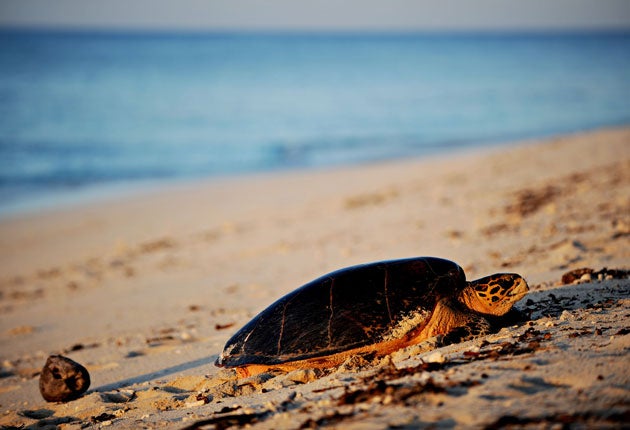
At midnight tonight, the world's largest fully protected marine reserve will come into force in the British territorial waters of the Chagos Archipelago, in the Indian Ocean.
But this new sanctuary, designated as a "no-take" zone where commercial fishing will be banned, serves to underline how catastrophically the international community has fallen short of a goal set almost a decade ago to protect marine life.
In 2002, the Convention on Biological Diversity (CBD) and the World Summit on Sustainable Development made a commitment to protect 10 per cent of the world's oceans by 2012. Today, with only 15 months to go, it is estimated that just 1.17 per cent of the world's oceans are under some form of protection, and a mere 0.08 per cent classified as "no-take" zones.
Yesterday, government representatives at a UN conference on biodiversity held in Nagoya, Japan, put the 2012 deadline back to 2020. Marine experts warned that it is scandalous that the original deadline will not be met, and said the 10 per cent target falls far short of what is needed. A third of ocean waters need protection to give species a fighting chance of survival, they said.
The shortfall between target and achievement was described as "massive" by Dr Heather Koldewey, manager of the Zoological Society of London's international marine and freshwater conservation programme. The failure to get anywhere near the original goal would result in "a massive loss of marine resources and, with that, an associated loss of people's livelihoods", she warned. "In terms of maintaining marine environments in some kind of operational form, science believes that actual protection should be in the region of 30 to 40 per cent," she added.
More no-take marine reserves are vital to maintain sufficient life in our oceans, according to the marine biologist Professor Charles Sheppard, from the University of Warwick. "Governments need to stand up to the fishing industry lobby before it is too late. We cannot afford to have any more delay by governments in honouring their commitments to protect areas of ocean." Failure to do this would result in "degradation of the habitat, followed swiftly by degradation of the people who would have been supported by the habitat", he added.
Alistair Gammell, director of the Pew Environment Group's Chagos campaign, said: "It is scandalous that governments are nowhere near the targets agreed to in 2002. The consequence of that failure is that fish and other species are declining in nearly every place you look."
The Chagos reserve covers an area of 544,000 square kilometres – twice the size of Britain. Its waters are home to the critically endangered hawksbill turtle, as well as green sea turtles, dolphins and one of the world's largest coral reefs – a habitat for more than 1,200 species of coral and fish.
Marine life in the waters of the Chagos Archipelago has been hit hard by overfishing. The Zoological Society of London estimates that, over the past five years, around 60,000 sharks, an equivalent number of rays and many other species have been caught there as "by-catch" – as an accidental adjunct to commercial fishing for tuna, for example.
In an attempt to prevent the reserve becoming little more than a park on paper, a fisheries patrol vessel will police the waters to ensure the fishing ban is not breached.
In a statement last night a Foreign Office spokesman said: "The Government believes that a Marine Protected Area (MPA) is the right way ahead for furthering the environmental protection of the British Indian Ocean Territory.
"As the world's largest MPA, the UK's example is encouraging others to do the same in other important and vulnerable areas."
Join our commenting forum
Join thought-provoking conversations, follow other Independent readers and see their replies
Comments
Bookmark popover
Removed from bookmarks