Nature

Rain (AM and PM) 6° London Hi 9°C / Lo 7°C

Britain takes up tuna's cause

Government joins forces with France to press for global ban on sale of bluefin
By Martin Hickman, Consumer Affairs Correspondent

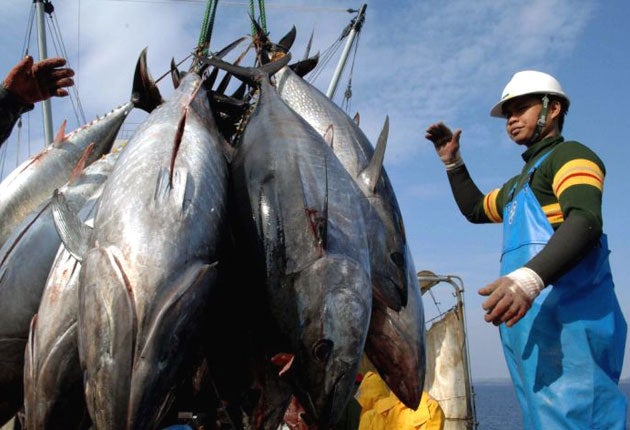
A fisherman loads tuna in Croatia before it is transported to Japan

AFP/Getty

A fisherman loads tuna in Croatia before it is transported to Japan

Britain is to join France lobbying governments around the world for an international ban on the sale of the bluefin tuna, which is on the brink of extinction after years of over-fishing.

The fisheries minister Huw Irranca-Davies told The Independent the UK would back and seek support in Washington and other international capitals for a proposal to ban the fish at Cites (the Convention on the International Trade in Endangered Species).

France, which has a bigger bluefin fishing fleet than anyone else, also announced yesterday it would back a Cites ban, bringing a a real prospect that the fish – which will be wiped out in the Mediterranean by 2012, according to the World Wildlife Fund for Nature (WWF) – may be saved.

Speaking of the need to protect global fish stocks, French President Nicolas Sarkozy said: "Ours is the last generation with the ability to take action before it's too late."

Wildlife groups were elated at support for the ban, which would bypass management by the fisheries body in charge of the bluefin tuna, Iccat (International Commission for the Conservation of Atlantic Tunas), which has been roundly derided for its failure to protect the fish.

However it is almost certain to put the UK on a collision course with Japan, where bluefin is highly-prized as sushi and sashimi. A single fish can fetch $100,000 [£60,800] in Tokyo, making it the most expensive food on earth.

Motivated by the bounty, organised crime in Italy is believed to be involved in the Mediterranean fishery, which is believed to land 60,000 tons of bluefin a year, almost treble the legal catch and four times the amount recommended by scientists. Concern has grown this summer following the screening of the docu-film The End of the Line, which presented the bluefin as the starkest example of 21st Century over-fishing.

Nobu, the Japanese restaurant chain, attracted criticism for continuing to serve the fish at its eateries in London, despite acknowledging on its menu that it was a "vulnerable" and advising diners to choose an alternative.

Monaco, the tiny Mediterranean principality, has been privately canvassing support for a Cites ban during recent weeks. Speaking to The Independent, Mr Irranca-Davies said: "We've been in some discussions with Monaco to see how that proposal is progressing. Our biodversity unit has been talking with their counterparts in Monaco and other Cites member states – the US and Canada – to see whether there's any appetite for proposing this action and what form it might take.

"Now we've had sight of the proposals in the last day or so, I can confirm that the UK will support a Cites listing of bluefin tuna. We do think this is not a substitute for Iccat and the work it does, but we are pleased to give that proposal for Cites listing our strong support. We hope that others will come on board as well."

Providing it attracts sufficient support, Monaco will table its resolution by 17 October for Cites's meeting in Doha, in Qatar, in March. A ban – requiring a two-thirds majority – would take effect 90 days later, ending the annual summer bluefin hunt.

Asked whether he was braced for a fight with Japan, Mr Irranca-Davies said: "I don't think we need to get into a fight over this. There will be people for whom this bluefin tuna is important either as a consumer nation or as a fishing nation, but what we cannot get away from is the stark evidence that is staring us in the face."

Willie MacKenzie, Greenpeace oceans campaigner, said: "It's fantastic the UK is taking such a strong stance on bluefin by backing the listing on Cites, and it's one that an increasingly-aware British public will welcome. Not only does this show the UK's understanding of the severity of the problem, but it must compel other countries, notably the US, to follow suit. Bluefin tuna are the blue whales of our time, and have been relentlessly over-exploited for far too long."

"This iconic species has long disappeared from UK waters and we need to ensure the same does not happen in the Mediterranean," said Sally Bailey, marine programme manager at WWF, who praised the UK's "great step forward."

Charles Clover, author of the book The End of the Line, while also welcoming the action, said there was evidence that bluefin tuna of breeding age had already been fished out.

"France is one of the nations principally responsible for wiping it out," he said. "There are no mature spawners on the Japanese market. A third of the fish that are being sold are under the legal size."

"What's coming together now is that everybody knows there's no fish left in the sea. They probably caught them all in 2007, while we were filming it. This is Europe's great fisheries disaster."

Post a Comment

View all comments that have been posted about this article.

Offensive or abusive comments will be removed and your IP logged and may be used to prevent further submission. In submitting a comment to the site, you agree to be bound by the Independent Minds Terms of Service.

Comments

Our Collective Paradigm is Completely Wrong
[info]errol888flynn wrote:
Friday, 17 July 2009 at 04:56 am (UTC)
We continue to follow a paradigm (of rabid exploitation of natural resources) that only ever had a limited shelf life.

The buck has been passed for the last time.

The idea that all you have to do to get rich is dig a hole in the ground or drag a huge net in the sea will have to be killed off for good.

Those living at the top of this ponzy pyramid will have to be wiped out before their greed and megalomania wipes us all out.

The Western world must end its mechanical exploitation of nature and furthermore ... it must also stop accommodating and excusing the failures of cheap and irresponsible states such as India, the Philippines, Indonesia, and much of the Gulf Arab countries whose populations have literally exploded since 1950.

India grew from 350 million in 1947 to something over 1,200 million today. If that level of selfish irresponsibility (Delhi was warned as early as 1955) isn't reason enough to quarantine that pathetic country I don't know what is.
[info]acidpen wrote:
Friday, 17 July 2009 at 05:23 am (UTC)
worrying that the legal amount which can be fished exceeds the recommended amount, i think its time to ban net fishing for a few generations, all those who's livelihood depends on fishing should be given work farming fish, its obvious that we cant sustain their work for much longer anyway, so the short term solution of keeping them employed is pointless!
[info]pmh200111 wrote:
Friday, 17 July 2009 at 06:47 am (UTC)
Japan won't change its ways. Any criticism there is seen as others telling them what to do and they regard food as culture in an obsessive way.
Tuna
[info]sandn09 wrote:
Friday, 17 July 2009 at 07:26 am (UTC)
If people realised how efficient Tuna (and other fish at the top of the food chain) are at accumulating Biocides ( such as herbicides, fungicides, insecticides,etc) people would have given up Tuna long ago. The importance of the problem is such that authorities are suggesting that women who are pregnant and small children should not eat more than ONE portion per week of oily fish, such as Tuna. I suppose that if Tuna are fished to extinction more and more nations will go back to whales until they again are faced with extinction.

Unfortunately eating some of the excess human population of the Earth is not yet a solution.
Re: Tuna
[info]pcsobilly wrote:
Friday, 17 July 2009 at 09:17 am (UTC)

Uncomfortably true, it is also applicable to fish lower down the food chain especially sea floor feeding species which are the bulk of fish consumed in the U.K. Cod, Plaice, Haddock, Bass, Sole and naturally nearly all shellfish ! Best stop taking the cod liver oil.

wondering now what contains more biocides and heavy metals, us or fish ?

Thanks for raising the spectre of a Soylent Green future.

Japan
[info]billdavy1949 wrote:
Friday, 17 July 2009 at 08:55 am (UTC)
If Japan wants tuna, which is presumably traditional and therefore local, let them catch their own.
What, all gone?
Well, there's a lesson for them.
At the very least we (EU) should not export them.
A guide to help turn the tide
[info]kirstendirksen wrote:
Friday, 17 July 2009 at 09:17 am (UTC)
While obviously governments need to do something- 2012 is frighteningly soon- we, as consumers, can try not to eat tuna (and other big fish in danger of extinction). I think most of us could benefit from some education. Before filming an interview on the topic, I knew surprisingly little about just which fish were big and which were small and more sustainable (e.g. sardines): http://faircompanies.com/videos/view/the-end-fish-a-guide-to-help-turn-tide/ When things come in cans or supermarket packaging, it's too easy to be unaware.
Re: A guide to help turn the tide
[info]errol888flynn wrote:
Friday, 17 July 2009 at 10:12 am (UTC)
With all due respect, kirstendirksen, I think it is too late to expect an "educated consumer" to make a decisive difference before the Blue Fin is rendered effectively extinct.

I first ate Sushi and Sashimi during the 1980s, when I was travelling in SE Asia, long before it became a silly fad amongst the wine-sipping faux cosmopolitans who now infest London, Toronto, New York, Dubai, Singapore, Sydney, and all major cities in between. Dominated by their out-of-control egos, that destructive class of people are little more than ignoramuses with far more money than sense.

This Sushi / Sashimi fad has been one of the main drivers of the industrialized catching of Blue Fin Tuna in the Mediterranean for export, not only to Japan, but to Japanese Restaurants world-wide. Think about it! First those New Yorkers scam humanity for $-billions via their endless Ponzi schemes, then they use their ill-gotten wealth to strip the oceans of the best and rarest fish when they plonk their fat backsides down on a seat in some competitive-minded restaurant.

Most Mediterranean littoral cultures have an ancient Tuna recipe in their repertoire, but these are normally served by local fishermen; not by the industrial fishing fleets who have sprung up in the Med during the past 12 years or so.

Look closely at the photograph above, heading this article. That fisherman in a blue smock and hard hat is a Filipino. No question about it. Therefore, one has to ask what the h*ll are Filipino fishermen doing in Mediterannean waters, off the coast of Croatia? I'll tell you why; he's working for a large Corporation.

In the Philippine archipelago, the fish stocks (and the Coral on which they depend) have already been devastated by the widespread use of dynamite! I have seen this damage first hand. This behavioural fact makes the arrival of Filipinos onboard industrial fishing ships operating in the Mediterranean even more insulting and unacceptable.

The only way to save the Blue Fin, particularly in the Mediterranean, is to pass the appropriate laws without delay and then task the Italian, Spanish, French, Royal, and Egyptian navies to enforce those laws, and with lethal force if necessary.

If the only Tuna caught is that caught by local fisherman using lines (not nets), and operating within their territorial waters, then all will be well (eventually).
Re: A guide to help turn the tide
[info]kirstendirksen wrote:
Friday, 17 July 2009 at 10:20 am (UTC)
You've raised a great point. I agree that governments need to act and can make the most difference, but there are examples of consumer action campaigns that have made a difference. And even if it is too late for that, I, personally, feel morally obligated to try to change my behavior and that of my friends and acquaintances. I also think that consumer awareness is voter awareness and the opinions of their constituents can help affect the decisions of governments/politicians.
Re: A guide to help turn the tide
[info]errol888flynn wrote:
Friday, 17 July 2009 at 03:26 pm (UTC)
kirstendirksen ... of course I wish you the best of luck with your Consumer Awareness efforts. If you feel sufficiently motivated then you owe it to yourself to fulfil your destiny to your best ability. And there is nothing more noble than a moral obligation!

Meanwhile, please keep in mind the hard-edged political angle I described in my previous comment. You are probably in a far better position than I to reach politicians and NGOs directly.

If you are willing to do both (or if you know others who could pick up the "Tuna fishing moratorium" cudgel) then the fastest route would surely be to lobby all Euro MPs WITHOUT DELAY. Remember that 90% of all politicians are basically dumb creatures with very big egos, so nobody in the European Parliament is going to take any initiative unless and until their Constituents kick up one hell of a fuss.

Please don't wait for the next election to indicate concern over the Blue Fin Tuna ... that will be too far into the future, and every week that passes without change makes it more likely the Mediterranean Tuna will go the way of Cod in the North Sea, or even of the Dodo.

Frankly speaking, if those representatives in Brussels can't even prevent the extinction of the Blue Fin Tuna in Mediterranean waters, then the whole European Political Project is a toothless sham built for Corporate interests, and should be abandoned. Either they prove their worth to the public in a practical sense, or this time it's over ... finis.
Re: A guide to help turn the tide
[info]kuma2000 wrote:
Friday, 17 July 2009 at 02:18 pm (UTC)
I immediately thought the same though I did not make the connection to being a Phillippines vessel. With our own fishermen subjected to strict quotas why are we expected to allow other nations to come into our waters and fish? Perhaps instead of harassing European fishermen we could harrass other nations whose quota to fish in our waters is a big fat zero.
Secondly, whilst the article says France has the biggest bluefin fishing fleet you do not see the tuna for sale in France so it is ending up somewhere else - all suspicious eyes look east... Looks like Japan having came close to destroying their own stocks has turned their eyes to ours. It seems like Japan regards themselves above the law when it comes to endangered aquatic species - despite a ban on hunting whales they have continued to do so under the guise of it being a "scientific mission" the results of which end up on the tables of certain Tokyo restaurants. A lot of this is down to the "cultural right" to eat whale rather than whale being loved by the Japanese - my Japanese wife tells me that when she was a child it was given to schoolchildren as cheap fodder meals and the kids tended to find it pretty nasty stuff.
Re: A guide to help turn the tide
[info]errol888flynn wrote:
Friday, 17 July 2009 at 03:43 pm (UTC)
kuma2000 ... the vessel will not be Philippine owned. The vessel will most likely be owned by a European company (registered in the Caribbean?) or even by a syndicate with Japanese shareholders, etc. Don't be surprised if the operations are registered in criminal alley (aka New York City).

What happens is that these international (Corporate) vessels invariably get crewed by people sourced from the Philippines. This is what happened to the British Merchant Navy (that was).

Since the late 1960s, the population of the Philippines has exploded from around 35 to 40-million, to around 80 million today; the bulk of whom represent the New World Order's favourite coolie.

Nobody knows exactly, but educated estimates put the overseas Filipino / Filipina population at about 11-million. That is getting on for half the archipelago's total adult population (between the ages of 25 and 55) propping up key sectors in the economies of the Middle East, Africa, Singapore, Hong Kong, Japan, Korea, Britain, and the USA.

Malaysia is obliged to routinely round-up thousands of illegal immigrants from the Philippines, before unceremoniously deporting them without compensation or remorse. You reading this Jack Straw?
Report incomplete.
[info]pcsobilly wrote:
Friday, 17 July 2009 at 10:09 am (UTC)

coupla things ;

Mitsubishi corporation of Japan is freezing and stockpiling bluefin Tuna in anticipation of extinction or fishing ban, thereby increasing catches and price now, increasing the probability of extinction or a ban which will simply increase their profit. See worldfishingtoday.com (a trade site)!

The Japanese contrary to popular opinion are more aware and take more action at an individual level to lessen their impact on the environment. Often finding us in the west to be hypocrites as for all of the bleating and blame in the media we in reality do nothing as individuals passing responsibility to government or expecting others to take action for us. We are all complicit.

See Kyoto agreement and what the Japanese spent and achieved to comply and compare it to what we as Europeans spent and did not achieve.

When a species is made extinct as a direct result of man killing every last being it is not a lesson, it is evidence of ignorance.

Re: A guide to help turn the tide Pls no fotos of Tunas Try the Jaws
[info]famulla wrote:
Friday, 17 July 2009 at 12:27 pm (UTC)
Re: A guide to help turn the tide
"France is one of the nations principally responsible for wiping it out," he said. "There are no mature spawners on the Japanese market. A third of the fish that are being sold are under the legal size.
So why are we complaing NOW Talk to them to return all the fotos and Scots Oil cod and Tunas and red herrings Talk to Tony the EU MD
I thank you
Firozali A. Mulla
Alright
[info]kodak321 wrote:
Friday, 17 July 2009 at 04:01 pm (UTC)
Who cares?...just get rid of them...and then the problem's solved...
Re: Alright
[info]conform_not wrote:
Friday, 17 July 2009 at 09:33 pm (UTC)
The problem is simply that Japan, who are the main culpirates of all of this, through their belief that they have a right to eat sushi delusion, must be told to stop, regardless of how much money they have!

The world is much bigger than them and as an individual nation with the availability of lots money should not be the means to the extinction of a species?
Re: Alright
[info]kodak321 wrote:
Friday, 17 July 2009 at 10:53 pm (UTC)
I meant the Japanese....not the fish.....
Re: Alright
[info]errol888flynn wrote:
Saturday, 18 July 2009 at 08:00 am (UTC)
Yes, but a Japanese girl is every western man's first choice for a wife, so ... can you think of another, better idea?
A good start but .....
[info]avraamjack wrote:
Friday, 17 July 2009 at 11:44 pm (UTC)
The tuna ban is a good start but it is inadequate.

The better solution is the Rolling Ban.

Rolling Ban splits the world's fisheries into a small set and then, in turn, implements a complete fishing ban on each member of the set.

This is the only way to restore the world's fisheries - which are all being depleted.

For a bit more detail:
http://corporate-statesmen.com/images/Rolling_Ban.pdf
Re: A good start but .....
[info]errol888flynn wrote:
Saturday, 18 July 2009 at 07:56 am (UTC)
Have just read the PDF. The "Rolling Ban," on the face of it, certainly looks an excellent idea and should be implemented, but I would venture, even that great idea would not be enough.

Remember, as the ban on each sector or 'set' is lifted, Trawlers from all around the world would descend on that Ocean area like a flock of Vultures and together could devour everything in sight in quick time.

The capacity of modern Trawling methods to denude the waters of fish is unprecedented. Even with periodic bans, a fleet of corporate scale Trawlers working around the clock could empty the Atlantic of at least two species of fish within just 18 months.

Therefore, the Rolling Ban would have to be supplemented by other strict control methods.

So, as I said earlier, naval gunboats will have to be deployed to enforce any and all protection laws, because there is now too much money at stake for those involved.

With the exception of local fishermen, who serve the needs of local populations on a day-to-day basis, it is the short term commercial greed of the few that now dominates the political landscape w.r.t. the world's fisheries. This takes us back to the "wrong paradigm" model, where not enough food is being produced local to where it is actually being consumed.
Re: A good start but .....
[info]avraamjack wrote:
Saturday, 18 July 2009 at 01:55 pm (UTC)
=

I completely agree.

There has to be a strict quota system governing the entire fishery. Every single thing that is commercially harvested has to be subject to a limit.

The political considerations are toughest. If all the nations can agree to these quotas, perhaps they can use some of their surplus naval vessels to form multinational patrol groups to enforce the quotas?

Thanks for replying. I appreciate the feedback.

+
(no subject) - [info]iq_tests - Monday, 20 July 2009 at 05:00 pm (UTC) Expand
(no subject) - [info]iq_tests - Tuesday, 21 July 2009 at 07:41 am (UTC) Expand

Article Archive

Day In a Page

Sun | Mon | Tue | Wed | Thu | Fri | Sat

Select date