Buzzing again: Why 2009 was a good year for wasps - and the rest of Britain's wildlife
It began with an Arctic blast, suffered the heaviest 24-hour period of rain on record, and ended with another icy bombardment sweeping down from the North. Yet 2009 was surprisingly kind to much of Britain's wildlife given that the two previous wet summers had decimated many species of birds and butterflies.
Wildlife experts at the National Trust said that a combination of a biting January and February – the coldest winter for 20 years – and a reasonably warm and dry early summer saved many of the warmth-loving insects that had suffered badly in the rainy summers of 2007 and 2008. Wasps and flies prospered, and there was even an unusual sighting of a humpback whale.
"After two wash-out summers we've in many ways had more traditional weather year, with an old-fashioned cold winter and some hot and dry periods during the spring and summer," said Matthew Oates, nature conservation adviser at the National Trust. "For many insects, and insect-feeding birds and mammals, this year has been a saviour as they were being severely tested.
"A lot of wildlife started 2009 really on its knees, and would have been in serious trouble if we'd had another year like the previous two. We would have seen some local extinctions at the parish or district level."
The harsh winter was followed by a reasonably warm, dry spring, but then suffered a setback with a cold, wet May. After picking up again in June, temperatures fell again in July, unseasonably wet for the third year running.
Mr Oates said: "Because we had those reasonably good spells at the end of May and beginning of June, a good end of June and beginning of July, it did a lot of good. So it's picked itself up, 2009 has stopped the rot."
He added: "A lot of wildlife populations recovered, but we are overdue a good July, and long overdue a good May. In August it depended on where you where. In the east it was really quite dry but in the west it wasn't. Then everybody had a good, dry September and October. What we hadn't expected was a snowy, rather old-fashioned winter, because we hadn't really had one since 1986 or 1987.
"It was good for things that need to hibernate properly, like some caterpillars. When they wake up too early there's nothing for them to eat. They hibernated properly last winter."
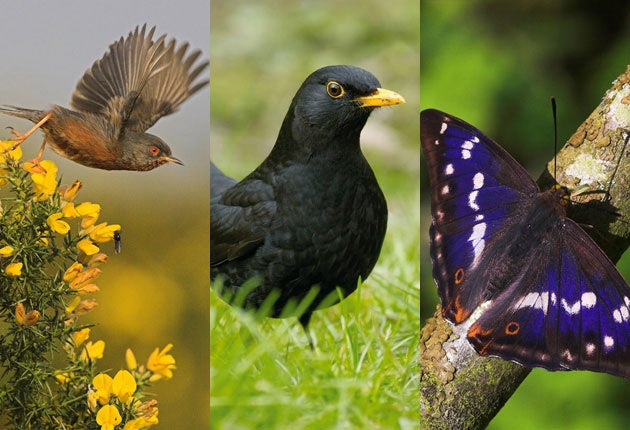
This may be one of the main reasons why the purple emperor butterfly did so well this year. Butterflies in general did better than previous years because they finally had a reasonably long period of dry, warm weather in early summer to feed and mate.
The cold February frosts helped check the highly invasive hottentot fig, a weed that is spreading on the sea cliffs of south-west England. But it was not so good for choughs, an endangered member of the crow family mainly found in Cornwall and Pembrokeshire, because the ground was often too hard for them to feed.
Winners and losers: How wildlife coped in 2009
January
*Frogs on the Lizard Peninsula in Cornwall suffered in the Arctic weather but the cold snap helped knock back many unwelcome invasive, non-native plants such as hottentot fig. In Cornwall and Pembrokeshire, choughs, a relative of the crow, also suffered because the frozen ground made feeding difficult.
*The second half of the month was very mild with bumblebees appearing.
February
*Coldest winter for 20 years in some parts of the UK, in two spells, with heavy snow and extreme frosts. Countless trees were lost to snow damage in north Somerset and Dartford warblers suffered in the south-east of England.
*Yet the first swallows appeared a month early on Holy Island in Northumberland. Swallow numbers overall were down on previous years.
March
*After the cold winter and two wet summers there were noticeably fewer ticks in much of the countryside: good news for walkers, dog owners and farmers. Ticks can carry Lyme disease, which can cause severe symptoms in humans if untreated.
*A dry month, with birds nesting earlier than usual, such as blackbirds at Cragside in Northumberland.
April
*Exceptionally dry weather resulted in several moorland fires at Hardcastle Crags and Marsden Moor in Yorkshire.
*It was a difficult year for oak trees. A myriad of caterpillars of the Green Oak Roller moth defoliated many trees, especially in the south-east, then Oak Mildew, a leaf fungus, affected the re-growth in late summer.
May
*Swarms of green and whitefly in Northern Ireland arrived on warm southerlies late in the month, unusually early in the summer.
*The tree bumblebee ( Bombus hypnorum) was a common sight at Runnymede in Surrey. This distinctive species was first recorded in the UK in 2001 and seems to be spreading especially in the east.
*Massive migration of painted lady butterflies into the UK.
June
*It was difficult year for cuckoos even in their hotspot areas.
*Glow worms suffered at Arnside Knott in Lancashire because of a wet late June and early July.
*Mid-summer storms decimated the Arctic tern population at Beadnall Bay in Northumberland. Storms normally seen in the spring and autumn have become more common in the summer with serious impacts.
July
*A fantastic year for the purple emperor butterfly, the best since 1983 for some sites.
*Thousands of seven-spot ladybirds ( Adalia septempunctata) were seen in the arable fields at Wimpole in Cambridgeshire with large swarms in East Anglia and Somerset.
August
*Wasp numbers were back up, thanks to a fine spring and mild summer.
*Leaves began to fall by the end of August at Ham House in London, thanks to a dry summer in the south-east.
*A second generation of Duke of Burgundy butterflies in Gloucestershire rewrote the record books. It was only the third time this has happened in the last 100 years, and all since 2005.
*Bats had a better year, having suffered in the previous two wet summers.
September
*A humpback whale was spotted, a very rare sighting, near to the Farne Islands in Northumberland.
*Another poor year for the common autumn cranefly (Tipula paludosa), otherwise known as daddy-long-legs: the second in a row after the 2008 crash. This has a knock-on effect for bats as it's an important food source ahead of the winter months.
*A bumper year for blackberries in the south-west of England, though relatively poor elsewhere.
October
*Hatfield forest in Essex saw few fungi as it was too dry for them to fruit; by contrast, record numbers of waxcaps were seen a month late at Cragside in Northumberland.
*Lack of rain in the East of England meant Orford Ness on the Suffolk coast ran dry, affecting migration stopovers for wading birds.
*Apple trees and strawberry plants flowered again in October in Northern Ireland; overall a good year for pear trees and a mixed year for apples.
November
*A wet month with flooding in Cumbria and monsoon conditions on the Yorkshire moors. Temperatures began to drop at the end of the month.
*Wardens on the Farne Islands took 16 days to get back to the mainland because of the stormy seas, which drove seabirds such as storm petrels and Leach's petrels ashore along the south coast of England.
December
*The warm April ensured that it was a good year for mistletoe and holly with an abundance of berries.
*The first frost at Hadrian's Wall was on 1 December, five weeks later than normal. Snow and ice gripped the country at the end of the year, just as it did at the beginning.
Source: The National Trust
Join our commenting forum
Join thought-provoking conversations, follow other Independent readers and see their replies
Comments
Bookmark popover
Removed from bookmarks