Nature

10° London Hi 14°C / Lo 8°C

Cut emissions or acidity will kill coral reefs, scientists say

'Underwater catastrophe' is imminent without action
By Steve Connor, Science Editor

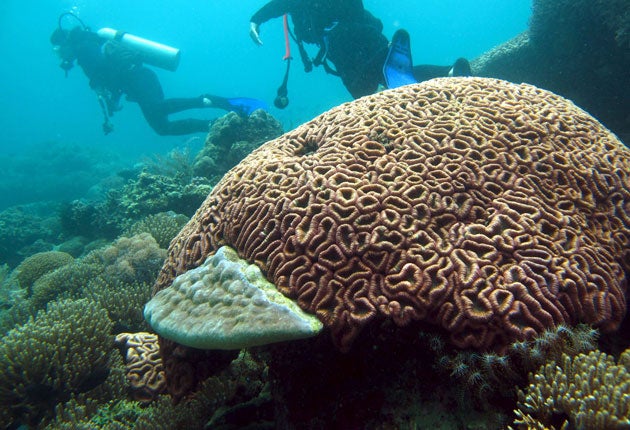
Scientists say rising ocean acidity levels, resulting from carbon emissions, are putting the world's coral reefs in jeopardy

EPA

Scientists say rising ocean acidity levels, resulting from carbon emissions, are putting the world's coral reefs in jeopardy

Rising acidity in oceans is leading to a global catastrophe that would be unparalleled in tens of millions of years, according to the national science academies of 69 countries which want governments to take the issue more seriously in the run-up to the December climate change conference in Copenhagen.

The rate at which the oceans are turning acidic because of rising carbon dioxide concentrations in the atmosphere is faster than at any other time since the extinction of the dinosaurs 65 million years ago, the scientists said in a joint statement issued today in advance of this week's pre-Copenhagen conference on climate change in Bonn.

As carbon dioxide increases in the air above the ocean, more of the gas gets dissolved in the surface water of the sea, creating carbonic acid. Since the start of the industrial revolution, the acidic activity of the oceans has increased by 30 per cent. At current rates, they will become so acidic that few shell-forming organisms and coral reefs will be able to survive by mid-century.

The academies, which include those in China and the US, have called on governments to treat ocean acidification as an important problem caused by the rising levels of man-made carbon dioxide, urging them to agree on significant cuts in carbon dioxide emissions – at least to half of 1990 levels by 2050. Lord Rees of Ludlow, the president of the Royal Society – Britain's national academy of sciences – said: "Unless global CO2 emissions can be cut by at least 50 per cent by 2050 and more thereafter, we could confront an underwater catastrophe, with irreversible changes in the makeup of our marine biodiversity," Lord Rees said.

It is estimated that the oceans have absorbed about a quarter of man-made carbon dioxide emissions since the industrial revolution but one of the outcomes of this absorption has been a fall in the natural alkalinity of the sea and a corresponding increase in its acidity.

As carbon dioxide dissolves in water, it produces acidic hydrogen ions which attack the carbonate ions that are the building blocks of the calcium shells and skeletons used by corals and shellfish. Carbonate ion concentrations are lower now than at any other time in the past 800,000 years, the panel said.

"Global atmospheric CO2 concentrations are now at 387 parts per million ... model projections suggest that by mid-century, CO2 concentrations will be more than double pre-industrial levels and the oceans will be more acidic than they have been for tens of millions of years," the panel said.

"These changes in ocean chemistry are irreversible for many thousands of years, and the biological consequences could last much longer."

Even if levels of carbon dioxide were stabilised at the target of 450 parts per million, more than 90 per cent of tropical coral reefs will be affected by uncomfortably high levels of acidity. Stabilisation at 550 parts per million could result in reefs dissolving.

Post a Comment

View all comments that have been posted about this article.

Offensive or abusive comments will be removed and your IP logged and may be used to prevent further submission. In submitting a comment to the site, you agree to be bound by the Independent Minds Terms of Service.

Comments

Really?
[info]derekcolman wrote:
Monday, 1 June 2009 at 01:29 am (UTC)
This is yet another scare story from the global warming alarmists. I note that the oceans are not becoming acidic, but just less alkaline. Corals and other crustaceans have been around for millions of years. That includes times when CO2 levels in the atmosphere were many times higher than today. By their reckoning the seas must have been far more acidic then. Why were these creatures not driven to extinction then? The answer is probably that, as the seas become more acidic, species that favour alkalinity will decline, while species that favour acidity will bloom and replace them. Increasing acidity will not diminish the richness and diversity of marine life. It will merely change the predominance of species. I have just read an article in a science magazine reporting that scientists were amazed to find that a particular species of starfish had lost a lot of calcium from their bodies due to increased acidity, but had happily adapted to it.
Re: Really?
[info]someofusknow wrote:
Monday, 1 June 2009 at 04:08 am (UTC)
Just one problem with your theory: it is the current ecosystem balance that keeps humans (and most other currently living species) alive.

So presumably, when you promote unrestrained CO2 emissions -as you always seem to do in your postings- you are actually advocating rapid self-extermination of the human race, along with most other vertebtrate species.

Nice one!!!!

If the is one thing this planet does not need, it is a plague of greedy apes wrecking everything. Hence, nature is ridding itself of its biggest problem right now.

Each day that passes it looks more certain that ants, cockroahes, scorpions and jellyfish will inherit the Earth.
Re: Really?
[info]derekcolman wrote:
Tuesday, 2 June 2009 at 01:58 am (UTC)
If you read the article more carefully you will see that this effect only applies to water near the surface, and so only affects species that live close to the surface. Deeper water is anaffected because it can only absorb an amount of CO2 proportional to it's temperature. Surface water is in contact with CO2 containing air and thus has to reach an equilibrium with it. That tends to make the near surface water more acidic than deeper water. I think you may not have understood that this is not something that affects the whole of the oceans.
Re: Really?
[info]tatcawh wrote:
Monday, 1 June 2009 at 07:13 pm (UTC)
The first sentence of the article; '...according to the national science academies of 69 countries'.

Clearly just a bunch of tree-hugging hippy alarmists who don't know nearly as science as Derek Colman?

And 'not becoming acidic, but just less alkaline' is only a quantum less scientifically literate than 'not becoming warm, but just less cold'.
Re: Really?
[info]derekcolman wrote:
Tuesday, 2 June 2009 at 02:15 am (UTC)
If you read the article again you will notice this phrase "a fall in the natural alkalinity of the sea". The zero point for alkalinity/acidity is pure water. This phrase means that the sea is still alkaline with respect to water, but by definition less alkaline = more acidic. I am not criticising the science academies as such, but this article for the way it is presented. You will notice a lot of "if this happens, then the result could be" in the article. That is speculation, not science. You may have also noticed that in the past a hell of a lot of scientific speculation has turned out to be wrong. The scientists are not actually saying that this will happen, but the article makes it appear so.
acidity will kill coral reefs
[info]mackinlay wrote:
Monday, 1 June 2009 at 04:45 am (UTC)
Australia's world respected CSIRO has for many years studied the problems with the Great Barrier Reef and its subsideries. The damage caused to these is the agricultural run off from the Queensland coast (and not just pesticides), and the fact of ocean sewerage outflows from both Queensland and New South Wales towns and cities, which is barely treated before it gets into the sea.
Coping with acidity
[info]mhenriday wrote:
Monday, 1 June 2009 at 07:00 am (UTC)
I note that the US Navy is dealing with the on-going acidification of the oceans and the destruction of coral in its own inimitable fashion : by sinking outdated ships in shallow waters to serve as replacements. Perhaps these ships constitute the sort of 'species that favour acidity' that our dear derikcoleman has in mind ?...

Henri
Ocean traffic
[info]drahcir38 wrote:
Monday, 1 June 2009 at 09:40 am (UTC)
An article on the Today programme this morning stated that much of the pollution caused by "traffic" was indeed from ocean going vessels, producing tens of times more pollutant per million partys of air than airoplanes, cars or lorries. Apparently there is no reason, other than cost, why these marine engines should not have cat convertors. The person on the programme said that when people found layers of dust on their cars that this was largely produced by marine traffic and not cars which he said were comparitively clean. Did anyone else hear this and does anyone else know if this might be true? If it is then surely there needs to be some pressure put on shipping companies if only for the sake of our lungs?
Science conducted by politicians?
[info]clothcap wrote:
Monday, 1 June 2009 at 10:39 am (UTC)
Enron getting desperate?
"Even if levels of carbon dioxide were stabilised at the target of 450 parts per million, more than 90 per cent of tropical coral reefs will be affected by uncomfortably high levels of acidity. Stabilisation at 550 parts per million could result in reefs dissolving." Evidence free hearsay.
Can these people read?
Temperature affects coral, the algae that feeds them dies, the coral loses its coating and shows its calcium shell. Algae that find the temperature comfortable moves in, colonises the coral and the coral resumes eating. When the temperature changes too frequently, coral suffers because the algae don't respond so fast. CO2 is food for algae.

Humans add 1 part per million to the air every 5 years (Spencer). If you can believe what the IPCC says, 50% of human CO2 is absorbed by nature so a maximum 1 part per million goes from the air every 5 years. At least 30% is taken up by land biomass. So every 7 years 1 part per million of human emissions in the air gets into the oceans.

Copenhagan attendees wanting the truth should look here:
http://www.co2science.org/education/reports/corals/toc.php
here:
http://www.theaustralian.news.com.au/story/0,20867,21144521-601,00.html
"Interestingly, scientific studies show that over the past 100 years, a period of modest global warming, there has been a statistically significant increase in growth rates of coral species on the Great Barrier Reef. There have also been periods of coral bleaching, but no conclusive evidence to suggest that either the frequency or severity has increased."
and here:
http://www.seafriends.org.nz/issues/global/acid.htm

Desperate times for the dogma. Alarm is showing.
http://climaterealists.com/index.php?id=3508
http://www.jennifermarohasy.com/blog/archives/002303.html

Has anyone done a cost-benefit analysis of these public funded conferences?
Re: Science conducted by politicians?
[info]tatcawh wrote:
Monday, 1 June 2009 at 07:19 pm (UTC)
Gee, the national science academies of 69 countries, or some industry-funded bloggers. How am I supposed to know who to believe?
Re: Science conducted by politicians?
[info]colinru wrote:
Monday, 1 June 2009 at 07:49 pm (UTC)
Well, why not post a refutation of the links that clothcap has posted?
Re: Science conducted by politicians?
[info]clothcap wrote:
Tuesday, 2 June 2009 at 10:53 am (UTC)
tatcawh, I find it highly suspect that such a controversial issue has seemingly unanimous support. I would like to see the results of the membership polls these academies conducted before presenting their support. Academy boards are all too often political in that toeing the official line gets funding. Conflicting with board views is apparently punished. Monckton did an article in which he expressed how the politics of one scientific organisation is biased and is worth reading before considering that academy views are representative.
http://scienceandpublicpolicy.org/images/stories/papers/commentaries/reviewed_or_not.pdf
If I can find anything out about the academies of the 69 countries, I'll post it and put a link here.

colinru, thanks, I had access problems yesterday.

Firozali, are you lost?
69 academies can't be lying
[info]clothcap wrote:
Tuesday, 2 June 2009 at 11:38 am (UTC)
Can they?
This is the document that seems to be the cause of the kerfuffle. It lists the academies. If I get time I'll check to see which have ongoing scientific research into coral reef dissolution.
http://www.interacademies.net/Object.File/Master/9/075/Statement_RS1579_IAP_05.09final2.pdf
No mention of science therein, just opinion.
Guess I'll have to dig up the science myself.
The first place I will look is at the science that says the oceans' ability to absorb CO2 is falling. I seem to remember that for the N.Hemi a banana boat and for the S.Hemi, a woman with a plastic fizzy drinks bottle were at the root of that alarm.
Who says research isn't fun?
:-)
oops - I did an Algorism
[info]clothcap wrote:
Monday, 1 June 2009 at 11:00 am (UTC)
For 1 part per million I did of course mean per 100,000. Sorry Roy.
CO2 absorbtion capacity
[info]frwilliams wrote:
Monday, 1 June 2009 at 12:13 pm (UTC)
The comment that the sea is not becoming acid but losing its alkalinity is correct, though academic. If biological systems are adapted to a particular pH then a change in pH will change those systems. But one of the main concerns about CO2 and the oceans is that they may be losing their capacity to absorb CO2 and therefore their buffering capacity. This is one of the positive feedbacks that could result in more rapid build-up of atmospheric CO2.
The bodies of a man, woman and child were found at the foot of a cliff today.
[info]famulla wrote:
Monday, 1 June 2009 at 01:31 pm (UTC)
No sir. It is killing men. The dirty condones choke fish and kids.
Man, woman and child found at foot of Beachy Head
The bodies of a man, woman and child were found at the foot of a cliff today.
The three unidentified bodies were recovered from the bottom of Beachy Head, near Eastbourne, East Sussex, this morning. Sussex Police were alerted after they received a call from the Coastguard at 8.20pm last night.
A police spokesman said: "The bodies - confirmed as a woman and man and believed to be a young child - are yet to be identified. They are not thought to be local."
I thank you
Firozali A Mulla
tatcawh - they can, they can
[info]clothcap wrote:
Tuesday, 2 June 2009 at 01:51 pm (UTC)

(being kind) mislead.
http://www.scientificamerican.com/article.cfm?id=state-of-the-science-beyond-the-worst-climate-change-case&page=2
Carbon Sinks Slowing - The world's oceans and forests are absorbing less of the CO2 released by human activity, resulting in a faster rise in atmospheric levels of greenhouse gases. All told, humanity released 9.9 billion metric tons (2.18 X 10¹³ pounds) of carbon in 2006 at the same time that the ability of the North Atlantic to take in such emissions, for example, dropped by 50 percent.
..............................

Here are some real scientific findings to digest whilst I'm checking out the academies.
From "Earth's Incredible Dissolving Corals" by Sherwood, Keith and Craig Idso | May 27, 2009
http://scienceandpublicpolicy.org/images/stories/papers/commentaries/Idso%20-%20Earth%27s%20Incredible%20Corals%20-%20by%20Jenn-b%2005%2028%2008.pdf

[...] Finally, in a study devoted to corals that involves a much longer period of time than all of the others we have discussed, another research team (Crabbe et al., 2006) determined the original growth rates of long dead Quaternary corals found in limestone deposits of islands in the Wakatobi Marine National Park of Indonesia, after which they compared them to the growth rates of present-day corals of the same genera living in the same area. This work revealed that the Quaternary corals grew "in a comparable environment to modern reefs," except, of course, for the air's CO2 concentration, which is currently higher than it has been at any other time throughout the entire Quaternary, which spans the past 1.8 million years. Most interestingly, therefore, their measurements indicated that the radial growth rates of the modern corals were 31% greater than those of their ancient predecessors in the case of Porites species, and 34% greater in the case of Favites species.
To these papers we could add many others that also depict increasing rates of coral calcification in the face of rising temperatures and atmospheric CO2 concentrations, including Clausen and Roth (1975), Coles and Jokiel (1977), Kajiwara et al. (1995), Nie et al. (1997), Reynaud-Vaganay et al. (1999), Reynaud et al. (2007) and Lough (2008). Clearly, therefore, the "unprecedented" 20th-century increases in atmospheric CO2 and temperature appear to have not harmed earth's corals. In fact,they actually appear to have helped them, which is a far cry from Silverman et al.'s contention that most coral reefs are currently calcifying at rates that are "20% to 40% less than their pre-Industrial Revolution rates." Just like the incredible shrinking man, earth's incredible dissolving corals are pure science fiction.

References that take over up more than 3 pages begin:
Adjeroud, M., Augustin, D., Galzin, R. and Salvat, B. 2002. Natural disturbances and interannual variability of coral reef communities on the outer slope of Tiahura (Moorea, French Polynesia): 1991 to 1997. Marine Ecology Progress Series 237: 121-131.
Adjeroud, M., Chancerelle, Y., Schrimm, M., Perez, T., Lecchini, D., Galzin, R. and Salvat, B. 2005. Detecting the effects of natural disturbances on coral assemblages in French Polynesia: A decade survey at multiple scales. Aquatic Living Resources 18: 111-123.
Ayre, D.J. and Hughes, T.P. 2004. Climate change, genotypic diversity and gene flow in reef-building corals. Ecology Letters 7: 273-278.
Bessat, F. and Buigues, D. 2001. Two centuries of variation in coral growth in a massive Porites colony from Moorea (French Polynesia): a response of ocean-atmosphere variability from south central Pacific. Palaeogeography, Palaeoclimatology, Palaeoecology 175: 381-392.
Buddemeier, R.W., Lkeypas, J.A. and Aronson, R.B. 2004. Coral Reefs & Global Climate Change: Potential Contributions of Climate Change to Stresses on Coral Reef Ecosystems. The Pew Center on Global Climate Change, Arlington, VA, USA.
..............................

99% of CO2 absorbed by oceans remains unchanged, of the 1% a little reacts chemically to form acid. Humans contribute less than a third of that 1% and less than a third of the fraction that goes to forming acid. The upper ocean has about 50 times the aerial CO2 so say 1 part in perhaps 600 million to make acid is anthropogenic.
Tragic for Science
[info]phe15 wrote:
Wednesday, 3 June 2009 at 07:08 am (UTC)
It is a shame that so many leading scientific institutions should put their names to such propaganda. The main purpose of this is to offset the dwindling argument for man-made global warming as temperature rises stall. At Copenhagen they will say: 'we believe warming will continue, but even if you question this, the problem of ocean acidity still justifies our hysteria'. The statement includes not one single scientific reference. Who wrote it, and on what is it based? The clearest propaganda is to refer to "increased acidity" (ie. emotive) when the reality is 'reduced alkalinity'. Also to state a pH change of 0.1 represents a 30% increase hydrogen ion activity (while true) is intended to deliberately mislead the reader to think the ocean is '30% more acidic'. This is propaganda that respectable scientists should not support. Also, a 'science journalist' should be making the same type of challenges instead of just regurgitating press-releases. Is Steve Connor an 'independent' journalist, or just a propaganda mouthpiece? You don't have to be a 'global warming' sceptic to aknowledge the folly in this statement, which will likely lead to a 'cry wolf' reaction when outrageous predictions fail to materialise.
The sorcers apprentice and modern economics.
[info]culture_rules wrote:
Thursday, 4 June 2009 at 05:44 pm (UTC)
Economics is causing reckless over prodution.
After the second war 1 man produced 20 cars per year. With robots the number has multiplied by 10.
Presumably in time 1 man could produce 2000 cars a year. The forces of economics no longer encourage economy. It now costs twice as much to sell a car as to make it. Therefore in time it will cost 20 times as much. The mark up on all retail goods is 3 times production costs.

All businesses want more consumption. Rising taxes force them to work even harder to stay still.
World politicians have to agree on a model that reduces exports not just to reduce climate change but to conserve finite resources.
Instead of taxing people for working people should be negatively taxed for saving consumption and taxed for consuming. This will involve the abolition of income tax and a redefinition of value added tax.

Article Archive

Day In a Page

Sun | Mon | Tue | Wed | Thu | Fri | Sat

Select date