Double dose of pesticide poses new danger for bumblebees
Government study suggests long-term exposure to chemicals can destroy colonies
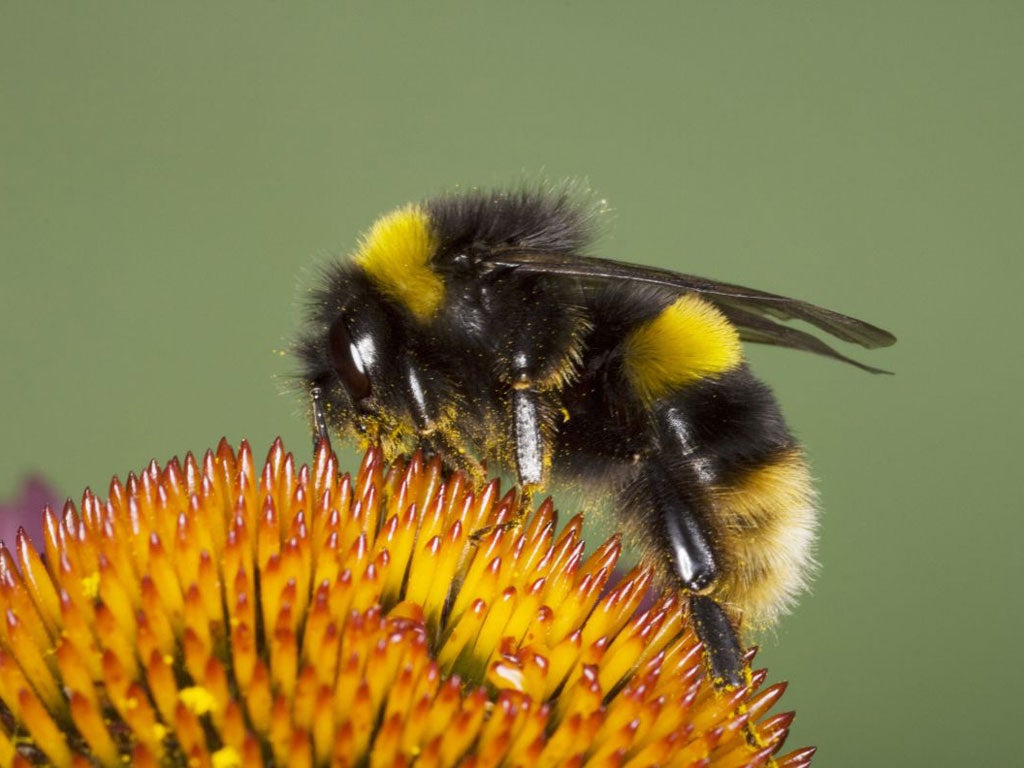
The combination of two pesticides commonly used on UK fields can have damaging effects on the behaviour of bumblebees and cause their colonies to collapse, new research by British scientists has found.
And long-term exposure to individual pesticides – for up to a month – is also likely to have damaging effects, the scientists say. They argue that current safety tests are insufficient, as guidelines only demand pesticides are tested on bees for four days.
The findings, which come from a Government-funded study, represent the fifth major piece of research to appear this year linking the worldwide and worrying declines of bees to pesticides, and in particular to the use of the relatively new nerve-agent pesticides, the neonicotinoids.
This new study is considered particularly important because bees forage widely so are likely to encounter more than one type of pesticide.
The research was carried out at Royal Holloway College, University of London, as part of the Insect Pollinators Initiative, a £10m British programme looking at threats to pollinating insects such as bees, butterflies, moths and hoverflies.
Published last night in Nature online, the study reports that exposure to two commonly used pesticides, one a neonicotinoid and the other from a different pesticide family, a pyrethroid, at concentrations approximating what might be found in the field, impaired the natural foraging behaviour of bumblebees. This led to increased numbers of deaths and in some cases the failure of colonies. The compounds involved were made by major agrochemical manufacturers: the most widely used neonicotinoid, imidacloprid, manufactured by Bayer and already implicated in problems with bees in earlier studies, was one, while the pyrethroid was lambda-cyhalothrin, originally developed by Syngenta.
The Royal Holloway researchers found that bees exposed over a month to imidacloprid were less able to collect pollen effectively, which meant that their colonies had less food available and so could not raise as many workers. On average, the percentage of workers leaving the colony and then getting lost was 55 per cent higher in those receiving imidacloprid than those that were not exposed to pesticides.
Two of the test colonies that were exposed to both pesticides together collapsed completely.
"The risk of exposure to multiple pesticides, or of the same pesticides being applied to different (adjacent) crops, is currently not considered when evaluating the safety of pesticides for bees," the researchers say.
On long-term effects, they say: "Considering that we did not detect significant effects until two to four weeks into our study, the current... guideline of a maximum exposure of 96 hours for testing acute effects of pesticides on honeybees appears to be insufficient."
A spokesman for Syngenta said yesterday: "There's no evidence that pesticides damage the health of bee populations but yet again we see unrealistic research being used to prove the opposite."
Join our commenting forum
Join thought-provoking conversations, follow other Independent readers and see their replies
Comments
Bookmark popover
Removed from bookmarks