Edinburgh Zoo: Chimps with everything
Why have Edinburgh Zoo's primates been given a new £6m home, with an indoor climbing frame and climate control? Rob Sharp asks if the world's gone bananas
Approaching this lustrous, hi-tech building, you might first notice its jaunty angles, exotic veneered wood and towering glass walls. Glinting in the sunlight, it looks like an upmarket holiday resort, or a boutique hotel. Behind the perfectly finished surface of the glazing that extends above you like a skyscraper, the interior is filled with plush green creepers, a forest's worth of vegetation.
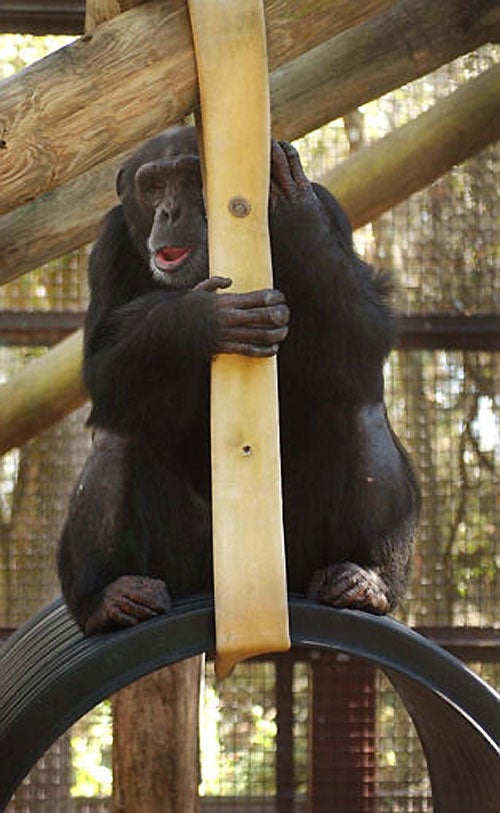
Look closer still and you might well see something furry and brown dart past. These are not motorbikers on a day trip to see Zaha Hadid's latest monolith. They are, in fact, the inhabitants of the world's largest chimpanzee enclosure. Costing £6m, and boasting the world's biggest climbing frame for apes, Edinburgh Zoo's Budongo Trail will open on 1 May. Its backers hope it will become the centrepiece of a new £80m redevelopment of what is already one of the city's principal tourist attractions.
But, crucially, it is not just an exotic place to visit. The designers of the new enclosure hope it will allow both the public and the zoo's legion of academic researchers to learn more about chimps – and one of their closest cousins in the animal kingdom, namely us – than ever before. And they hope it will also underline concerns over the destruction of the apes' sub-equatorial habitats.
Iain Valentine, head of animals, education and conservation at the Royal Zoological Society of Scotland, one of those behind the scheme, says: "Moving through the enclosure, people will be able to see the animals in an environment never hitherto seen in the UK. From watching them play during the day to making nests at night, it will be an up-close experience unmatchable in terms of quality worldwide."
The building's architect, Gary Wilson, has designed the building around three central climate-controlled "pods", between which the apes can make choices over where they spend most of their time. Each pod will be maintained at its own humidity and temperature. They also have their own type of "substrate", or material such as wood chippings, spread across the floor.
Around 650,000 visitors already visit the zoo every year, and a large proportion of these will swing by the Budongo Trail. They will be treated to flashy exhibits demonstrating chimpanzee behaviour and information on their natural environment. Children will be able to learn how chimps use tools in the wild, and will be encouraged to learn about ape locomotion (by, for instance, mimicking how the animals walk on four legs). Visitors will be able to email their observations to the zoo's researchers after their trip.
Stephen Woollard, education and interpretation manager for the Royal Zoological Society of Scotland, adds: "We hope people will become engaged with the story of the chimpanzees. We want them to feel empathy towards the individuals, but we also want them to feel a connection with the issues that face the animals in a wild scenario."
People will also be able to engage directly with the zoo's scientists. An annexe running off one of the principal enclosures will allow researchers and public alike to present the animals – via a safety hatch – with different foods, or puzzles. Scientists claim that observing the behaviour of chimps – with whom humans shared a common ancestor between five and eight million years ago – can tell us reams about ourselves.
Valentine explains: "As our close cousins, seeing how primates react under different circumstances can further our understanding of many different areas of science, such as human psychology, including how cultures evolved. It can also tell us things about the development of children – how they learn, for example."
While the chimps in this enclosure hail from west Africa, they are very similar, in terms of diet and behaviour, to a population in the Budongo rainforest in Uganda, where the zoo has a research field station. Through its exhibits, the Edinburgh enclosure also hopes to highlight and raise money for the zoo's work in Africa. At the Ugandan Budongo Conservation Field Station, the effects of local deforestation on the animals are also being studied. Here, the zoo employs 26 locals. Experts such as Valentine are keen to stress that the boost the zoo provides for the local economy reduces poaching and deforestation.
But despite the zoo's best intentions, those who dispute the need to hold animals in captivity are not convinced. Lisa Wathne, captive exotic animal specialist at People for the Ethical Treatment of Animals (Peta), says: "We are always pleased to see zoos improve conditions for the animals they already have. But no zoo can provide an adequate environment for an animal as intelligent and complex as a chimpanzee. The zoo authorities would not come close to what they would experience in the wild. Even though this seems to be a natural jungle-type environment, I would like to know how much of it is available to the animal. Often you walk into these exhibits, full of lush greenery to which the animals do not have access. Another very concerning thing is that the zoo intends to breed chimpanzees. Existing sanctuaries do not always have space for all the chimpanzees this may create. They can end up in circuses or other grossly inappropriate environments."
However, Valentine maintains that this modern environment is necessary to carry out cutting-edge research. He continues: "Such places are imperative if we are to have a proper academic reputation. To find out as much as we can about these animals we need to look at them in a combination of both in the rainforest and in places like zoos. While looking at apes in the wild will give us the most accurate picture, it is hard to do 'close work' there. Sometimes you have to track the animals over long areas, which can be impractical. Also, those bred in captivity tend to be more co-operative. Wild animals have a natural fear of human beings." If those behind the Budongo Trail are to be believed, man and ape will soon be better friends than ever.
The world's wildest animal attractions
Stephen Woollard, one of the team behind the Budongo Trail, names the zoo enclosures from around the world that helped inspire his project at Edinburgh:
1. New York's Bronx Zoo has won worldwide acclaim for its Congo Gorilla Forest. This realistic rainforest environment features over 300 animals, including one of the largest breeding groups of lowland gorillas anywhere. Woollard praises its "walk-through experience, where the forest is discussed before the gorilla is encountered". During this walk, visitors are introduced to creatures that share the gorillas' natural habitat, such as bush pigs, and the giraffe-like okapi.
2. Zurich Zoo has the particularly fine Masoala Rainforest Hall, an attempt to recreate a lush Madagascan habitat beneath a dome. "They have gone for a different approach to the Bronx," explains Woollard. "They have created an unobtrusive habitat and then introduced animals, such as lemurs. The visitor is given a book and is invited to explore it themselves. It is a means of creating something natural for the animals and the visitors."
3. Arnhem Zoo in the Netherlands has a covered rainforest house spanning several acres. The zoo has won plaudits for its fences, which keep the animals safely enclosed, but, crucially, are not visible from the paths that visitors walk along. It also has what experts term an "integrated approach" to exhibits and visitor attractions – including an animal-themed rainforest café.
4. One of the world's largest primate enclosures, with orang-utans and bonobo chimps, Pongoland at Leipzig Zoo is a faithfully reproduced home for apes. "There is a bridge walkway running through it; and the animals are not caged, which was something we were keen to emulate in Scotland," Woollard says. "They have a lot of room to move around so it feels more like the wild."
5. In the Costa del Sol's Fuengirola Zoo, architects have employed clever "set design" so that, as visitors move through the zoo along a path, they are shielded from seeing their fellow zoo-goers at different points. "They have tried to keep the public hidden while opening up the experience. This is something a lot of us are trying to incorporate," says Woollard.
Join our commenting forum
Join thought-provoking conversations, follow other Independent readers and see their replies
Comments
Bookmark popover
Removed from bookmarks