Nature

Rain (AM and PM) 3° London Hi 9°C / Lo 6°C

Emperor penguin 'marching to extinction by end of the century'
By Steve Connor, Science Editor

Emperor penguins are expected to be too slow to adapt to climate change

Emperor penguins are expected to be too slow to adapt to climate change

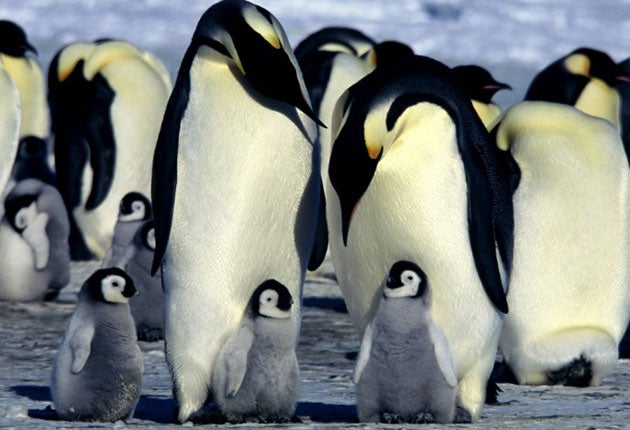
The Emperor penguin is marching towards extinction because the Antarctic sea ice on which it depends for survival is shrinking at a faster rate than the bird is able evolve if it is to avoid disaster, a study has found.

By the end of the century there could be just 400 breeding pairs of Emperor penguins left standing, a dramatic decline from the population about about 6,000 breeding pairs that existed in the 1960s, scientists estimated.

The latest assessment of the future size of the Emperor penguin population is based on the projected increase in global temperatures and subsequent loss of sea ice due to the changes in the Antarctic climate that are expected in the 21st Century, the study found.

Scientists based their pessimistic outlook on the long-term changes to the number of Emperor penguins in a colony living in a part of the Antarctic Peninsula called Terre Adelie, which has been surveyed regularly since 1962 and has experienced regional warming over the past 50 years.

The study by Stephanie Jenouvrier and Hal Caswell of the Woods Hole Oceanographic Institution in Massachusetts concluded that there is at least a 36 per cent probability of “quasi extinction” of the Emperor penguin -- when the population declines by at least 95 per cent -- by the year 2100.

“To avoid extinction, Emperor penguins will have to adapt, migrate or change the timing of their growth stages,” the scientists report in the journal Proceedings of the National Academy of Sciences.

“However, give the future projected increases in greenhouse gases and its effect on Antarctic climate, evolution or migration seem unlikely for such long-lived species at the remote southern end of the Earth,” they say.

Emperor penguins are probably unique among birds in that they hardly ever set foot on land. They breed, raise their young and feed from floating platforms of sea ice that forms each Antarctic winter.

Fluctuations in sea ice during the 1970s, and the effect that it has on the penguin population, were used as a model of what could happen on a larger scale during the next 100 years or so of climate change.

"The key to the analysis was deciding to focus not on average climate conditions, but on fluctuations that occasionally reduce the amount of available sea ice," said Dr Caswell, an expert in mathematical ecology.

"This analysis focuses on a single population, that at Terre Adelie, because of the excellent data available for it. But patterns of climate change and sea ice in the Antarctic are an area of intense research interest now. It remains to be seen how these changes will affect the entire species throughout Antarctica," Dr Caswell said.

Dr Jenouvrier said that if future climate change happens as predicted by the Intergovernmental Panel on Climate Change, the penguin population ion Terre Adelie will probably decline dramatically in the coming decades.

"Unlike some other Antarctic bird species that have altered their life cycles, penguins don't catch on so quickly," Dr Jenouvrier said.

"They are long-lived organisms, so they adapt slowly. This is a problem because the climate is changing very fast," she said.

Emperor penguins are renown for the way the males are left to incubate the eggs on the sea ice through the long Antarctic winter while the females return to the sea to feed.

In August, at the end of the Antarctic winter, the females return to feed the newly-hatched young as the males go to fatten up -- they lose 40 per cent of their body weight during the winter months.

In the next few weeks, both parents take it in turns to feed until the chick is old enough to join other chicks that huddle together in groups to keep warm. In December, with the winter sea ice breaking up, the entire family march together to the open sea to feed.

Post a Comment

View all comments that have been posted about this article.

Offensive or abusive comments will be removed and your IP logged and may be used to prevent further submission. In submitting a comment to the site, you agree to be bound by the Independent Minds Terms of Service.

Comments

Emperor Penguins
[info]kingscote wrote:
Tuesday, 27 January 2009 at 05:17 am (UTC)
When you can tell me how many breeding pairs there were last time the ice melted, and how many there were at the turn of the 19th century, I might start believing in your science. As much as it could be true, the one word which seems to always appear in any article is "if". I read the other day where astronomers were predicting the Milky Way would collide with another galaxy in four and a half billion years, not the seven previously thought. I am sure that gave the people of Gaza even more worry. I cannot believe people actually get paid to do this work. Dean
Pick up a penguin
[info]calum100 wrote:
Tuesday, 27 January 2009 at 10:10 am (UTC)
More models, more nonsense.

Satellites images show that the Antarctic sea ice is now at its greatest observed extent. The Antarctic sea ice has been growing since 1979, and is still growing.

You won't get real science if you don't deal with real data.
Proof of effects of increased CO2 in sea water
[info]pathofssr wrote:
Tuesday, 27 January 2009 at 10:34 am (UTC)
When large amount of CO2 is dissolved in sea water, this will give the effect of warmer streams with higher consentrations of CO2 engulfed by colder streams of sea water.

Energy (heat) surrounding the streams with a lot of CO2 will get in, but not out until the streams get near the cold ice bergs; since the streams can't travel further - and the rule of "the path of least resistance" means that energy in the warmer streams will be delivered suddenly to the surrounding colder water.

The high temperature differences between warm and cold water means that this will give a lot of large turbulence and stormy weather; and a lot of sea sprays; and because of that a lot of salt from the sprays to powerfull hit the ice bergs. This salt will then cause a rapid melting of the ice.

So increased amount of CO2 in the atmosphere due to human activities means more CO2 dissolved in sea water and this will give in the end more melting of the ice bergs. QED.
[info]rooster281 wrote:
Tuesday, 27 January 2009 at 02:33 pm (UTC)
What a lot of nonsense again from Steve Connor. This is Playstation science and Steve laps it up.

For Polar Bears, read Penguins.
"By the end of the century there could be just 400 breeding pairs of Emperor penguins left standing, a dramatic decline from the population about about 6,000 breeding pairs that existed in the 1960s, scientists estimated."

In the real world, as with Polar Bears, Penguin numbers have increased considerably since the 1960's:
"Penguins are now enjoying a population boom. Their increasing numbers can be partly attributed to the over-fishing of baleen whales in the past which has resulted in a super-abundance of krill, a key species in the Antarctic ecosystem. In addition to krill, penguins feed heavily on fish, squid, and other small crustaceans."

http://www.antarcticconnection.com/antarctic/wildlife/penguins/emperor.shtml - population, 200,000 breeding pairs.

Conservation status - http://en.wikipedia.org/wiki/User:Alastor_Moody/Emperor_Penguins
Current estimates of the Emperor penguin population range from 150,000—200,000 breeding pairs. As of 2006, the species is considered at a stable level.

So why doesn't Steve Connor do any independent research before he publishes this fiction? Sadly, it is his headline that will traverse the world on the green blogs and add to the continuing extinction myths, needed by WWF and the like to keep the money rolling in.
By Steve Connor, Science Editor
[info]mpopove wrote:
Tuesday, 27 January 2009 at 06:43 pm (UTC)
By Steve Connor, Science Editor

Can I have this man's promise to quit his job when he is exposed as an intellectual sycophant. I am trying to get Al Gore to commit to the same pledge. The one real problem with reason is that people like Steve Connor are aware of it's existence, but that is where the relationship ends. HOW, HOW, HOW does Steve Connor has a job still while hardworking, intelligent and HONEST people are losing theirs.
Emperor Penguin extinction
[info]colinru wrote:
Tuesday, 27 January 2009 at 07:27 pm (UTC)
Unlike the headline, what this article says is that IF the temperature goes up (they have been stable or dropping for the last 10 years) the Penguin will be in trouble. In other words, more attempts to drum up AGW hysteria! IF a bus falls on my head, I will be in trouble - why do you not print an article on that.

It was going to be the Polar Bear but, unfortunately for the "Warmists", numbers seem to be rising. So now they will give Penguins a whirl - see if that frightens us all into more Government Control & taxes.
utter rubbish
[info]pugshoes wrote:
Tuesday, 27 January 2009 at 11:11 pm (UTC)
Recent population estimates of emperor penguins are nearly 500,000.00.

Science "EDITOR"??? Don't you check your sources?!
Re: utter rubbish
[info]calum100 wrote:
Wednesday, 28 January 2009 at 09:14 am (UTC)
I have to agree. This story (you can't call it a study) is "utter rubbish" and comes under the heading of alarmist propaganda.
Ed Zuiderwijk
[info]edjzet wrote:
Wednesday, 28 January 2009 at 10:03 am (UTC)
Two facts: 2007 was a record year for Arctic ice cover, it being at a minimum. 2007 also was a record year for Antarctic ice cover, it being at a maximum. Not that you read about the latter in the press, you have to find out for yourself. So, the Polar Bears are "endangered" by melting ice and the Penguins evidently are "endangered" by too much ice.

The solution is obvious: these animals find themselves at the wrong pole! Just ship all the bears South and all the birds North and problem solved.
Epeeror penguin extinction
[info]wagonrider wrote:
Wednesday, 28 January 2009 at 06:56 pm (UTC)
Paddy L wrote:
This article is full of outright lies. According to The Antarctic Connection, the current population of Emperor penguins is a robust 200,000 breading pairs.
http://www.antarcticconnection.com/antarctic/wildlife/penguins/emperor.shtml

The Antarctic sea ice extent in 2008 reached record levels. The Antarctic seas are cooling. The Continent's temperature has been cooling for 50 years.
http://arctic.atmos.uiuc.edu/cryosphere/IMAGES/current.anom.south.jpg
http://www.physorg.com/news148239677.html
http://data.aad.gov.au/aadc/soe/display_indicator.cfm?soe_id=1

If the Emperors are indeed in jeopardy it is due to the increasing sea ice. Their migrations take the from the edge of the ice inland until the reach land. The penguins risks increase as in proportion to the length of the migration.

It is quite disgusting to read this ridiculous propaganda in a supposedly reliable newspaper.


Article Archive

Day In a Page

Sun | Mon | Tue | Wed | Thu | Fri | Sat

Select date