From Iron Curtain to Green Belt: How new life came to the death strip
Thanks to German conservationists, the Cold War dividing line between East and West has become a haven for wildlife. Tony Paterson reports
A teenage twitcher and a small buff-coloured songbird called the whinchat were the keys that turned the Iron Curtain's landscape of barbed wire, mined death strips and Kalashnikov-toting border guards into what is probably the most enduring green success story in Europe since the Cold War. Two decades after its fall, the border between East and West Germany has already become Europe's biggest nature reserve: an 858-mile "ecological treasure trove", no longer the Iron Curtain but the Green Belt, and home to more than 600 rare and endangered species of birds, mammals, plants and insects.
But when its creators mark its 20th birthday this year, they will also be celebrating the fact that 23 European countries are currently engaged in a project to make it nearly five times as long. "The aim is to turn the Iron Curtain's entire 4,250-mile length – extending from the Arctic to the Black Sea – into what is already being called the 'Central European Green Belt'," says Dr Kai Frobel, a German ornithologist and conservationist.
He was the man who started it all back in 1970s. In those days, it seemed impossible that the Berlin Wall might one day fall or that the Soviet empire could crumble. But that was almost irrelevant to Frobel, now a leading member of the German nature protection group, Bund, but then a teenager from the West German village of Hassenberg, which stood nearly in the Iron Curtain's shadow. At 13, he was an enthusiastic birdwatcher. Equipped with a pair of pre-war Zeiss binoculars, a green army surplus parka, and heavy gumboots, he used to spend most of his free time in the hilly wooded countryside of his native northern Bavaria looking for new bird sightings, which he would record in his notebook.
Frequently his expeditions would take him close to Bavaria's heavily fortified border with neighbouring communist East Germany. "It was only about 400 yards from our village. I grew up with the Iron Curtain. For me it was almost normal," he now recalls. Frobel was less interested in the politics of the frontier than what it meant for the birds and other wildlife. For despite its watchtowers, mines, miles of impenetrable fencing and stone-faced guards with orders to shoot would-be escapers on sight, the area was, for the most part, a weird oasis of calm.
The way the Iron Curtain was constructed had much to do with it. In Germany it ran in a line more than 100 yards further east than the actual East-West border. Another 100 yards even further east, there was another fence, and behind that, deeper still into the communist part, there was a so-called restricted zone, accessible only to residents, usually with good party credentials, but barred to the rest of the world. Apart from the death strip, which was kept barren, the Iron Curtain remained almost untouched by human hand, or foot, for its entire 37-year existence. It rapidly turned into natural wilderness. "No fertilisers were sprayed in the border zone. It was full of small bushes and types of grass that had been wiped out elsewhere as a result of farming on an industrial scale," says Frobel. As a result, it was also an Shangri-La for threatened species of birds, mammals, insects and plants.
The whinchats seemed to derive the most profit from this environment. The buff, black and white coloured songbird (pictured), which is about 4.5in long, migrates from southern Africa to northern Europe for only four months each summer. Frobel noticed that the birds were to be found almost exclusively around the Iron Curtain. "It was extraordinary," he recalls. "The whinchats would perform their courtship displays perched on the barbed wire. When we later carried out a proper study, we found that 90 per cent of the birds' nesting sites were on border territory."
At the end of the 1970s, Frobel's Iron Curtain whinchat study was the winning entry in a nature competition for local school students. The findings aroused such interest among conservationists, and what was then Germany's budding Green Party, that the Bavarian government started buying up countryside close to the Iron Curtain to prevent its being developed
By this time, Frobel's wanderings, often at night, along the western side of the inner German border had turned him into the East German Stasi's most renowned West German ornithologist. His reputation grew when he began visiting his East German penfriend Gunter Berwing across the border. His meetings with similarly minded ornithologists in the East were watched by the Stasi. After the fall of the Berlin Wall, Frobel got hold of his Stasi file, which was an inch thick and codenamed "Alternative". The Stasi concluded that he was "abusing environmental issues to inspire alternative political activities intended to undermine the Warsaw Pact".
Even in the mid-1980s, Frobel and his East German friends were convinced that they would never live to see the Iron Curtain fall. "As the only East Germans allowed to travel to the West were pensioners, we calculated it would be at least 40 years before my friends could visit me," he says.
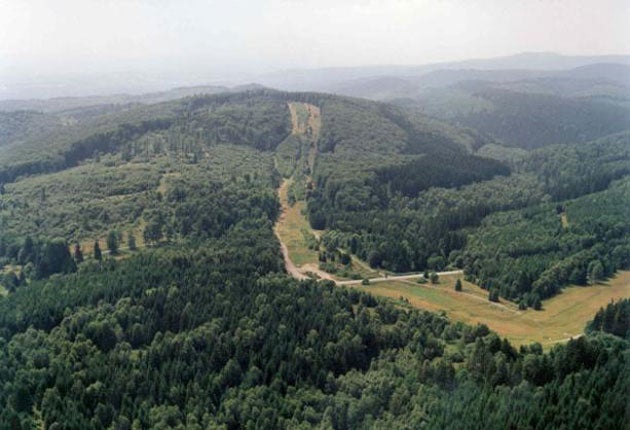
But of course, the Wall did fall and Germany's conservationists reacted extraordinarily quickly to ensure its ecological value was preserved. In December 1989, barely a month after the Berlin Wall was breached, conservationists from East and West met to hammer out a plan that was to lead to the creation of Europe's largest and longest permanent nature reserve. Germany's Grünes Band or Green Belt stretches along the length of the former Iron Curtain from the Baltic to Bavaria's borders with the Czech Republic. It encompasses some 861 square miles and is home to hundreds of rare or threatened species such as the wild cat, black stork and otter. More than half of Europe's 25,000 red kites are to be found in Germany and most inhabit the Green Belt.
Up in the hills of Germany's Thuringian Forest last week, the Green Belt was instantly recognisable because of the rash of bright green-leafed birches that have grown up along it over the past two decades. The barbed wire and watchtowers of the former death strip have all gone. The only visible trace is a seemingly endless tank track, constructed from perforated, and now weed-covered, concrete slabs.
An invisible trace is left by the last of the 1.3 million mines that used to litter the area. The vast majority were removed but the German authorities say they still cannot guarantee that all the Green Belt is completely mine-free. "This has its positive sides," says Matthias Fanck, who is showing an exhibition on the Green Belt project in the former border town of Probstzella: "It means that tourists tend to stick to the paths and leave the nature reserve untouched."
Twenty years on, the Green Belt has become an important part of Germany's tourist industry. At strategic points along its route, visitors can call a free mobile phone number and listen to witnesses' accounts of what the border once was. "It gives today's generation of young Europeans an idea of what the Iron Curtain meant," says Frobel.
And it's perhaps no surprise that the Green Belt's logo is a picture of a whinchat, wings outstretched and perched on top of an East German border post.
Join our commenting forum
Join thought-provoking conversations, follow other Independent readers and see their replies
Comments