Global warming threatens fish that inspired 'Finding Nemo'
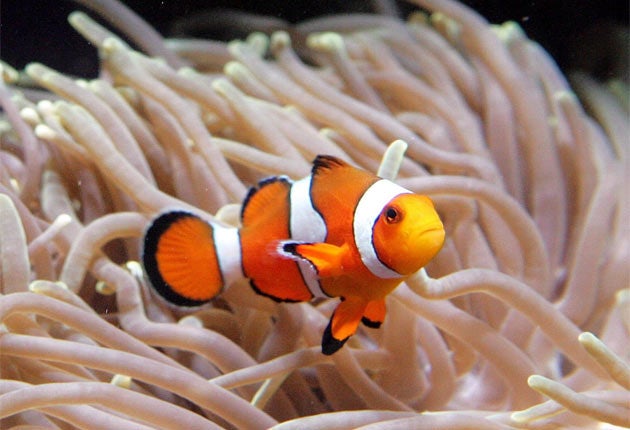
Finding Nemo could soon become easier for a hungry barracuda because the rising acidity of the oceans is likely to cause baby clownfish to go deaf to the sounds made by potential predators, a study has found.
Scientists have shown that the sensitive hearing of fish can be affected by high concentrations of carbon dioxide in the atmosphere, which influences the acidity of the ocean and the ability of marine creatures to form calcium-containing shells.
The researchers found that baby orange clownfish – the same species as Nemo in Pixar's Oscar-winning 2003 animated film, Finding Nemo – lost their ability to detect the underwater noises made by potential predators when carbon dioxide pumped into their tanks reached certain concentrations.
According to the results of the experiments, Nemo and marine fish like him could begin to go deaf by the middle of this century when the ocean acidity is expected to have reached a threshold that starts to interfere with the ability of a fish's tiny "earbones" to pick up vibrations in the water caused by nearby predators.
"What we have done here is to put today's fish in tomorrow's environment, and the effects are potentially devastating," said Steve Simpson of the University of Bristol, who is the lead author of the study published in the journal Biology Letters.
"We designed a totally new kind of experimental choice chamber that allowed us to play [coral] reef noise through an underwater speaker to fish in the lab and watch how they responded," Dr Simpson explained.
"Fish reared in today's conditions swam away from the predator noise, but those reared in the carbon-dioxide conditions of 2050 and 2100 showed no response," he said.
It is estimated that globally, the sea has absorbed about 142 billion tons of carbon dioxide produced by the burning of fossil fuels since the start of the industrial revolution. When carbon dioxide dissolves in seawater it causes it to become slightly more acidic – making it more difficult for marine organisms to incorporate calcium into their shells or other hard parts of their anatomy, such as the sound-detecting earbones, called otoliths.
Dr Simpson said there was no visible difference in the otoliths of clownfish raised in different carbon-dioxide concentrations, but other studies have shown that rising ocean acidity can affect shell formation and the ability of fish to detect underwater odours. The latest study is the first to reveal a direct relationship between carbon-dioxide concentrations and a definite behavioural response to the underwater sounds of potential predators.
"Fish live in a very acoustically-rich world and are often devoid of other senses such as vision," Dr Simpson said. "If their sense of hearing is affected by changes in acidity, it would have widescale implications for a range of behaviours, from avoiding predators to choosing mates.
"What we don't know is whether, in the next few generations, fish can adapt and tolerate ocean acidification," he added. "This is a one-way experiment on a global scale, and predicting the outcomes and interactions is a major challenge for the scientific community."
Join our commenting forum
Join thought-provoking conversations, follow other Independent readers and see their replies
Comments
Bookmark popover
Removed from bookmarks