Has a cure been found for Dutch Elm Disease?
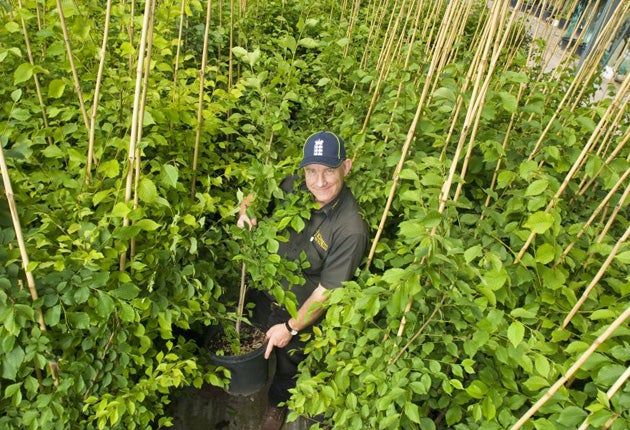
As Paul King toured the English countryside in the 1980s going about his work as a contractor cutting down trees ravaged by Dutch Elm Disease, he was always struck by two specimens close to his Essex home which in the midst of the countrywide destruction remained untouched by the killer fungus.
The pair of elms continued to flourish as the disease largely wiped from the landscape a tree once considered as intrinsically English as the oak and Mr King decided to take cuttings from the two apparently resistant elm specimens to see if he could recreate their success.
Some 23 years later, it seems the nursery owner may have cracked the secret of how to reintroduce to the countryside the species that was immortalised on canvas by John Constable in The Hay Wain. Mr King has produced 2,000 healthy English Elm saplings from the original pair of 200-year-old disease-resistant trees.
Customers including the Royal Botanic Gardens at Kew and Leicestershire County Council are buying the rare specimens of English Elm, whose Latin name is Ulmus procera, after it was found they have the unusual ability to repel the tree-boring beetle which carries the fungus causing Dutch Elm Disease (DED).
Mr King, from Rayne, near Braintree, said: "My job in the 1970s and 1980s was cutting down diseased elms. Over the years we must have cut down thousands and it was heartbreaking. But I always noticed how these two particular elms near my house somehow survived.
"It always struck me as remarkable that they were still alive when every other elm around had succumbed. So I took a couple of cuttings as a hobby to try to get them to grow on. They grew to about 12-15ft in height and about six years ago I had to make a decision about whether to park the project or pursue it seriously.
"I decided I wanted to do it properly and scaled up production with about 2,000 seedlings. Those seedlings are the ones that are now available and they are healthy and disease free, just as the two original trees remain today. I would love to be able to help bring the English Elm back to our landscape."
With its ability to effectively trick trees into slowly blocking off their own system for transferring nutrients, the DED fungus, Ophiostoma novo-ulmi, is one of the most devastating arboreal diseases. Early variants of the disease, which originated in Asia and was first identified in the Netherlands (giving the fungus its name), were introduced to Europe in 1910. They claimed only a small proportion of elms before dying out in the 1940s. But a far more virulent and deadly strain emerged later and, after arriving in Britain in 1967 on a shipment of elm logs from North America, it slowly spread across the country, killing more than 25 million trees by causing their branches to brown and wither from the top down.
Over a period of 30 years, Ulmus procera has almost disappeared from the English countryside and is now undergoing its "second wave" of DED attack, killing younger sprouting elms which have emerged in hedgerows in recent decades only to succumb to a new onslaught of beetle attacks.
Mr King used a laboratory-based technique known as micropropagation to speed up production of his disease-resistant trees. A company in Scotland used a sample of plant tissue to grow cells from the old elms and create multiple new trees, which have been grown in pots in Mr King's nursery.
The precise reason for the ability of the trees to ward off the DED beetle remains unclear and although the new trees seem highly resistant to the fungus, it is not yet known whether they are permanently immune to the disease. English elms only become fully susceptible to DED after about 10 years of growth, when they develop a cork-like bark which is attacked by the beetles.
Mr King said: "My nursery is bordered by a hedge with elms that died and throw up suckers that continually get re-infected and die back, so there is no doubt that my original trees have been exposed to the disease. They are certainly highly resistant but we cannot say they are immune. It is only once they have been widely reintroduced and survived for a good period of time that we can begin to say that."
Among those hoping that the two Essex elms and their offspring carry a genetic block to the disease are the leaders of Leicestershire County Council, who have already planted 12 of the saplings with a view to distributing more to schools. Botanists at Kew have also planted two trees to monitor their progress.
Colin Crosbie, manager of the Royal Horticultural Society garden at Wisley, Surrey, said: "There have been examples of apparently resistant trees which have been propagated elsewhere and been found to be not quite so resistant. But the English elm is one of the most beautiful trees in the landscape and it would be very exciting to find a new fully resistant tree. We need to get these elms out into different areas and see how they do."
Oak diseases
Acute Oak Decline
While the English Elm has been routed by disease, the English Oak also faces an uncertain future. Conservationists have warned that a new and little-understood pathogen, which causes trees to "bleed" black fluid and kills them within five years, is spreading far more rapidly across Britain than previously thought.
The condition, which some experts have warned could be as devastating as Dutch Elm Disease, has been identified by the Forestry Commission at 55 sites across southern England, the Midlands and East Anglia. But woodland groups believe it has already spread to far more locations and have accused the Government of starving scientists of the funds needed for research.
Sudden Oak Death
The second disease assailing the king of British forests is a relative of potato blight. It has already been recorded at dozens of locations. Despite its name, it affects more than 100 species of plants and trees. It is caused by a fungal algae and has already killed hundreds of thousands of oak trees in California.
Join our commenting forum
Join thought-provoking conversations, follow other Independent readers and see their replies
Comments