'Krak' (that's falling branch in monkey speak)
Researchers claim to have deciphered the way primates communicate
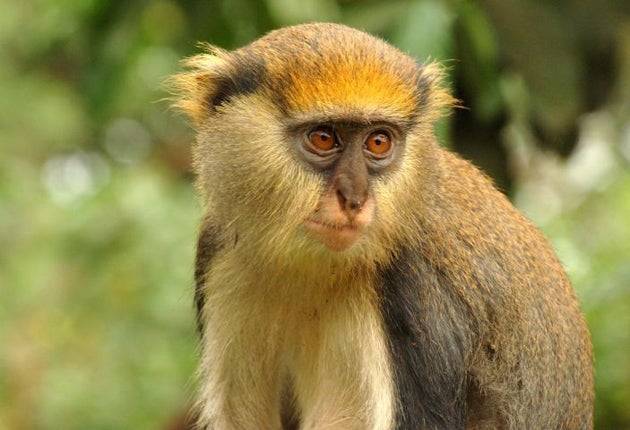
The secret behind the origins of human language may lie in the jungle chatter of a species of monkey, a team of scientists has claimed.
The researchers spent months studying the calls of the Campbell's monkey, or Cercopithecus campbelli, which lives in the forests of the Tai National Park in the Ivory Coast. They discovered that the animals not only use distinctive alarm calls to warn of specific predators nearby but can also combine them with other sounds to convey extra information – in much the same way humans use prefixes and suffixes.
The team, led by Professor Klaus Zuberbühler of the University of St Andrews, studied alpha male monkeys whose main task is to look out for potential threats and disturbances before using their calls to alert the rest of their group.
The animals used several instantly recognisable alarm sounds, which the scientists described as "boom", "krak" and "hok". A boom was sounded to warn of a falling branch nearby; a krak was only sounded when a leopard had been seen; and a hok was almost exclusively reserved for when a crowned eagle was spotted above the forest canopy.
But further analysis revealed that while booms were unaltered, the monkeys occasionally added an "oo" to kraks and hoks, an alteration which appeared to change what their message.
The krak-oo call seemed to be a general alert sounded to warn about most disturbances, but hok-oo was only used to draw the group's attention to movement high in the tree tops – the presence of neighbouring groups of monkeys or a sighting of birds, for example.
"If you add this subtle additional oo unit to turn krak into krak-oo, then that call can be given to a whole range of other contexts. If you take the suffix away then it is almost exclusively a leopard alarm call," Professor Zuberbühler said. "What is interesting is that the same acoustic modifier is being used for these calls, and that is really analogous to using a suffix in human language."
The team, whose findings are published in the US journal Proceedings of the National Academy of Sciences, also discovered that a boom-boom call was given to encourage other group members to make their way towards the monkey making the sound. If a pair of booms was followed by some krak-oos, falling trees or branches had been spotted.
Furthermore, two booms followed by a combination of krak-oos and hok-oos was sounded to signal the presence of another group of Campbell's monkeys. The scientists said the system "may be the most complex example of 'proto-syntax' in animal communication known to date".
A grasp of language has usually been regarded as a uniquely human faculty. When scientists have tried to teach basic syntax to chimpanzees, the animals seemed unable to string together sounds they learned into a sentence with a more complicated meaning.
Simian speech: A brief dictionary
*"Boom" Look out, falling branch, move!
*"Boom-boom" Come to me
*"Krak" Look out, a leopard!
*"Krak-oo" Watch out, a general warning
*"Hok" There's a crowned eagle up there
*"Hok-oo" Movement above
*"Boom-boom, krak-oo krak-oo" Look out – falling tree
*"Boom-boom, hok-oo krak-oo hok-oo" We are near another group of monkeys
Join our commenting forum
Join thought-provoking conversations, follow other Independent readers and see their replies
Comments
Bookmark popover
Removed from bookmarks