Lost at sea: On the trail of Moby-Duck
The fate of a shipment of bath toys missing since 1992 has led to greater knowledge of the world's oceans
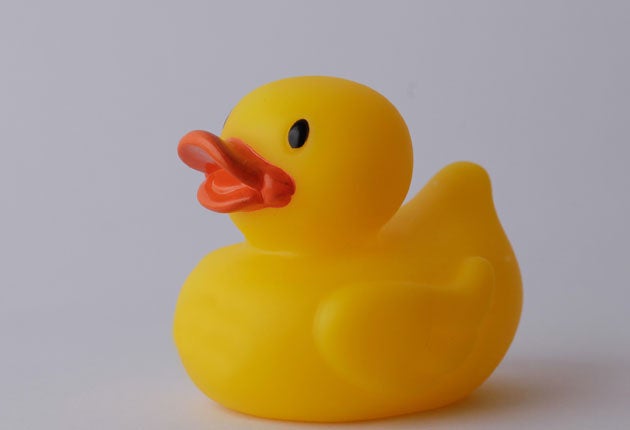
They are small, yellow and designed to endure nothing more stressful than a quick journey around a bathtub. But after almost 20 years lost at sea, a flotilla of plastic ducks has been hailed for revolutionising mankind's knowledge of ocean science.
The humble toys are part of a shipment of 29,000 packaged ducks, frogs, turtles and beavers made in China for a US firm called First Years Inc. They were in a crate that fell off the deck of a container ship during a journey across the Pacific from Hong Kong in January 1992.
Since that moment, they have bobbed tens of thousands of miles. Some washed up on the shores of Hawaii and Alaska; others have been stuck in Arctic ice. A few crossed the site near Newfoundland where the Titanic sank, and at least one is believed to have been found on a beach in Scotland.
Now the creatures, nicknamed the "Friendly Floatees" by various broadcasters who have followed their progress over the years, have been immortalised in a book titled Moby-Duck. It not only chronicles their extraordinary odyssey, and what it has taught us about currents, but also lays bare a largely ignored threat to the marine environment: the vast numbers of containers that fall off the world's cargo ships.
No one knows exactly how often containers are lost at sea, due to the secretive nature of the international shipping industry. But Donovan Hohn, the book's author, says that oceanographers put the figure at anything from several hundred to 10,000 a year. While some sink, others burst open, throwing their contents into the upper layer of the ocean where they often pose a threat to wildlife. Plastic debris can be particularly hazardous, since it eventually breaks into small particles, which are eaten by fish and mammals.
"I've heard tales of containers getting lost that are full of those big plastic bags that dry cleaners use," says Mr Hohn. "I've also heard of crates full of cigarettes going overboard, which of course end up having their butts ingested by marine animals. In fact, one of the endnotes in my book lists the contents of a dead whale's belly: it was full of trash. Plastic pollution is a real problem. It's far from the greatest environmental danger to the ocean, but it is one of the most visible, and that means it can be important as a symbol of less visible damage, such as overfishing, agricultural run-off and the warming of the oceans."
The fate of the ducks has been studied by a small but devoted band of enthusiasts since roughly six months after the accident, when the ducks began to wash up in large numbers on the beaches of Alaska, Canada, and America's Pacific north-west.
Curtis Ebbesmeyer, a retired oceanographer and enthusiastic beachcomber who lives in Seattle, used records held by First Years Inc to trace the ship they had been carried on. By interviewing its captain, he was able to locate the exact point at which their journey began. He was able to track their rate of progress on the constantly circulating current, or "gyre", which runs between Japan, south-east Alaska, Kodiak and the Aleutian Islands.
"We always knew that this gyre existed. But until the ducks came along, we didn't know how long it took to complete a circuit," he says. "It was like knowing that a planet is in the solar system but not being able to say how long it takes to orbit. Well, now we know exactly how long it takes: about three years."
Mr Ebbesmeyer estimates that a couple of thousand of the ducks are still in the gyre, and have completed half a dozen circuits. Others went south towards Hawaii or north to the Bering Sea, through which they are thought to have reached Europe. "I have a website that people use to send me pictures of the ducks they find on beaches all over the world," he says. "I'm able to tell quickly if they are from this batch. I've had one from the UK which I believe is genuine. A photograph of it was sent to me by a woman judge in Scotland."
Understanding the 11 major gyres that move water around the world's oceans is thought to be highly important, says Mr Ebbesmeyer, who has also tracked lost shipments of 51,000 Nike shoes. It will help climatologists to predict the effects of climate change on the marine environment.
The fate of the ducks also tells us about the longevity of plastic, he adds. "The ones washing up in Alaska after 19 years are still in pretty good shape."
Join our commenting forum
Join thought-provoking conversations, follow other Independent readers and see their replies
Comments
Bookmark popover
Removed from bookmarks