Magpies reflect on a newly discovered intellectual prowess
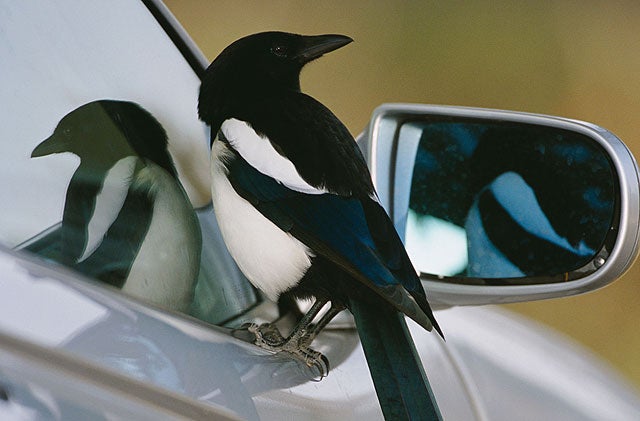
They may have a brain the size of a pea but magpies have been shown to possess the intellectual prowess necessary to recognise themselves in a mirror – a feat that, until now, has only been seen in humans, apes, elephants and dolphins.
Self-recognition is considered to be one of the hallmarks of a highly evolved brain so it has come as a surprise to find that the magpie can see its own reflection for what it is. A study has shown that magpies can recognise themselves in a mirror as well as any chimpanzee, despite being separated from the mammals and their highly developed brain by some 300 million years of evolutionary history.
The findings may come as no surprise to anyone who has watched a magpie's seemingly sly and arrogant behaviour in the garden, where they frequently raid the nests of smaller birds and are infamous "thieves" that steal shiny objects to adorn their own nests.
Helmut Prior, of Goethe University in Frankfurt, said the findings demonstrate that the ability to recognise a reflection as yourself, rather than seeing it as another individual, does not necessarily depend on the sophisticated mammalian brain. "Our findings provide the first evidence of mirror self-recognition in a non-mammalian species," he said. "They suggest that essential components of human self-recognition have evolved independently in different vertebrate classes with a separate evolutionary history."
Dr Prior and colleagues from Ruhr-University Bochum tested the magpie's self-discriminatory powers in experiments involving five magpies marked with coloured dots on their throats, which could only be seen by looking at their own reflection.
Two of the magpies – named Gertie and Goldie – quickly learnt that the image they could see in a mirror placed in their cages was of themselves and tried to dislodge the coloured dots they could see on their throat feathers.
The "mark test" is frequently used as an indicator of self-recognition in animals and young children as, if done properly, there is only one way the individual can see that the mark is on themselves rather than someone else.
"A crucial step in the emergence of self-recognition is the understanding that one's own mirror reflection does not represent another individual but oneself," said Dr Prior, whose study is published in the online journal Public Library of Science (PLos) Biology. "Mirror self-recognition has been shown in apes and, recently, in dolphins and elephants ... Using the mark test we obtained evidence for mirror self-recognition in the European magpie, Pica pica. This finding shows that elaborate cognitive skills arose independently in corvids [the crow family] and primates, taxonomic groups with an evolutionary history that diverged about 300 million years ago."
Other scientists have already shown that some crows show exceptional intellectual skills, such as using and making simple tools that are used for food foraging.
The relative intelligence of magpies has traditionally presented a problem to gamekeepers and conservationists seeking to control their numbers. Their wariness makes them difficult to shoot, so the most widely used form of population control is a larsen trap, which is baited with a magpie from outside a bird's normal social circle. Dr Prior added: "In addition to showing social understanding during competition for food, magpies are curious and prone to approach new situations, making them ideally suited for an experiment that requires spontaneous interaction with a new and puzzling context."
Join our commenting forum
Join thought-provoking conversations, follow other Independent readers and see their replies
Comments