Maori legend of man-eating bird is true
Creature that features in New Zealand folklore really existed, scientists say
A Maori legend about a giant, man-eating bird has been confirmed by scientists. Te Hokioi was a huge black-and-white predator with a red crest and yellow-green tinged wingtips, in an account given to Sir George Gray, an early governor of New Zealand. It was said to be named after its cry and to have "raced the hawk to the heavens". Scientists now think the stories handed down by word of mouth and depicted in rock drawings refer to Haast's eagle, a raptor that became extinct just 500 years ago, shows their study in The Journal of Vertebrate Paleontology.
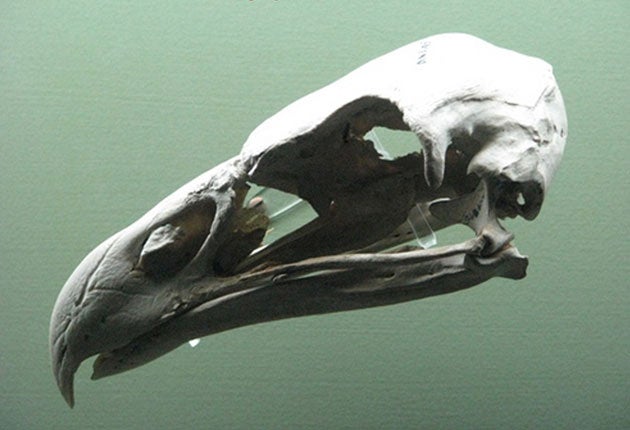
Haast's eagle (Harpagornis moorei) was discovered in swamp deposits by Sir Julius von Haast in the 1870s. But it was at first thought to be a scavenger because its bill was similar to a vulture's with hoods over its nostrils to stop flesh blocking its air passages as it rooted around inside carcasses.
But a re-examination of skeletons using modern technology, including CAT scans, by researchers at Canterbury Museum in Christchurch and the University of New South Wales in Australia showed it had a strong enough pelvis to support a killing blow as it dived at speeds of up to 80kph.
With a wingspan of up to three metres and weighing 18kg, the female was twice as big as the largest living eagle, the Steller's sea eagle. And the bird's talons were as big as a tiger's claws. "It was certainly capable of swooping down and taking a child," said Paul Scofield, the curator of vertebrate zoology at the Canterbury Museum. "They had the ability to not only strike with their talons but to close the talons and put them through quite solid objects such as a pelvis. It was designed as a killing machine."
Its main prey would have been moa, flightless birds which grew to as much as 250kg and 2.5 metres tall. "In some fossil sites, moa bones have been found with signs of eagle predation," Dr Scofield said.
New Zealand has no native land mammals because it became isolated from other continents in the Cretaceous, more than 65 million years ago. As a result, birds filled niches usually populated by large mammals such as deer and cattle. "Haast's eagle wasn't just the equivalent of a giant predatory bird," said Dr Scofield. "It was the equivalent of a lion." The eagle is thought to have died out after the arrival, 1,000 years ago, of humans, who exterminated the giant moa. The latest study shows it was a recent immigrant to the islands, related to the little eagle (Aquila morphnoides) an Australian bird weighing less than 1kg.
Remains of Haast's eagles are rare because there never were many. They lived only on New Zealand's South Island, with probably not more than 1,000 breeding pairs at any one time.
Join our commenting forum
Join thought-provoking conversations, follow other Independent readers and see their replies
Comments