Mystery of the vanishing sparrows still baffles scientists 10 years on
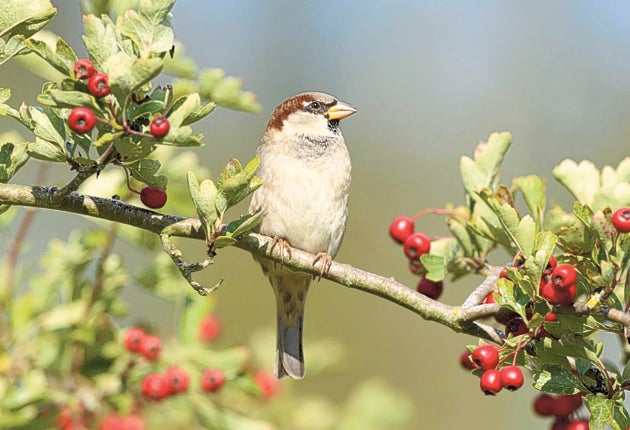
The greenfinch may be declining because of a parasitic disease, but nobody knows – still – the reason for the decline of the house sparrow.
It was once our most common and familiar bird. Now, in many places, it has vanished. Yet, more than 10 years after The Independent offered a prize of £5,000 for a proper scientific explanation of the house sparrow's widespread disappearance from many of our towns and cities, London above all, its vanishing remains one of the great environmental mysteries.
Yesterday, for example, there were no sparrows visible in London's Trafalgar Square, whereas 25 years ago the major tourist destination scattered with sandwich crumbs was full of them – as similar sites in major cities around the world are full of them still.
In the 1990s London's house sparrows entered a sudden and sharp decline until, by the turn of the century, they had virtually disappeared from the capital – the last pair of sparrows in St James's Park, packed with other birds, nested in 1998.
When this newspaper launched its "Save The Sparrow" campaign on 16 May 2000, it made international headlines. The fact that the cheeky "Cockney sparrer", the street smart urban survivor par excellence, was no longer surviving in urban habitats, caught people's imagination, not least because their disappearance may resemble the miner's canary – a warning of some unknown and wider danger. If something in the urban environment was devastating sparrows, what was it doing to us?
However, we did not succeed immediately in drawing out definitive explanations. Suggestions for the reason behind the decline ranged from the increase in suburban predators such as magpies, sparrowhawks and cats to the trend in "tidying up" houses and gardens leaving fewer nesting spaces. Disease, mobile phone radiation and insect decline were also posited.
It was not until 2008 that we had a serious entry for the prize, for which the rules were fairly stiff – the explanation had to be in a paper published in a peer-reviewed scientific journal, and accepted by our referees, the Royal Society for the Protection of Birds (RSPB), the British Trust for Ornithology, and the world expert on sparrows, Dr Denis Summers-Smith.
The 2008 entry was based in the work of a young postgraduate student, Kate Vincent, whose 2005 PhD thesis at De Montfort University in Leicester showed that sparrow chicks in some places were dying of starvation in their nests because of the lack of suitable insect food, such as aphids.
Her data, analysed intensively by senior ornithologists led by Dr Will Peach of the RSPB, formed the basis of a paper in the journal Animal Conservation which was submitted for the prize. But of our three referees, one thought it merited the award, one thought it did not, and one thought it merited half the award. It was certainly a serious contender, but as it was possible that another entry might secure the prize unanimously, we felt the award should be held back.
The other entry, submitted earlier this year from Christopher Bell, an independent scientific researcher, and other scientists, was published as a paper in the online version of Auk, the journal of the American Ornithologists' Union, and suggested that the cause of the decline was predation by sparrowhawks. It was rejected by all three referees.
In March, Dr Summers-Smith circulated a note to researchers interested in the sparrow's disappearance, summarising all the theories and suggestions of the last 10 years. His own view is that insect decline, leading to chick mortality, is "a primary factor" but as he says himself: "It is a necessary, but not a sufficient condition."
He feels that other factors must be involved, and that the insect decline has not been properly explained (his own belief is atmospheric pollution).
The most puzzling aspect of the affair remains the suddenness of the decline in the 1990s, when London's sparrow population fell off a cliff. What can have caused it? The introduction of lead-free petrol (containing other harmful chemicals)? The introduction of mobile phones? That does not explain why house sparrows are still numerous, for example, in New York and Washington.
You tell us. The prize remains to be claimed.
Join our commenting forum
Join thought-provoking conversations, follow other Independent readers and see their replies
Comments
Bookmark popover
Removed from bookmarks