Nature Studies by Michael McCarthy: Exhausted, deforested landscapes show the truth about over-population
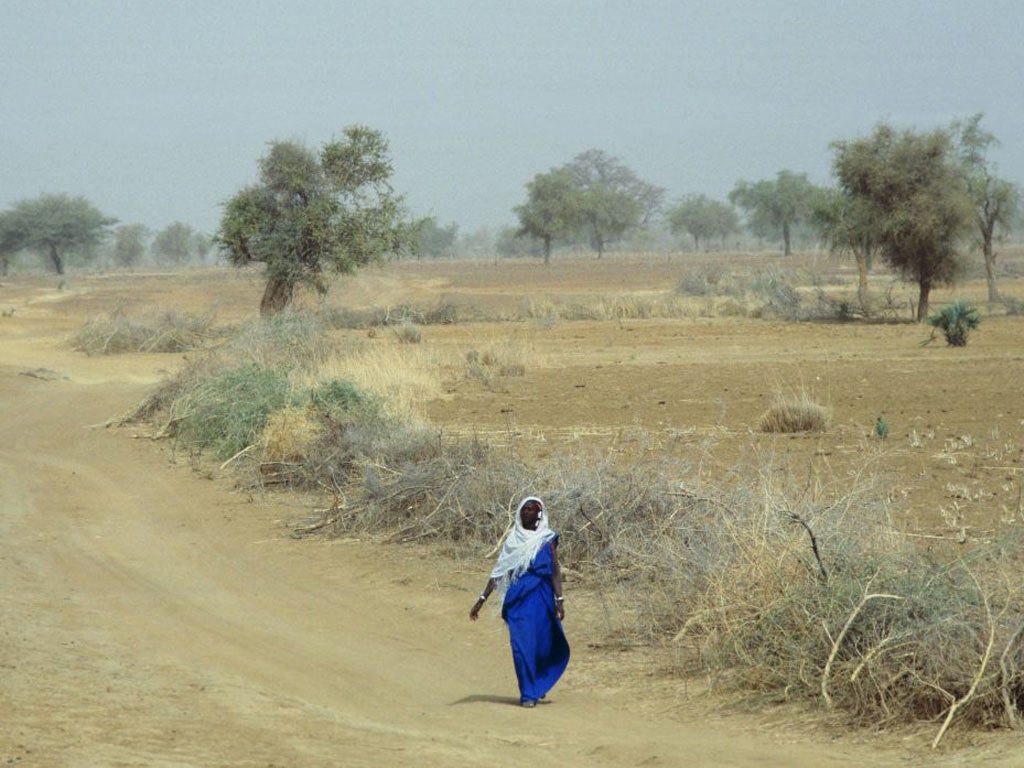
I imagine most people would be hard put to place Burkina Faso on a map; it neatly fits that cliché of a faraway country of which we know nothing.
It is a landlocked state in West Africa, a bit bigger than Britain, once a French colony; it used to be called Upper Volta. Burkina is in the Sahel, that semi-arid belt of savannahs, grasslands and dry forest which runs across Africa below the Sahara, the transitional zone between the desert to the north and the rainforest to the south.
There is a peculiarity about its economy, which is noticeable if you visit, as I did a few years ago: more than 90 per cent of its energy needs are supplied by wood. The vast majority of the people rely on wood fires to cook the daily meal of millet, and carts stacked high with firewood throng the roads leading to the capital, Ougadougou. They really do. Cart after cart.
This wood is gathered from the countryside, from the dry forest which covers it – or used to. For it has been so overexploited that much of Burkina is now a deforested wasteland, a dusty wrecked moonscape as shocking as anything in the Amazon – it simply hasn't been publicised. In the villages I visited, the women who go out at dawn to gather wood were having to go further every year, four kilometres, then five, then six, as the area around each village became exhausted.
These people were visibly, and tragically, trashing their own natural resource base: not only was the forest gone, the soil itself was disappearing. Who could blame them? It was done out of need. They were only trying to survive. But they were consuming their own future. Many were aware of this, of course, and their attempts at reforestation – struggles might be a better word – were moving and inspiring, and I reported on them. But one specific factor means that these struggles will get much harder – population increase.
When I visited Burkina in 2003, its population was just under 13 million. Now it is closer to 17 million. By 2015, it will have doubled – in just 20 years – to about 20 million. (You can find all these figures in the UN's 2010 Revision of World Population Prospects). Then it really takes off. By 2050, according to the UN's central estimate, it will be 46.7 million. If you want to be optimistic, their low variant gives 41.8 million; if pessimistic, the high variant gives you 51.8 million. That's in less than 40 years.
Where on earth, where in God's name, are all these people going to find their firewood in a countryside that will have long since been devastated? You may say, electricity supply will have replaced firewood as the main energy source, and perhaps it will; but the demand on the exhausted landscape for crops or livestock or whatever you care to name, from a population three times the size of the one that had already largely wrecked it, will be unbearable. The Burkinabé, the people of Burkina, will not be able to support themselves; their future is misery.
Last week the population of the world passed 7 billion, on the way to a possible 9.3 billion by 2050; and I read liberal commentator after liberal commentator insist how this wouldn't be any sort of a problem, nay, it was to be welcomed. I read with a growing sense of disbelief, but in the end I simply resigned myself to human folly, and shook my head.
We’re not really feeling the heat here
One of the things that make the future of a country such as Burkina Faso even more problematic is that the stresses that will come with a tripling of its population in 40 years may well be severely exacerbated by climate change.
It is quite natural, and to be expected, that global warming should have tumbled down the list of public and political concerns with the onset of the recession and especially the current global financial crisis.
But although many of us may have forgotten about it, the gigantic volumes of carbon dioxide we are adding to the planet's atmosphere (currently 30 billion tons annually) continue to increase and will continue to raise world temperatures remorselessly.
Anyone who knows the Sahel knows that subsistence agriculture there is often poised on the edge of failure; a major rise in temperature may be enough to tip it over completely. In such a case, would the people of Burkina Faso try to migrate, to, say, neighbouring Ghana? And would the Ghanaians let them in? There are worse things on the horizon than the future of the euro.
Join our commenting forum
Join thought-provoking conversations, follow other Independent readers and see their replies
Comments
Bookmark popover
Removed from bookmarks