Nature Studies by Michael McCarthy: If your wish is for the wild, St Kilda will fulfil it
It is the remotest part of the British Isles, 40 miles into the Atlantic
Why are so many people drawn to wildness, and wild places? Is it some inner dissatisfaction with our own nature as humans, some unspoken, hardly acknowledged guilt that there is a dark side to us as a species, and that what we touch rarely turns to gold? For by wild, we tend to mean places unhandled by us, free from our malign influence, and the less touched they are, the wilder we perceive them to be and the more we admire them; few now share the credo of classical gardeners that nature is there to be improved upon.
But what is it that we are looking for, in the shrinking number of wild places, if and when we can find them? Unspoiled beauty, certainly, and the bliss of solitude, and peace; but I have a sense that there is something more, a hunger or a longing, and perhaps that is to do with the quite astonishing fecundity of the natural world in its natural – that is, pre-human – state: the Garden of Eden, teeming with life, from which we were cast out.
Eden's a powerful fable. But as a myth it's only a few thousand years old, and I think the longing for nature in its pristine state is much older. Remember, we have been computer operators for a single generation, and workers in offices for about three; but we were farmers for 400 generations, and before that we were hunter-gatherers for perhaps 20,000.
In the course of all those millennia, where we lived as one with the natural world, so much about it seems to have infused itself into our genes, from our liking for panoramic views to our fear of snakes; maybe, deep in our tissues, there is a memory too of a world where life was abounding, with great herds of animals roaming the plains and endless shoals of fishes crowding the seas, most of which, of course, we have destroyed.
There are not many places where you can get a sense of this, in Britain at least, but one of them, I found three weeks ago visiting with my children, is St Kilda, the remotest part of the British Isles, the small archipelago of four islands more than 40 miles out into the Atlantic from the Hebrides.
Despite its isolation. St Kilda was occupied for centuries by a community of about 100 who lived mainly on seabirds, gannets, fulmars and puffins, which they harvested by scaling the precipitous sea cliffs. It was always a tough life and in the early part of the 20th century, as the attractions of modern living began to draw the community's young people away, it got too tough; in 1930, the remaining 36 inhabitants asked to be taken off, and were resettled in mainland Scotland.
The melancholy of this story has captured imaginations ever since and is a principal reason why people return to see the remains of the settlement at Village Bay on Hirta, the largest island, with its "main street" of abandoned houses now lovingly looked after by the National Trust for Scotland; to gaze on the relics of the village on the edge of the world.
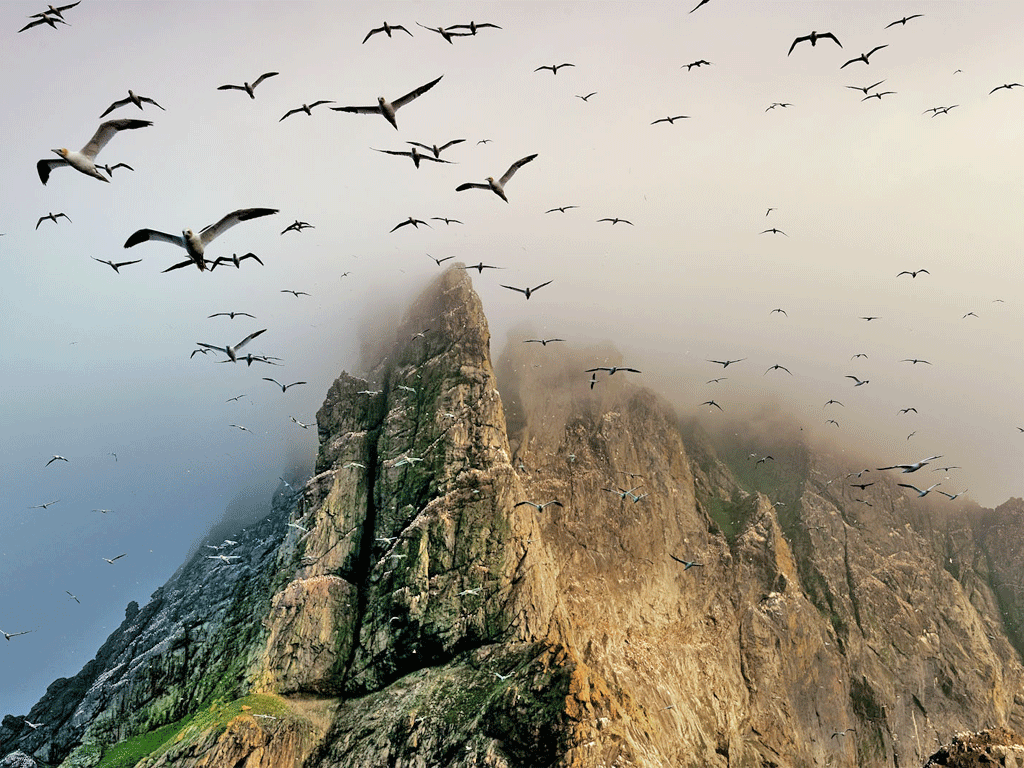
But there is another reason to go to St Kilda, and that is its wildness, for despite the remnants of its community, despite even the small military base, it is a place which in essence feels untouched. You sense that, sailing around all the islands, Hirta, Dun and Soay, astonishingly green in their deep blue sea, but most of all at Boreray, four miles out, home to the biggest gannet colony in the world: perhaps 100,000 of the great white birds are in the air above you, jostling, calling, diving, being harassed by skuas, while below there are cliffs full of guillemots and razorbills and rafts of puffins on the water.
Here is the profusion of life that our distant ancestors knew, the natural abundance of which we maybe still have a memory, which calls to us, insistent, over the millennia. Going to St Kilda feels more than a journey, it feels like a pilgrimage, especially if, in your wish for wild places, you are searching for something, as all pilgrims are; for if your longing is for the world before we altered it, this is where it will be fulfilled.
Join our commenting forum
Join thought-provoking conversations, follow other Independent readers and see their replies
Comments
Bookmark popover
Removed from bookmarks