Navy exercises blamed over dead dolphins
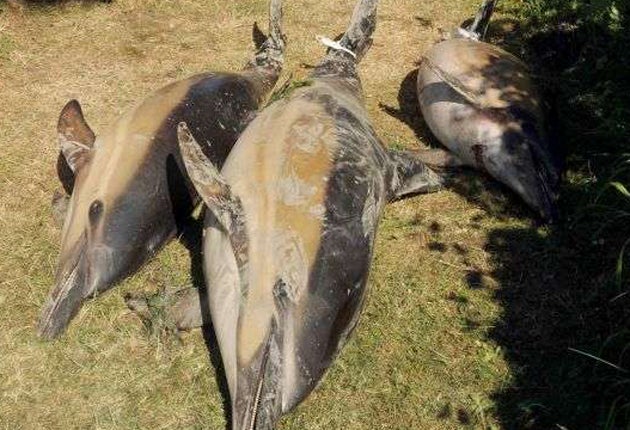
Naval exercises could have contributed to the mass stranding of 26 dolphins on the Cornish coast a year ago, a scientific report found today.
The pod of dolphins beached themselves at four separate locations around the Percuil river near Falmouth in June last year after Navy exercises in the area involving surface ships and a submarine.
At the time, rescuers said they believed the worst mass stranding of the marine mammals in UK waters was the result of the dolphins being panicked by an underwater disturbance.
According to the today's study led by Zoological Society of London (ZSL) researchers, sonar used in the exercises was "highly unlikely" to have directly caused the dolphins to beach themselves.
But the activities of the Navy could have been a contributing factor in pushing the marine mammals close to shore and put them at risk of beaching.
Dr Paul Jepson, of ZSL, said: "We don't have definitive information but we've ruled out everything else, and it's possible that something in the naval exercises caused the mass stranding."
The study said a definite cause for the stranding could not be found, although the dolphins could have reacted to a "trigger" event or suffered an "intrinsic error of navigation".
The research said the common dolphins were unusually close to shore and at a greater risk of beaching themselves - possibly because they were in unfamiliar waters.
Naval activities such as the use of sonar for anti-submarine training could have been a factor in the dolphins, which are sensitive to underwater sounds, coming closer to shore.
Natural behaviour such as foraging for food could also have played a part.
The ZSL researchers said information supplied by the Ministry of Defence (MoD) under the Freedom of Information Act showed several days of "mid-frequency sonars for anti-submarine warfare training" ended some 60 hours before the stranding.
A "short-range side-scan sonar" for sea-bed mapping trials was used by the Navy the day before the dolphins beached themselves, but the technology is common and has not been implicated in strandings, the study said.
As a result the use of underwater sonar in the Navy exercises was "highly unlikely to have directly triggered the mass stranding event", but the researchers believe other parts of the exercises could be to blame.
The study also ruled out other potential causes including disease, poisoning, attacks by killer whales or bottlenose dolphins and even earthquakes as the reason for the mass stranding - only the fourth recorded in England since 1913.
In the wake of the report, the Whale and Dolphin Conservation Society said it believed that as all other potential causes had been ruled out, the military was to blame of the strandings.
Sarah Dolman, ocean noise campaigner for WDCS, said: "The post-mortem results have shown us that those dolphins that died were healthy animals prior to stranding.
"Something frightened them ashore, way up inside the river system, where this species in not generally known to go.
"The unusual behavioural response of all these groups of otherwise healthy animals was triggered by something.
"An 'error of navigation' would not lead this many dolphins to strand, and other groups to behave in such an unusual manner, on the same morning - but over a distance of 20km."
She called on the Ministry of Defence to conduct transparent environmental assessments of its exercises to see what effect they were having on marine life, and to suspend use of sonar once a stranding occurs until rescued animals are out of danger.
The mass beaching in Cornwall was one of two unusual stranding events of cetaceans - the group of marine mammals including whales, dolphins and porpoises - last year.
No cause could be found for the other event, in which a number of long-finned pilot whales and various species of beaked whale were found stranded in Scotland, Wales and Ireland over a three-month period at the beginning of 2008.
The annual report for 2008 from the UK Cetacean Stranding Investigation Programme, also published today, revealed the number of dead and stranded whales, dolphins and porpoises increased by 6.2% on the previous year.
Some 583 cetaceans were reported to the programme, of which 485 were found stranded and dead, 81 were live strandings and 17 were found dead at sea.
The most common species reported were harbour porpoises which were mainly found to have died of starvation, disease, attacks by bottlenose dolphins or as a result of being accidentally caught by fishermen, and short-beaked common dolphins, which mostly died as a result of stranding themselves live, the report revealed.
Join our commenting forum
Join thought-provoking conversations, follow other Independent readers and see their replies
Comments
Bookmark popover
Removed from bookmarks