New pesticide link to sudden decline in bee population
US study says nerve agent causes Colony Collapse Disorder
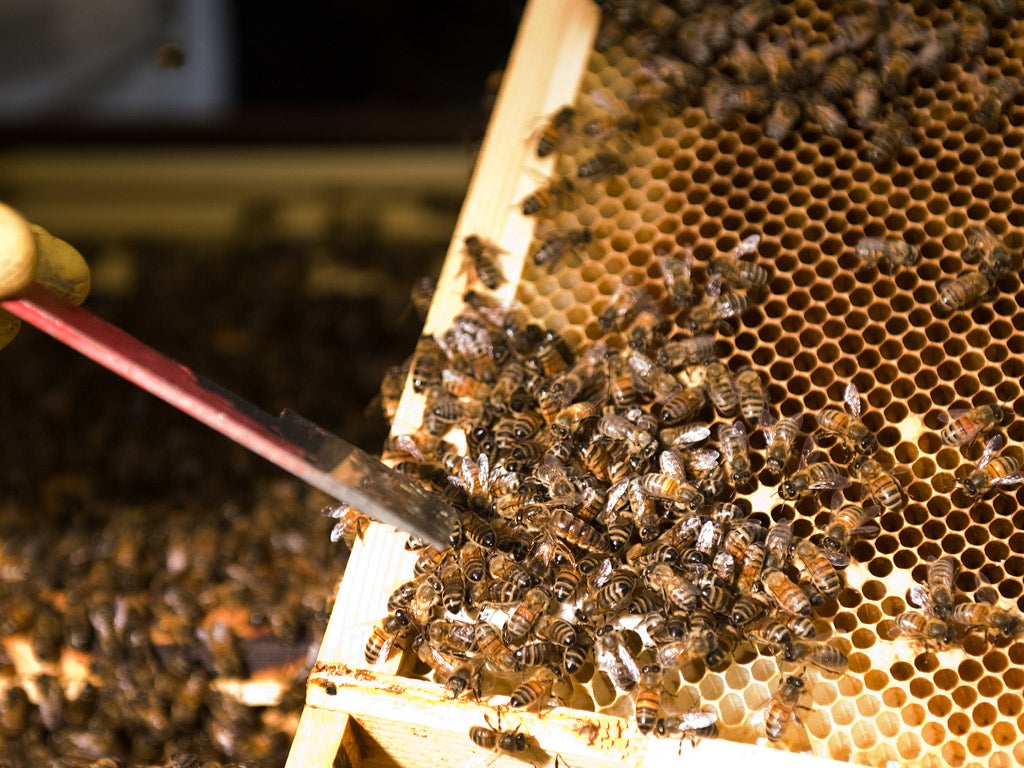
A commonly used nerve-agent pesticide is the likely culprit in sharp worldwide declines in honey bee colonies in the last five years, a scientific study claimed yesterday.
Imidacloprid, one of the neonicotinoid family of pesticides introduced over the past 15 years, is likely to be responsible for Colony Collapse Disorder (CCD), the recently observed phenomenon in which bees abandon their hives en masse, according to the study by scientists from the Harvard School of Public Health in the United States.
The study, to appear in the June issue of The Bulletin of Insectology, provides "convincing evidence" of the link between imidacloprid and CCD, claim the authors, led by Alex Lu, associate professor of environmental exposure biology in the school's Department of Environmental Health. It follows two other widely publicised studies, from Britain and France, published last week in the journal Science, which strongly suggested that neonicotinoids were linked to the declines in bees and other pollinating insects seen in Europe and the US.
Neonicotinoids, which attack the central nervous system of insects, are considered by some scientists as dangerous to species which are not the compounds' principal targets, because they are "systemic" – meaning they do not just sit on the surface of a plant but are taken up into every part of it, including the pollen and nectar, where they can be ingested repeatedly by bees and other pollinating insects.
Imidacloprid, manufactured by the German agrochemicals giant Bayer, was one of the first neonicotinoids to be introduced and has since been used on millions of acres of crops, especially in the US. The compound was Bayer's top-selling insecticide in 2009, earning the company £510m.
The Harvard researchers dosed bees with imidacloprid at levels "determined to reflect imidacloprid residues reported in the environment previously", they said. They found that at the end of the research period, the hives had been abandoned.
The Green MP, Caroline Lucas, said yesterday: "This research from Harvard, together with the two recently published studies from Britain and France, clearly exposing the risk to bee colonies from neonicotinoid insecticides, should be a deafening wake-up call for the Government."
She has written to the Environment Secretary, Caroline Spelman, "to demand an immediate ban on both lethal and non lethal doses of neonicotinoids". No one from Bayer was available to comment yesterday. However, Matt Shardlow, chief executive of Buglife, the invertebrate conservation charity, criticised the Harvard research. "This study is further evidence of the toxicity of neonicotinoids to bees, but the levels of pesticide in the food fed to the bees was higher than would be found in pollen and nectar in treated crops, hence it would be stretching the point to claim that it was strong evidence that neonicotinoids are responsible for Colony Collapse Disorder," he said.
Join our commenting forum
Join thought-provoking conversations, follow other Independent readers and see their replies
Comments
Bookmark popover
Removed from bookmarks