Not so Dumbo: scientists crack elephant code
San Diego study shows animals use low frequencies as a 'secret vocabulary'
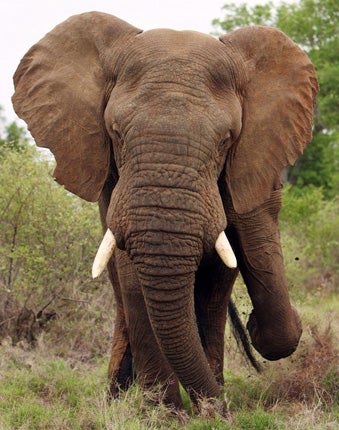
You don't have to sit through Dumbo and The Jungle Book to stumble upon a talking elephant: researchers in the US have discovered that the world's largest land mammals already communicate via a highly advanced "secret" language of their own.
A team from San Diego Zoo spent months monitoring conversations between its resident herd of African elephants. They now believe the animals communicate far more often than was previously thought, and are capable of exchanging relatively complex pieces of information. In addition to their trumpet call, elephants also emit a more subtle growl or rumble. A detailed analysis of that sound has revealed that two-thirds of it is transmitted at frequencies too low to be picked out by the human ear.
"What we have found is essentially a sort of secret vocabulary," said Matt Anderson, who led the project. "It falls very low in the sound spectrum. We have been able to capture and start to analyse it in detail and what it shows us is potentially very exciting.
"Researchers have always thought that elephants were able to exchange a few simple words, but by looking at the structure of these rumbles we're now finding that their vocabulary is actually much larger and more complex than people previously realised."
Dr Anderson, the zoo's acting head of behavioural biology, made the discovery after fitting eight of the elephants at its 1,800-acre safari park, in the hills east of San Diego, with leather collars that track movements via GPS and record all the sounds exchanged between them. By analysing every "conversation" during a 24-hour period each week for 10 weeks, he was able to establish that female elephants are more prone to enjoying chit-chat than male counterparts. A creature's ranking in the herd also tends to play a role in how noisy they are.
Previously, it was thought that females (who, unlike males, always tend to live in herds) only exchanged the growls to attract a mate from a relatively long distance away. But Dr Anderson now believes they conduct regular low-frequency conversations within close proximity of each other.
Sometimes, the exchanges are used to establish a pecking order. At other times, they appear to have been designed to help the herd to organise itself for important life events. When an elephant is getting ready to give birth, for example, Dr Anderson has discovered that she uses the low part of her growl to let companions know the arrival is imminent. The others then form a protective circle around her to ward off predators. "A pregnant female, in the last few days of a gestation period of up to two-and-a-half years, is manipulating that rumble," he said. "They react by changing their position and standing in a circle, all facing out. In a wild setting, where a calf can potentially be taken by predators, it will be in the middle of that circle and protected."
Although some elephant noises have previously been recorded, this is one of the first projects where their low-frequency sounds have been meticulously compared to their behaviour.
Trunk calls: Elephant language
*Elephants growl, sometimes over great distances at pitches undetectable to humans, to soothe or chide their young, locate mates, to keep contact with family members, or in playfights
*Roaring is less common but more intense than a growl, denoting the perception of a threat
*Anger isn't the only emotion indicated by trumpeting: as well as in response to surprise or imminent danger, a trumpet can be a greeting when two elephants are reunited
*From a baby a shriek may only mean distress; in an adult it signals pain
Join our commenting forum
Join thought-provoking conversations, follow other Independent readers and see their replies
Comments
Bookmark popover
Removed from bookmarks