Portuguese Men o'War invade Med for first time in a decade
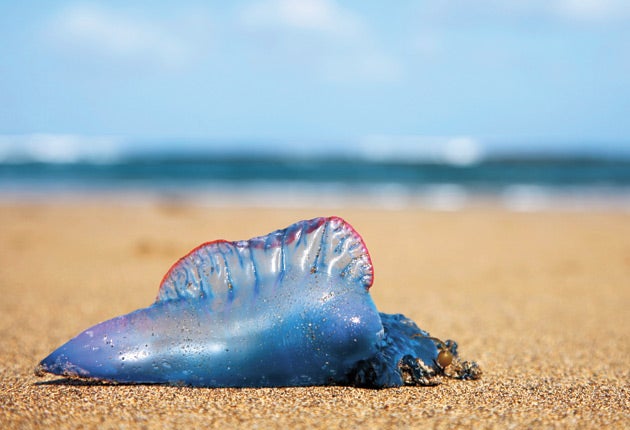
Anyone planning to take a Mediterranean holiday in defiance of the plunging pound may be stung by something more painful than the exchange rate: the killer Portuguese Man o' War, one of the world's most poisonous jellyfish. The graceful glutinous creature, whose trailing tentacles carry a potentially lethal poison, was spotted this week off Spain's favourite beaches for the first time in 10 years.
Swept by westerly winds through the Gibraltar Strait from its north Atlantic habitat, Physalia physalis is set to colonise the Med and cause more pain to beleaguered holidaymakers.
Clusters of up to 50 Men o' Wars, which are not strictly jellyfish but floating colonies of microscopic hydrozoans, are drifting off the Murcian resort of San Pedro del Pinatar on Spain's Costa Calida. Scientists say they could soon invade waters around the Balearic Islands and advance towards the Catalan coast.
With a sting 10 times stronger than an ordinary jellyfish, it presents a more dangerous threat than the annual jellyfish invasion of beaches in Spain, France, Italy and North Africa.
Men o' War are propelled by currents and winds and if these head inland, the species end up on the coast. Colonies of Portuguese Man o' War resembling a sea of plastic bags have been sighted off the Cabo de Gata, the rugged Andalusian coastline near Almeria, and along the Costa del Sol between Cadiz and Malaga. One was picked up last Sunday from a beach near the Murcian port of Cartagena.
"Climate change is changing the migration patterns of many creatures. If they establish themselves it would be very worrying because they really are very dangerous," says Xavier Pastor, the European director of the Oceana ecological campaigning group.
Even if the creature expires after being washed ashore, its tentacles still retain their poison. The only way to get rid of them is by hauling them from the sea by hand. "The Portuguese Man o' War hasn't been seen in the Mediterranean for a decade, and its appearance off the Spanish coast could herald a process of colonisation, which has happened with other invading species," Mr Pastor said.
Join our commenting forum
Join thought-provoking conversations, follow other Independent readers and see their replies
Comments
Bookmark popover
Removed from bookmarks