Rangers v rebels: fight to save rare gorillas
A bloody battle is raging in Eastern Congo over the illegal charcoal trade that is killing the region's great apes
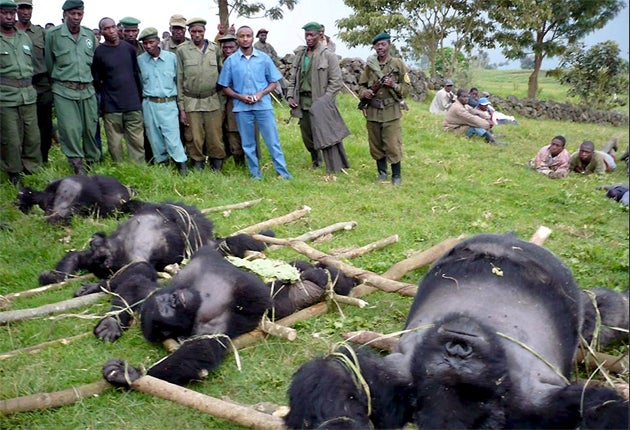
For the past week a remarkable battle has been raging in the mountain forests of Eastern Congo. Park rangers entrusted with protecting some of the world's most endangered gorillas have launched an offensive against the rebel armies in the area and the charcoal industry that helps to support them.
Specially trained wildlife officers, backed by UN troops, have attacked and destroyed hundreds of illegal charcoal kilns deep in the forests of Virunga National Park, in a bid to disrupt the environmentally devastating industry.
The $30m (£17.7m) trade helps fund the myriad armed groups who destabilise this region of the Democratic Republic of Congo (DRC), and its perpetrators are unlikely to accept the counterattack. Speaking from his mountain base in Rumangabo, the park's director, Emmanuel de Merode, said his men were "braced for a violent reaction" to their strike.
Virunga, Africa's oldest national park, lies across the mountain chain that straddles the border between DRC, Rwanda and Uganda. It is home to the most important remaining population of mountain gorillas.
But the 7,800 sq km reserve is also surrounded by as many as one million people, who have been displaced by the nearly continual civil war that has ravaged North Kivu in the last two decades. The tremendous local demand for cheap fuel for heating and cooking has been exploited by armed groups, and in many cases rogue elements from the Congolese national army, who have profited from a protection racket that has shielded illegal loggers and charcoal kilns from the law.
The lucrative trade has pitted armed rebels against the 200 gorillas and their protectors in a battle for the forest, with often murderous consequences. In June and July of 2007, seven gorillas were slaughtered and the shocking pictures of a dead 500-pound silverback, named Senkwekwe, being carried on poles by grieving villagers sparked a global outcry.
The killings were traced back to the corrupt circle protecting the charcoal trade, which produces 120,000 sacks of charred forest wood every month. Investigators found that rangers and their associates in the armed militias murdered the animals as a warning to their protectors not to interfere.
In addition to the great ape killings, more than 150 rangers have been murdered in the last 10 years in the five parks of Eastern DRC. The park authorities had been expelled from much of their own reserve for 18 months by one rebel army, the CNDP, until November last year.
Mr de Merode, a former anthropologist, said that it shouldn't be up to park authorities to fight armed militia but the destructive threat of the charcoal trade had left them with little choice. "It's not our job to fight the rebels, that's the army's job," he said. "Our job is to protect the park, but they are in the park and they are destroying it."
The Congolese national army is among the most dysfunctional institution in an already notoriously corrupt country. Last year its weakness was exposed by the rogue general Laurent Nkunda who routed a much larger national army force and briefly threatened to overrun Goma, the most important city in the region. Nkunda's CNDP forces held back and were eventually driven away, but only after assistance from the army in neighbouring Rwanda. Eastern Congo is overrun by dozens of armed groups which the army and Monuc, the UN mission, has failed to neutralise. The rebel groups include the FDLR, made up of remnants of the Rwandan Hutu soldiers who carried out the genocide across the border before fleeing into Congo's vast forests.
The FDLR has been one of the main factions profiting from the charcoal trade and is also blamed for many of the recent atrocities in Eastern Congo. "The illegal exploitation of resources is one of the main factors behind 15 years of civil war and the five million deaths that it has caused," said Mr de Merode.
He said that his rangers' efforts to disrupt the charcoal trade could only play a small part in addressing these problems but that the issue "goes to the heart of instability" in Eastern Congo. However, the Belgian conservationist admitted that to take out a few hundred kilns was only a "drop in the ocean" and further action would be needed.
The offensive comes as efforts to provide alternatives to the seriously impoverished communities that surround the park and live on the fringe of the city of Goma have been accelerated. An EU-backed scheme to set up small-scale village factories producing sustainable briquettes has so far employed 1,800 people in the area.
The programme, run by the Congolese Wildlife Authority (ICCN), has been training locals to use the kit to produce briquettes out of grass, leaves or dung. Officials plan to pull in 1,200 new producers each month, with the aim of getting 18,000 people employed in a new alternative fuel industry by 2011.
Fuelling the conflict: The charcoal trade
Few things illustrate the poverty in which millions of Africans continue to live as clearly as the fact that they cannot afford basic fossil fuels such as kerosene or natural gas for heating and cooking. In the absence of affordable alternatives many countries are locked into a cycle of expanding illegal charcoal use, increased deforestation and collapsing natural resources. The industry, both legal and illegal, is estimated to be worth more than $2bn (£1.2bn) per year across the 26 countries of sub-Saharan Africa. In energy terms charcoal use outstrips electricity, which remains unaffordable to many.*SUDAN Conflict and drought in the arid region of Darfur has seen more and more displaced people chasing fewer natural resources. The competition for scarce trees and the huge unregulated demand for charcoal has contributed seriously to the tensions that underpin clashes in Eastern Sudan.
Chad
The threat of desertification prompted the government to try a charcoal ban earlier this year, which prompted angry protests. The action was taken after 60 per cent of the country's trees were lost to the kilns.
Somalia
One of the neglected causes of the ongoing anarchy is the rampant deforestation in the acacia groves in the south. A highly organised illegal charcoal operation has destroyed the ecosystem in order to feed lucrative fuel exports to the Gulf States.
Democratic Republic of Congo
Profits from the charcoal trade have fuelled instability and funded rebel armies in North and South Kivu. With more than one million people displaced by the fighting authorities cannot afford to stop the trade until a viable alternative fuel can be found.
Join our commenting forum
Join thought-provoking conversations, follow other Independent readers and see their replies
Comments
Bookmark popover
Removed from bookmarks