Riches in the Arctic: the new oil race
New geological surveys show as much as a fifth of the world's undiscovered but exploitable gas and oil reserves lie under the Arctic ice. As the ice melts, the pristine wilderness could become 'the new Houston'. By Michael McCarthy
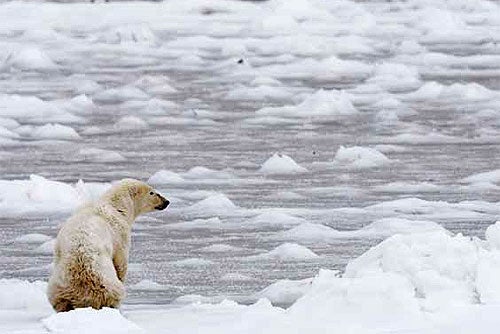
The future of the Arctic will be less white wilderness, more black gold, a new report on oil reserves in the High North has signalled this week. The first-comprehensive assessment of oil and gas resources north of the Arctic Circle, carried out by American geologists, reveals that underneath the ice, the region may contain as much as a fifth of the world's undiscovered yet recoverable oil and natural gas reserves.
This includes 90 billion barrels of oil, enough to supply the world for three years at current consumption rates, or to supply America for 12, and 1,670 trillion cubic feet (tcf) of gas, which is equal to about a third of the world's known gas reserves.
The significance of the report is that it puts firm figures for the first time on the hydrocarbon riches which the five countries surrounding the Arctic – the US, Russia, Canada, Norway and Denmark (through its dependency, Greenland) – have been eyeing up for several years.
It is the increasingly rapid melting of the Arctic sea ice, which last September hit a new record summer low, and of land-based ice on Greenland, which is opening up the possibility of the once frozen wasteland providing a natural resources and minerals bonanza, not to mention a major new transport route – last year the fabled North-West Passage from the Atlantic to the Pacific along the top of Canada was navigable for the first time.
Scientists consider that global warming is responsible for the melting, with the high latitudes of the Arctic warming twice as fast as the rest of the world.
Environmentalists see this as a massive danger, with the melting of Greenland's land-based ice adding to sea-level rise, while the melting of the sea ice uncovers a dark ocean surface that absorbs far more of the sun's heat than the ice did, and thus acts as a "positive feedback" reinforcing warming. The melting of Greenland's ice sheet has accelerated so dramatically that it is triggering earthquakes for the first time, with movements of gigantic pieces of ice creating shockwaves with a magnitude of up to three.
Conservationists are also concerned about the threat to the Arctic's unique ecosystems and wildlife.
The Arctic countries' governments, on the other hand, see it as a massive opportunity, and are already positioning themselves to claim stakes in the seabed of the Arctic Ocean, if – as many climate scientists now believe will happen – it becomes ice-free in summer within a couple of decades.
Just a year ago, to much media fanfare, the Russians planted a flag on the seabed some 2.5 miles beneath the ice at the North Pole, and dispatched a nuclear-powered icebreaker to map a subsea link between the Pole and Siberia, as part of an effort to circumvent a UN convention limiting resource claims beyond 200 miles offshore.
Canada said earlier this month that it plans to counter the Russian overture with "a very strong claim" to Arctic exploration rights.
This week's oil and gas study, carried out by the US Geological Survey, does not raise the national competitive stakes appreciably as it reveals that most of the reserves are lying close to the shore, within the territorial jurisdiction of the countries concerned. Much of the oil is off Alaska; much of the natural gas off the Russian coastline. There appear to be only small reserves under the unclaimed heart of the Arctic.
However, what the report does do is to indicate a very different future for one of the world's last remaining pristine and utterly unspoilt regions. If the oil is there, countries which own it will be very likely to seek to extract it, whatever the environmental cost.
"Before we can make decisions about our future use of oil and gas and related decisions about protecting endangered species, native communities and the health of our planet, we need to know what's out there," said the US Geological Survey's (USGS) director, Mark Myers, in releasing the report. "With this assessment, we're providing the same information to everyone in the world so the global community can make those difficult decisions," he said.
"Most of the Arctic, especially offshore, is essentially unexplored with respect to petroleum," said Donald Gautier, the project chief for the assessment. "The extensive Arctic continental shelves may constitute the geographically largest unexplored prospective area for petroleum remaining on Earth."
The geologists studied maps of subterranean rock formations across the 8.2 million square miles above the Arctic Circle to find areas with characteristics similar to oil and gas finds in other parts of the world. The study also took into account the age, depth and shape of rock formations in judging whether they are likely to contain oil.
More than half of the undiscovered oil resources are estimated to occur in just three geologic provinces: Arctic Alaska (30 billion barrels), the Amerasia Basin (9.7 billion barrels) and the East Greenland Rift Basins (8.9 billion barrels). More than 70 per cent of the undiscovered natural gas is likely to be in three provinces: the West Siberian Basin (651 tcf), the East Barents Basins (318 tcf) and Arctic Alaska (221 tcf), the USGS said. The study took in all areas north of latitude 66.56 degrees north, and included only reserves that could be tapped using existing techniques. Experimental or unconventional prospects such as oil shale, gas hydrates and coal-bed methane were not included in the assessment.
The 90 billion barrels of oil expected to be in the Arctic in total are more than all the known reserves of Nigeria, Kazakhstan and Mexico combined, and could meet current world oil demand of 86.4 million barrels a day for almost three years. But the Arctic's oil is not intended to replace all the supplies in the rest of world. It would last much longer by boosting available supplies and possibly reducing US reliance on imported crude, if America developed the resources.
The report did not include an estimate for how long it might take to bring the reserves to markets, but it would clearly be a substantial period. Offshore fields in the Gulf of Mexico and west Africa can take a decade or longer to begin pumping oil. But clearly, the massive amount of industrial infrastructure necessary to find the oil, extract it, and transport it to where it is wanted will come with a very considerable environmental cost. Senior US oil executives are urging the relaxation of prohibitions against offshore drilling, including much of Alaska, although Democratic leaders in both houses of Congress rejected President George Bush's effort on 14 July to end a 25-year moratorium on drilling in most coastal waters. But change may well be coming now.
Frank O'Donnell, president of the US environmental group Clean Air Watch, said not only do polar bears and other wildlife within the Arctic Circle face losing their habitat due to global warming, they would be hurt by companies searching for oil. "On the one hand you may see this region more accessible [for getting energy supplies], but we're definitely going to pay a different kind of price... you may lose species," Mr O'Donnell said. "The oil industry goes up there and industrialises what has been a pristine area... suddenly it becomes the new Houston."
Staking a claim
United States
The last country to formally stake its claim will be the first to start large-scale drilling. Thanks to its vast Alaskan territory the US will be confident of a huge oil bonanza. The White House resisted giving endangered status to the polar bear as long as it could to keep freedom to drill.
Russia
Dramatically upped the stakes in the race for the Arctic last year by planting its flag on the seabed at the magnetic pole with the help of an experimental submarine. The country least likely to baulk at the environmental cost of drilling in the wilderness.
Greenland (Denmark)
The island is financially dependent on its mother country, Denmark. Oil could change all that. Its tiny population of 50,000 fears being over-run by outsiders in a future oil rush. Denmark was the first to stake its claim to the North Pole.
Canada
Canada was affronted by Danish claims to the North Pole and has conducted military exercises over its vast northern territories to strengthen its claim to the Arctic. Ottawa has sent naval vessels and specialist troops to the far north.
Norway
The country does not want to be left out of an Arctic carve-up. But it backs a UN treaty to demilitarise the region and protect its pristine environment.
Join our commenting forum
Join thought-provoking conversations, follow other Independent readers and see their replies
Comments
Bookmark popover
Removed from bookmarks