Spread of killer fungus threatens British trees
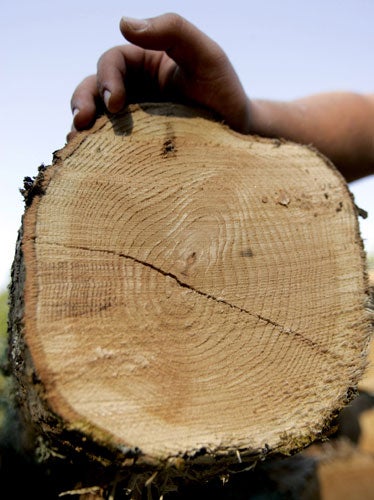
An aggressive new fungus-like plant disease spreading across Britain could destroy millions of garden shrubs, including historic ornamental plants, and transform the rural landscape.
Phytophthora kernoviae, a new plant pathogen from the same family as the mould which caused the Irish potato famine, was discovered in Cornwall in 2003 and is now spreading across the United Kingdom, with 52 cases identified in formal gardens and the countryside in England, Wales and Scotland.
The speed of the spread and the ability of Phytophthora kernoviae to rapidly kill or damage species has alarmed scientists, who say it is showing the capacity to target and destroy specific plants and trees, in particular wild rhododendrons and the European beech.
The organism is a close relative to Phytophthora ramorum, which is also a growing threat to plant life in the United Kingdom and is responsible for Sudden Oak Death – the disease which has devastated the population of American tan oaks in California and Oregon.
The Government has announced an urgent consultation to draw up measures to try to halt the spread, which could include removing rhododendrons and other host species from all woodlands and gardens at risk of the disease. Uprooting and burning infected plants has so far failed to control it.
Jeff Rooker, minister for Farming and Animal Health at the Department for Food, Environment and Rural Affairs (Defra) said: "Despite five years of emergency action, Phytophthora kernoviae and Phytophthora ramorum have continued to spread ... We now know that they have the potential to cause significant harm to businesses and the natural landscape, and we need to decide on a policy for future management."
It was announced this week that Phytophthora kernoviae has reached beyond gardens and woodland for the first time by infecting native Bilberry bushes on heathland in Cornwall.
The National Trust, which has seen 14 of its gardens infected, is creating a living archive of rare shrubs and plants on properties at risk of being destroyed. It called on the Government to provide long-term funding to halt the progress of the pathogens.
The Independent understands work is now being carried out to assess whether the fungus-like organism is reaching a tipping point where it can infect other hosts and go on to cause widespread damage beyond the 15 species it is already known to attack.
Dr Sandra Denman, senior pathologist at Forest Research, the scientific arm of the Forestry Commission, said that although the mould was first discovered in Britain, it does not originate from the UK and therefore presents a particular threat to plant life.
Scientists underline that the extent of the ability of the disease to spread without its key host, the Rhododendron ponticum, an exotic species from Asia introduced to the UK by the Victorians and already blamed for causing widespread damage to native plants by its voracious growth, remains unknown.
A Defra consultation paper published this month made clear that heathland, woodland and other habitats are at risk of an assault that could last decades.
One senior scientist said: "The worst case is that it finds another common host such as a tree species and begins to spread more rapidly."
Join our commenting forum
Join thought-provoking conversations, follow other Independent readers and see their replies
Comments