Spring is back to normal – after 15 freak mild years
The severe winter means that we still have to wait a few weeks for the return of blossoms, buds and wildlife, writes Michael McCarthy
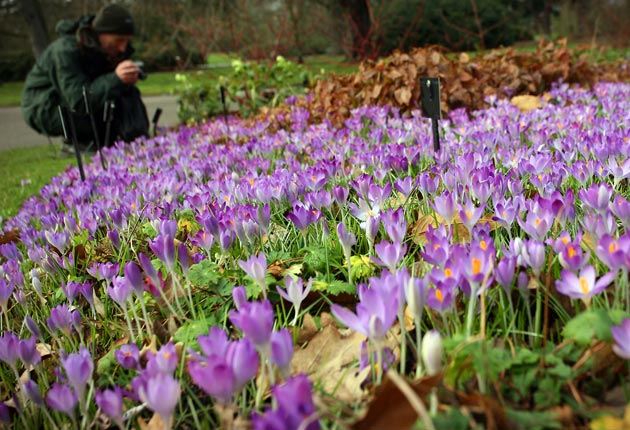
Spring begins today, Monday 1 March, and it is running about three weeks to a month late compared to recent years.
The coldest winter since 1981 has kept the natural world locked up tight, substantially setting back the blossoming of trees and spring flowers, and delaying the emergence of hibernating insects such as bumblebees, and red admiral and peacock butterflies.
Over the last 15 to 20 years, spring has advanced considerably because of the warming climate – according to the Met Office, Britain's average temperature has increased by a full degree centigrade since 1970 – and by mid-February in most years, blossom and spring flowers are in evidence, as well as butterflies on warm days.
But this year the natural world is only just awakening. At the Royal Botanic Gardens, Kew, for example, the million or so Crocus tommasinianus which form a quite spectacular carpet of pale violet began to flower on Friday – whereas they were out in early February last year.
Similarly, Kew's spectacular display of daffodils is not yet in evidence, but this time last year the yellow blooms had been vivid for nearly a month. And Kew's snowdrops, which last year came out in January, made a February emergence in 2010.
The man who looks after Kew's grounds, the head of the arboretum, Tony Kirkham, doesn't see this as a late spring. He sees it as a normal one.
"Over the past 20 years we've got accustomed to it being very early, but this really is a normal year, in terms of the way things used to be," he said.
Mr Kirkham welcomed the freezing winter, as trees and plants shut down completely and "had a good rest", he said. He is also hopeful the freeze will have damaged one of Kew's major insect pests of recent years, the horse-chestnut leaf-miner moth, which came to Britain from eastern Europe and whose caterpillars now turn horse-chestnut leaves brown and dessicated long before the onset of autumn.
Mr Kirkham hopes the cold will have reduced the number of life-cycles the moth can go through in a year and brought down the stress on the trees.
The cold has certainly affected insects, according to Alan Stubbs, the chairman of Buglife, the invertebrate conservation charity. "Normally you might have expected to see some of the bumblebees, and some of the hibernating hoverflies by now, as well as some of the overwintering butterflies, but I haven't seen any of them yet," he said.
"Things that hibernate need to find sources of energy quickly when they come out, but there's nothing for them yet. It's only in the last few days that the worms in my compost heap have become active, but as regards flying harbingers of spring, there haven't been any so far."
Birds are not so quite dependent on the weather for starting their mating season, and some species are pairing up, while the earliest breeders of all, ravens, are already nesting in places such as the Lake Vyrnwy reserve in North Wales.
"Ravens will have laid eggs by now," said a spokesman for the Royal Society for the Protection of Birds, Grahame Madge. "Their early nesting is probably something to do with the fact that they are carrion feeders and there's more carrion around at the end of winter."
Crossbills, which feed on pine cones, are also starting to nest, but it will be another month or so before most songbirds begin their breeding cycle, and a few weeks more for migrants like swallows, cuckoos and nightingales.
The RSPB must wait to see which of Britain's birds will have been hardest hit by the severe winter, especially the snows and ice of early January, which prevented birds from finding food. "Kingfishers are the species which everybody is most worried about," Mr Madge said. "In the hard winters of 1947 and 1963 they went down by 85 per cent." Initial indications from observers were that the population might have been reduced by half, he said. There were also worries about bitterns, the very rare brown relative of the heron, and also about green woodpeckers and goldcrests.
The results of the RSPB's Big Garden Birdwatch survey, which will give a clear indication of what species have lost out most, will not be known for another month.
When does spring start?
*There are two opinions as to when spring starts: the meteorological one and the astronomical one.
The first, used by the Met Office and sanctioned by the World Meteorological Organisation, bases the seasons on the months of the calendar, in three-month blocks. Thus, winter is December, January and February, spring is the months of March, April and May, and so on.
This is now used all over the world so that climate statistics can be easily comparable across the globe.
But there is another, astronomical way of marking the seasons, using day length – with the equinoxes and solstices, those moments in the earth's annual progression around the sun when days are of equal length (the spring and autumn equinoxes), and when they are longest and shortest (the summer and winter solstices).
This year the spring, or vernal equinox, falls on Saturday 20 March, at 5.32pm Greenwich Mean Time.
So if conditions aren't warm enough for you today, or there's not enough blooming or buzzing or billing and cooing going on, you're perfectly at liberty to say spring doesn't really start for another three weeks.
Join our commenting forum
Join thought-provoking conversations, follow other Independent readers and see their replies
Comments
Bookmark popover
Removed from bookmarks