Strawberry farms suck Spain dry
Decades of legal and illegal agricultural exploitation have brought western Europe's most important wetland to crisis point
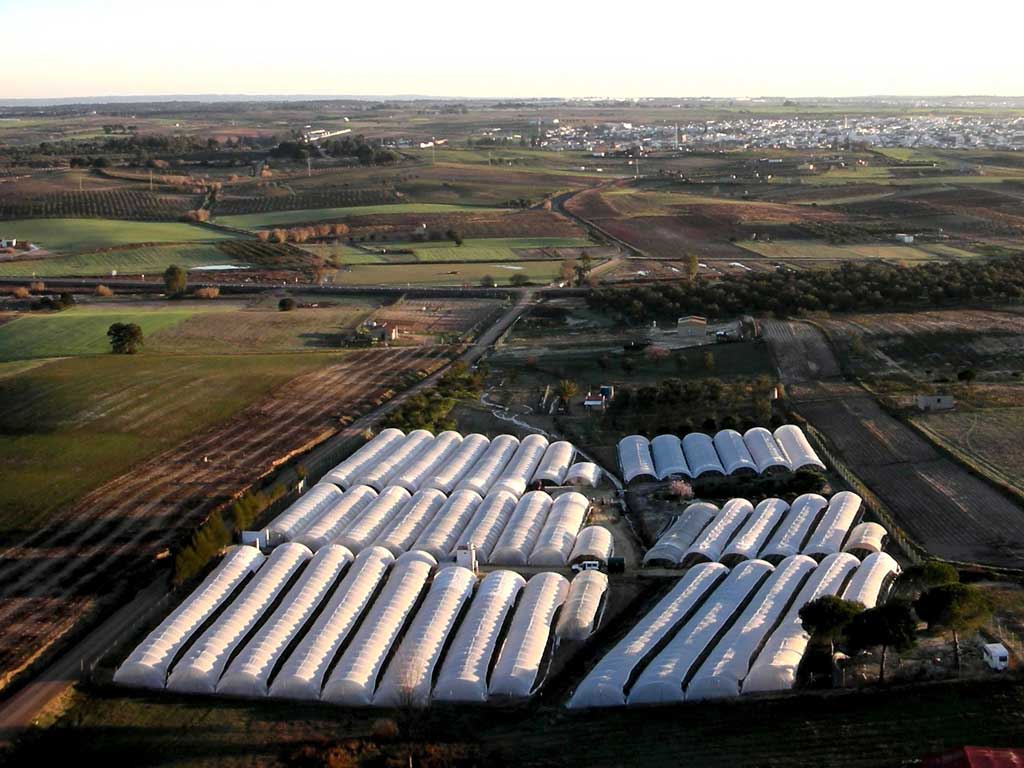
"If the Doñana park were a patient, it would be on the point of entering the intensive care unit," is how Eva Hernandez, the World Wildlife Fund's water expert in Spain, graphically describes the current state of western Europe's most important wetland. And one of the culprits for its critical condition just happens to be that delicious red fruit that comes in punnets and which, as the British rediscover every May or June, goes so very nicely with a dollop of fresh cream.
For decades, local fruit farmers around Doñana – a region that produces 90 per cent of Spain's strawberries and 30 per cent of the EU's total – have used wells, legal or otherwise, on the perimeter of the vast wetland on Spain's south-western coast. But, according to the WWF, farmers themselves estimate that the boom in the past 30 years in strawberry and rice farming has seen the number of illegal wells reach 2,000. These have brought drainage levels of aquifers in the 1,300sq km park desperately close to catastrophe. That some of these now illegal wells were created with public money in the 1970s and '80s, when the local government turned a blind eye to agricultural exploitation in the region, merely adds to the confusion.
"The extraction of water in the area is largely illegal and out of control," Miguel Ferrer, a research professor at Doñana and a representative for Andalusia on CSIC, Spain's biggest research council, says. "The drop in aquifer water levels, by several metres in places, can be noted 30 kilometres to the south of where the water is extracted."
Compared with more than a century ago, the Doñana area has lost roughly 80 per cent of its fresh water supply, Ms Hernandez says, although 60 per cent of the original wetlands have also disappeared over those years. Far more worrying is that the heavily cultivated valley of La Rocina, the principal source of water for Doñana, has lost 50 per cent of its flow in the past 30 years. In the same area, there are now 50 illegal wells and seven dams. Ms Hernandez adds: "We can see changes in the composition of the vegetation which indicate that not enough water is reaching the ecosystems. All it would take to resolve this situation is for everybody to work together but, unfortunately, for the last 15 to 20 years – if not more – there's been no such balanced approach."
Because Doñana is so flat, Mr Ferrer says, its natural vegetation is heavily dependent on narrow bands of earth remaining moist, and any change in water level has exceptionally harsh effects. Particularly affected are "birds that need water for reproduction in the late spring months", such as the marbled teal duck, already under threat of extinction in Spain. Their numbers at Doñana, he says, are dropping.
The WWF first sent out an alert about Doñana's falling water levels in the mid-1990s; it sent out another in a report this spring. Last July, Unesco, too, warned about the excessive drainage of Doñana's water resources by strawberry farmers. But, although some farmers have been heavily fined for water misuse in recent years, the last on-the-ground attempt to close an illegal Doñana well was in 2007. It failed. And a government plan for agriculture in the region has been gathering dust in a filing cabinet somewhere for nearly a year.
Until the 1980s, the fruit plantations were small, family-run affairs, Ms Hernandez says. But at that point "it all went a bit crazy, the farms expanded enormously, and areas of forest were cut down for planting. The only limits on the plantations were the ones the farmers decided on themselves. Some wells were legal, some were illegal, but nobody knew what was going on because there wasn't any control. But we saw that, after an exceptionally rainy 2010, the level of the aquifer was worse than after the drought of 1994."
Ms Hernandez is at pains to point out that there are plenty of farms using legal water. As Innocent Drinks, a British smoothie-making company, has proved, it is possible to get cast-iron guarantees that at least some Doñana-area strawberries are produced without damaging the environment. Innocent's head of sustainability, Jessica Sansom, says: "We work with our Spanish supplier to check the farms' water sources are legal, and we've cut out those that aren't."
But longer-term solutions are also being explored. Innocent has been funding a team of scientists from Cordoba University to see how "fertigation" – the term for the joint process of irrigation and deployment of fertilisers, which are carried through irrigation channels to each plant – can be carried out more efficiently.
The lessons about water management can be applied elsewhere, Mr Ferrer points out: "Given the importance of the park, and the issues about water this raises, any problem in Doñana is really a problem for the whole world."
Wildlife at risk
El Parque Nacional de Doñana is a highly important area of marsh, scrubland, dunes and beaches on Spain's south-west Atlantic coast. Just under the size of Greater London, it is home to hundreds of species, some severely endangered.
Among the 28 mammals are the horseshoe bat, polecat, weasel, small-spotted genet, Andalusian horse, mufflon, monk seal, wild boar, badger, rabbit, Spanish red deer, Egyptian mongoose and Iberian lynx. The wetlands have 17 species of reptile – including snakes, the spiny-footed lizard, spur-thighed tortoise, Lataste's viper and salamander – and nine amphibians, as well as dolphins and at least 20 types of fish.
There are more than 200 Mediterranean and African bird species, migratory and resident, including one of the world's largest colonies of Spanish imperial eagle, with 15 breeding pairs. Other birds include booted and short-toed eagles, black vulture, buzzard, hobby and black, red and black-shouldered kites, purple gallinule, nightjar, pink flamingo, greylag goose, white-headed duck, marbled teal, white-eyed pochard, wigeon, stone curlew and the stork.
Doñana was listed as a Unesco world heritage site in 1994.
Francesca Gosling
Join our commenting forum
Join thought-provoking conversations, follow other Independent readers and see their replies
Comments
Bookmark popover
Removed from bookmarks