Tasmania's rainforest at risk from mining
Green campaigners want the Tarkine Wilderness to be given World Heritage status, but the government isn't listening
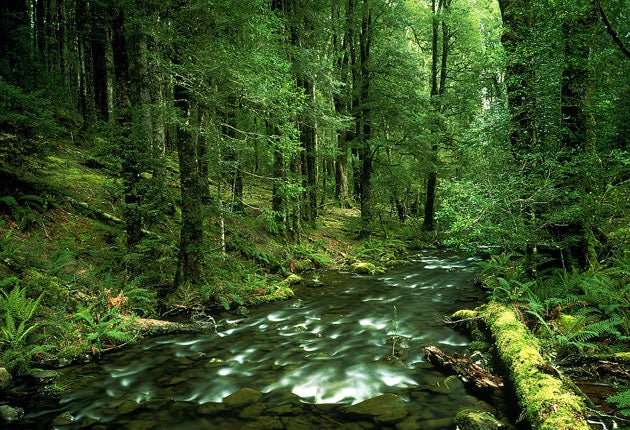
Considered one of Australia's natural wonders, the Tarkine Wilderness in Tasmania contains the southern hemisphere's largest temperate rainforest as well as ancient Aboriginal sites. Home to dozens of endangered species, it also has a unique landscape of karst gorges and cave systems. But that may not be enough to save it.
The Australian Heritage Council has no doubts about its significance – it has recommended that nearly half a million hectares of the Tarkine be listed to protect them from development. That would be a first step towards the World Heritage listing that many experts believe it merits.
The federal government, though, appears unconvinced. Rather than accept the council's advice, the environment minister, Tony Burke, has ordered it to carry out another evaluation. At the same time, he has given a British company, Beacon Hill Resources, permission to drill for magnetite, which is used in farming and pharmaceuticals. Beacon Hill is one of three companies keen to develop open-cut mines in the Tarkine.
Conservation groups are horrified and have accused Mr Burke of interfering in the heritage assessment process. He had refused to release the council's report, and it became public only after it was accidentally posted on a government website.
Christine Milne, the deputy leader of Australia's Greens, fears that by the time the Tarkine has been re-assessed, its natural assets will have been degraded by mining, making a heritage listing less likely. "You can't escape the conclusion that the government didn't like the advice it was given and is stalling in order to give the mining industry a window of opportunity."
Situated in north-western Tasmania, the Tarkine is the latest battleground in a state recognised as the birthplace of the global green movement. Like others of her generation, Senator Milne cut her teeth on a long and ultimately successful campaign in the early 1980s to prevent a huge hydro-electric dam being built along the Franklin River.
In the 30 years since the Franklin victory, the main protest arena has been Tasmania's ancient eucalypt forests, the scene of sometimes violent clashes between activists and loggers. A few months ago, in a stunning climbdown, the forestry industry announced that it will stop cutting down old-growth native trees. Now, though, green groups are worried that the threat has shifted to mining.
Of particular concern in the Tarkine is the risk that mining poses to the critically endangered Tasmanian devil, 70 per cent of which have been wiped out by a contagious facial tumour disease. The isolated rainforest is one of the last refuges for devils with a genetic immunity to the disease, and scientists believe the construction of mine access roads could hasten the animal's extinction.
The Tarkine shelters more than 60 rare, threatened and endangered species, including the Tasmanian wedge-tailed eagle and the giant freshwater lobster, which can grow to 3ft.
The area's magnesite karst systems include cave and pinnacle formations. Regarded as one of the world's great archaeological regions, the Tarkine also has more than 1,000 Aboriginal sites, the legacy of a long occupation by the Tarkiner indigenous people.
Scott Jordan, of the Tarkine National Coalition, an umbrella organisation for conservation groups, says 27 mining companies hold more than 50 exploration licences in the Tarkine, with their interest fuelled by high metal prices. And while Beacon Hill had to meet rigorous environmental standards, "it's open slather for the other companies", Mr Jordan says. "Our fear is that the Tarkine will get hammered."
The coalition has been pressing since 2004 for the Tarkine to be heritage-listed, but evaluation was delayed because of concerns about communities dependent on logging and mining. A state plan to carve a tourist access road through it prompted Mr Burke's predecessor, Peter Garrett, to grant it an emergency listing in 2009. That lapsed last December, and Mr Burke has refused to renew it.
The Tasmanian government wants mining to go ahead, to bring much-needed work to the north-west. Senator Milne says the same arguments were advanced in relation to the Franklin dam – but longer-term jobs were created by protecting the river and obtaining World Heritage listing for the surrounding wilderness area.
To her, the choice is plain. "Really you have to decide whether you're going to protect this precious wild tract of forest for its magnificent biodiversity and the threatened species for which it is a home, or you have to make the decision to put a scratch across the Mona Lisa."
Join our commenting forum
Join thought-provoking conversations, follow other Independent readers and see their replies
Comments
Bookmark popover
Removed from bookmarks