The Big Question: Are shark attacks on the rise, and can anything be done about them?
Why are we asking this now?
There has been a spate of shark attacks on bathers swimming in Sydney, the most recent occurring on Sunday when a 15-year-old boy was badly injured. He became the third shark-attack victim in as many weeks. In one of the previous attacks a navy diver in Sydney harbour lost an arm and a leg after being savaged by a bull shark. The other attack was on a surfer using the city's Bondi Beach whose badly severed hand had to be surgically re-attached. Local fishermen claimed that shark attacks are on the increase, aided by anti-pollution measures that have brought shoals of fish – and their natural predators – closer to shore.
Has there been an increase in shark attacks globally?
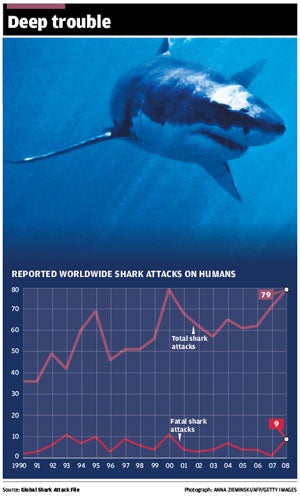
There is very little data to support the idea of a statistically significant increase in shark attacks. The recent instances from Australia get widely reported but there is no obvious trend which suggests that shark attacks are getting more common. In 2001, for instance, there was a wave of media reports about shark attacks around the world – it became known as the "summer of the shark". There did appear to be a cluster of attacks at that time. However, when experts came to examine the figures at the end of 2001, the actual number of shark attacks and deaths for the year were down slightly on previous years.
Why are we hearing more about shark attacks?
It's been a hot summer in Australia and that means a lot more people than normal are going swimming in the sea. The sheer increase in the number of bathers means that there is going to be a greater risk of a shark attack that gets reported in the media. In previous years, it was South Africa's turn to be the focus of attention. The lurid nature of the attacks make for captivating stories, like that of the 77-year-old South African woman who was attacked by a great white shark during one of her regular morning dips. Nothing was left of her but a floating swimming cap.
How many people are attacked by sharks?
Worldwide, between 50 and 100 shark attacks on people get reported each year on average. Less than 10 of these prove to be fatal. Given that there are millions of people who go swimming in the sea each year, the risk of being bitten by a shark – let alone dying from an attack – is incredibly small. Indeed, the risk is equivalent to highly unlikely events such as death from lightning strike, bee stings or being fatally attacked by farmyard animals. In America alone the chances of death from drowning is about 550 times greater than the probability of dying from a shark bite.
What kind of sharks attack people?
There are something approaching 400 species of sharks and only 27 of them have been implicated in, or suspected of, attacking humans. The four most dangerous sharks are the great white (Carcharadon carcharias), the tiger shark (Galeocerdo cuvier), the bull shark (Carcharhinus leucas) and the oceanic whitetip shark (Carcharhinus longimanus). The great white – made infamous by the 1975 film Jaws – is probably more likely to encounter humans in cool, temperate regions off California, South Australia and South Africa. The bull shark is more of a problem in shallow coastal areas and tropical rivers, whereas the tiger is often seen around tropical oceanic islands. The whitetip is a more often found in open, tropical ocean.
Why do sharks attack people?
There is no easy answer to this question. The idea that sharks can become blood-hungry "man-eaters" fixated on human flesh is simplistic and almost certainly wrong. More than 95 per cent of shark attacks involve a single bite, which suggests that they are not the result of the shark engaging in the sustained hunt of a potential item of prey. Wounds are typically open-mouthed slashes or simple "nip-and-release" bites which, although devastating for the attacked person, represent relatively restrained behaviour on the part of the shark.
Some commentators have suggested that sharks often mistake swimming humans for natural prey species, such as seals or sea lions. But experts are not convinced, saying that great whites, for instance, are unlikely to confuse the sleek movements of a fast-diving seal with the surface flapping of a human swimmer. Great whites attack seals with a devastating initial bite that bears little resemblance to the almost gentle nibble they impart on their human victims – albeit leaving horrendous wounds. This has led some shark experts to suggest that an attack by a great white – which senses objects in its environment through its teeth – has more to do with an exploratory gnaw of a novel object rather than an outright assault on an item of food.
What can be done to lessen the risk of attacks?
Experts suggest not to swim or surf alone. Even the presence of a companion might deter a shark from attacking, and a friend would certainly help if you were attacked. Avoid swimming between dusk and dawn, when sharks feed most actively, and avoid swimming in an area where there has recently been a shark attack, or a shark longer than five feet has been seen.
Also, it is advisable to avoid swimming near river mouths after rainfall, as the silt flowing into the sea can attract sharks. Experts also advise swimming with goggles or a mask to see underwater so that you can watch the behaviour of fish and look out for any large sharks. This all applies to swimming in tropical or semi-tropical waters. Swimming in British waters – even on the rare occasions when it is warm enough to do so – poses little or no risk of shark attack.
What should you do if you are attacked by a shark?
In the unlikely event of this happening, it is important not to panic. It might seem easy to say this, but many attacks result in injuries that are readily treated, and it is important to keep a clear head. Do not try to incite a retaliatory strike on the part of the shark. Call for help and get out of the water as soon as you can, stemming the flow of blood by pressing a hand against the wound. Try to keep an eye on the shark to make sure to keep out of its way as best you can. If you survive, sell your story to a newspaper and offer the film rights to Steven Spielberg.
Are sharks really vicious animals that deserve no sympathy?
Their "aggression" is borne out of the evolutionary necessity to survive as one of the ocean's top predators. Most species of sharks are threatened with extinction and they deserve our respect rather than our wrath. They have survived in the oceans for hundreds of millions of years yet never in their long history have they become so suddenly endangered.
When we reel in horror at the latest shark attack, we should spare a thought for a majestically beautiful animal that is likely to disappear if we don't do something about shark fishing, pollution and climate change. For more information on sharks go to www.sharktrust.org .
Are we wrong to demonise the shark?
Yes
*Millions of us swim in the sea – on average fewer than 10 people are killed annually by sharks
*There are around 400 species of shark. Of these a mere 27 have ever been involved in attacks
*The shark is itself an endangered species. Every time it attacks it is fighting for its own survival
No
*Of all possible ways that a wild animal could attack a human, attack by shark is uniquely terrifying
*The water is the shark's element, but not man's. What goes on below will always be a source of fear
*The great white is the most feared shark for a reason. Not much of its victim is left when it attacks
Join our commenting forum
Join thought-provoking conversations, follow other Independent readers and see their replies
Comments
Bookmark popover
Removed from bookmarks