The Big Question: What causes dolphins to swim to a point where they become stranded?
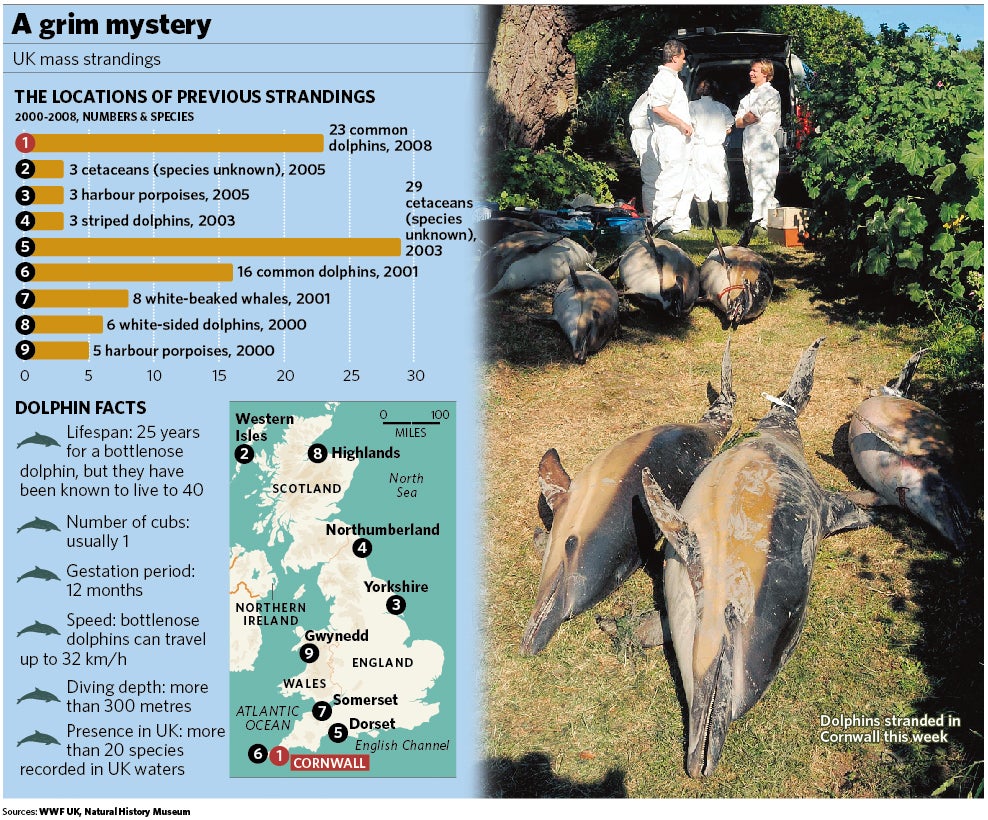
It appears that mass strandings are increasing, or are at least more widely reported
Why are we asking this now?
More than 25 dolphins were found stranded in four different river creeks around St Mawes, on the River Fal estuary in Cornwall, on Monday. A pod of many more dolphins was attracted to the area following the stranding. They were apparently lured there by the distress calls of the others but were successfully led to safety by coastguards. Neil Oliver, a Falmouth coastguard, said: "Initially, one dolphin swam up and got disorientated in shallow water. It put out a distress call and it looks as though the others have followed and thought 'we'll find out what's going on'."
What causes these mass strandings?
Scientists have gone to great efforts in trying to understand mass stranding but there appears to be no single explanation. The species involved in the Falmouth episode is the common dolphin but mass strandings occur in many other species of cetaceans (dolphins, porpoises and whales). Liz Evan-Jones, a zoologist at the Natural History Museum in London, said a mass stranding could occur because of sickness, disorientation of a pod leader, natural mortality, extreme weather or injury. Mass strandings are also thought to result from the use of naval sonar. Another possibility is that the dolphins may simply have been caught by fishermen and thrown overboard either dead, dying or disorientated.
"Whales and dolphins strand themselves for a number of reasons and we are not sure yet what happened with these dolphins. We haven't had a mass stranding in the UK since 29 cetaceans were seen floating in Dorset in March 2003," said Dr Evans-Jones. "Many different types of cetaceans strand themselves. In the past we've recorded harbour porpoises, white-sided dolphins, common dolphins an also whales beached along Cornish coast."
Is this a recent phenomenon?
Strandings have been recorded throughout history. It appears that mass strandings are increasing, or are at least more widely reported, but this may be because of better and faster communications rather than an absolute increase in their number. The Natural History Museum's records show there has been at least one stranding involving 100 or more animals since 1913. Worldwide, mass strandings seem to be becoming more common, but again this may be due to better reporting – or possibly because of the wider use of sonar by navies around the world. The navy confirmed yesterday that it was on exercises in the area.
What is the evidence of the link to sonar?
One the strongest pieces of evidence was published in 2003, when scientists examined 14 beaked whales found beached in the Canaries in an area where a Spanish naval exercise took place in 2002. The scientists found that sonar could induce a condition similar to decompression sickness in the stranded whales.
"The link between military sonar and stranded sea mammals has been established. Our study suggested a potential mechanism," Paul Jepson, of the Institute of Zoology in London, said at the time. Dissolved gases in the blood of the stranded whales appeared to have come out of solution to form tiny bubbles in the liver and other vital organs – leading to the effects of decompression sickness. Until then, it was thought that whales and dolphins could not get the "bends" but the scientists believe this is indeed the case when the animals are forced to come to the surface too quickly, for instance, if they are startled by a loud underwater explosion.
"A small number of stranded animals had gas bubbles and associated tissue injuries," Dr Jepson said. "Although decompression sickness was previously unheard of in marine mammals, we concluded that a form of marine mammal decompression sickness was the most likely cause."
A further study in 2004 lent weight to the idea. Scientists at Woods Hole Oceanographic Institution in Massachusetts found evidence of decompression sickness in the bones of sperm whales. The scientists studied the bones of stranded whales going back 111 years and found the sort of cavities associated with the bends. They concluded that anything which disrupted the slow ascent of the whales to the surface – such as acoustic signals from a submarine – could increase the risk of this sort of tissue damage.
So how do dolphins communicate with each other?
Dolphins uses a wide variety of methods to communicate as a result of being social animals that live in pods or schools of up to a dozen or more individuals. Sometimes several pods merge to form "superpods" of hundreds of dolphins, each communicating with a variety of clicks, whistles and other forms of vocalisation.
It would be wrong to say that dolphins have a language, but they do have a relatively sophisticated form of communication based on underwater sounds. They also use ultrasonic sounds for echo-location which they can use in conjunction with their very good sight to build up an underwater image of an object in semi-darkness.
How intelligent are dolphins?
Dolphins have fairly large brains for their size and, being warm-blooded mammals, they have evolved from animals that once lived a terrestrial existence. They appear to have a innate playfulness and inquisitiveness that makes them appealingly clever. They quickly learn new tricks in captivity. But just how intelligent they are is a moot point.
One study carried out on captive dolphins suggested that they may even have a "theory of mind", like humans, which would enable them to contemplate what another dolphin may be thinking. Even human children take a few years to learn the ability to put themselves mentally in someone else's shoes, which lies at the heart of empathic thinking. But this study, which involved training dolphins to choose something put in front of them, has not been replicated to the satisfaction of many zoologists sceptical that dolphins are able to think in this way.
Nevertheless, dolphins in the wild are surprisingly inventive. River dolphins in Brazil are known to drive shoals of fish towards the embankment where waiting fishermen cast their nets, making it easier for the dolphins to eat what is leftover. Other dolphins have been found to use simple tools in the form of sponges placed on the tip of their snouts, which prevents damage when foraging for food.
They are also caring creatures, often coming to the aid of one another, and even helping to fend off sharks when human swimmers are threatened. One wild dolphin, called Moko, managed to come to the rescue of a stranded pygmy sperm whale and her calf which had become disorientated in shallow waters off a beach in New Zealand. But, as the events over the weekend proved, dolphins can too often themselves become stranded.
Yes...
*Provided that the creatures are not sick or harmed, it is possible to lead them to safety.
*Unlike whales and other large sea mammals, dolphins are small enough to be man-handled.
*Their intelligence works in their favour in terms of finding a way to extricate themselves.
No...
*They are often found too late to prevent them from being seriously harmed.
*Their initial panic is only exacerbated by the stress of being man-handled.
*Without the pod leader, it is very difficult to direct a group of dolphins back out to sea.
Join our commenting forum
Join thought-provoking conversations, follow other Independent readers and see their replies
Comments
Bookmark popover
Removed from bookmarks