To be spotted again: India wants to bring back the cheetah
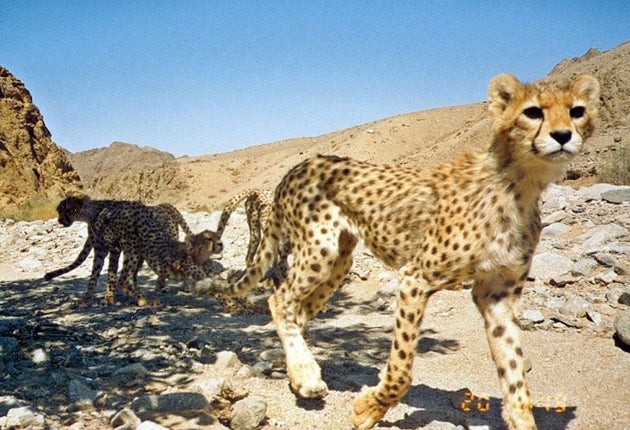
They appear in portraits and carvings and the Mughal Emperor Akbar was said to have kept more than 1,000 for hunting. But the cheetah – prized for its speed and its ability to be trained – has not been seen in India for at least 60 years.
Now the government wants to bring them back. In an ambitious plan to reintroduce an animal whose numbers were reduced to zero by hunting, India's Environment Minister Jairam Ramesh told parliament that plans were under way to identify whether the big cat's return would be possible. "The cheetah is the only animal to have been declared extinct in India in the last 1,000 years," he said this week. "We have to get them from abroad to repopulate the species here."
The plan will involve importing cheetahs from Namibia and trying to establish breeding populations in specially constructed enclosures. If this were successful the animals would be then set free in the wild – putting them alongside the leopard, the tiger and the Asiatic lion, which constitute India's other large cats.
The government's moves follow a proposal made by an NGO, the Wildlife Trust of India (WTI), that has drawn up a detailed plan to reintroduce the sleek, high-speed cat. It has identified several locations which it believes could become suitable habitats. An international conference involving experts from Africa and Europe will be held in September to move the project forward.
"The government has agreed in principle to the reintroduction of the cheetah," said MK Ranjitsinh, the WTI's chairman. He said the problems that the cheetah would confront would be the same as those faced by India's other wild cats – the proximity of humans and the decline in prey species. "We would have to build that up – the deer and the antelope," he added.
The cheetahs that once roamed from Arabia to Iran, Afghanistan and India, are Asiatic cheetahs. The name derives from the Sanskrit word chitraka, meaning "speckled". Yet while it is estimated that at the turn of the 20th century there may have been several thousand in India where they were known as hunting leopards, and were kept to hunt gazelle, the subspecies is today critically endangered with perhaps no more than 60 animals remaining in the wild. This last, tiny population is confined to Iran's Kavir desert with perhaps a few still remaining in south-west Pakistan.
Experts say that unlike the African and Indian elephant, there is little genetic difference between the African and Asiatic cheetahs. "These animals are very close. I think they could probably breed together, the only problem is that there aren't really any Asiatic cheetahs left – just some in Iran," said Stephen O'Brien, head of the US government's Laboratory of Genomic Diversity and author of Tears of the Cheetah: And Other Tales from the Genetic Frontier. "This reintroduction is something they have been talking about for decades. I think it's probably worth a try."
There is little doubt that the battle to reintroduce an animal such as the cheetah would be a tremendous challenge. Already India is fighting what appears to be a losing battle to retain its tiger population. Estimated to number perhaps 100,000 in 1900, the total today may be as few as 1,300. Almost every week there are reports of tigers being killed in India's national parks and reserves, either by poachers or villagers whose homes increasingly encroach on the animal's habitat.
India's population of leopards, meanwhile, may total 14,000, while the Asiatic lion, which once spread as far as the Mediterranean, is confined to the Gir forest in the western state of Gujarat where it numbers around 350. There are plans to reintroduce them to another national park in the state of Madhya Pradesh.
In addition to the problems of habitat and human population confronted by India's other big cat population, the cheetah would also face the issue of lack of genetic diversity. Studies have shown that the gene pool of the world's African cheetah population is unhealthily small, something that has led to low birth rate and high abnormalities. If there were just a small breeding population in India, the problem may be exacerbated.
This would not be the first time India has sought to reintroduce the cheetah. During the first half of the decade, scientists at the Centre for Cellular and Molecular Biology in Hyderabad worked on a plan to collect tissue samples from an Asiatic cheetah in an Iranian zoo and clone the animal. "In the end the Iranians did not give us permission," said the director, Lalji Singh.
It is commonly claimed that the last known three Asiatic cheetahs in India were shot dead in 1947 by the Maharaja of Surguja, the ruler of a princely state in what is now eastern Madhya Pradesh. He also bears the dark honour of holding the record for shooting the most tigers – a total of 1,360. Yet his great-grandson and the current maharajah, Tribhuvaneshwar Saran Singh Deo, questioned whether his ancestor was responsible for the cheetah's demise. While confirming the tally of tigers ("They were very different times," he said) he added that the family had no information that he had ever shot cheetahs.
Ironically, Madhya Pradesh is one of the areas that experts have identified as a location for the possible return of the cheetah.
The fastest thing on four legs
* The cheetah is the fastest land animal, capable of reaching speeds of between 112 and 120kph.
* When closing on its prey it is capable of accelerating from 0 to 110kph in three seconds, faster than most sports cars.
* The body length of an adult cheetah is between 115 and 135cm, of which the tail accounts for up to 84cm.
* An adult cheetah weighs between 40 and 65kg.
Join our commenting forum
Join thought-provoking conversations, follow other Independent readers and see their replies
Comments
Bookmark popover
Removed from bookmarks