Another reason to hope for a warm summer – it's good for Britain's rarest butterflies
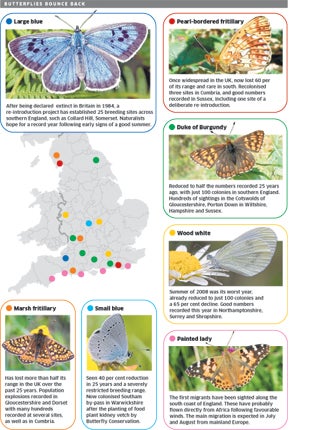
Some of Britain's most endangered butterflies appear to have enjoyed a comeback this year because of the recent spells of dry, warm weather which may have ended the run of three wet summers in a row, scientists said yesterday.
Butterfly experts are cautiously optimistic that if the good weather continues beyond mid-summer, many species might make significant recoveries from the destruction of recent years, when butterfly populations plummeted largely because bad weather added to the long-term pressures of habitat loss and intensive farming.
Martin Warren, the chief executive of the charity Butterfly Conservation, said there were early signs of a striking population explosion for many species of early summer butterfly that have been of the greatest concern to conservationists. The small Duke of Burgundy, for instance, has had one of its best early-summer sightings in years, Dr Warren said.
"It's a huge relief to see so many of our rarest butterflies doing well after three dire years. It looks as though some of our conservation work is beginning to pay off, but it will be a long haul to recover their populations after decades of habitat loss. We hope that the good weather continues to allow other species to recover," he said.
Most species of butterfly are vulnerable to bad weather, notably strong winds and rain, which stop them from flying and breeding. Their caterpillars also tend to do less well in cool, wet conditions which can encourage the spread of viruses and other infections that attack the young butterflies.
The wet summers of 2007 and especially 2008 were particularly bad for most species of butterfly. The UK Butterfly Monitoring Scheme, co-ordinated by Butterfly Conservation and the UK Centre for Ecology and Hydrology, found that butterfly numbers had fallen dramatically at the 1,000 sites regularly monitored by scientists. After these two bad summers, experts were hoping last year for a recovery, but July 2009 turned into one of the wettest on record.
Although official statistics on butterfly numbers have not yet been collated nationwide for this year, there is plenty of anecdotal evidence to show that some of the most threatened species have enjoyed an increase in numbers during May and the first week of June, Dr Warren said.
"After three of the worst years for butterflies, several rare species have had a good start to the year. The marsh fritillary, the pear-bordered fritillary, the wood white and the small blue all shows signs of doing well. And the first painted lady migrants have been seen along the South Coast," Dr Warren said.
"We've seen record numbers of Duke of Burgundy with hundreds of adults being sighted at several places, such as the Cotswolds in Gloucestershire and Porton Down in Wiltshire. It is partly due to the good weather, but also down to attempts to restore habitats," he said.
Matthew Oates, a nature conservation adviser for the National Trust, said that May is a particularly important month for the early summer butterflies and this May was, in contrast to previous Mays, largely devoid of any seriously bad weather. This enabled many butterflies to fly significant distances and breed. "The decimation we saw in previous years didn't happen, so the spring and early summer butterflies have done fairly well. They've lived long lives, they've laid eggs and more importantly they've wandered far and wide, which they only tend to do in the calm conditions of strong anticyclonic weather," Dr Oates said.
"This seems to be turning into quite a good butterfly summer, and it's about time too. It was really the spring and early summer species that we were the most worried about such as the Duke of Burgundy, and we are always worried about the large blue," he said.
Despite the welcome signs of a butterfly resurgence, conservationists warned that there is still the problem of a longer-term fall in numbers – seven out of 10 British butterfly species are in decline and half are threatened with extinction. Five species of British butterfly have gone extinct, including the large blue, which had to be re-introduced into southern England from Sweden in 1984.
Join our commenting forum
Join thought-provoking conversations, follow other Independent readers and see their replies
Comments