UK to get 'motorways for animals'
Corridors of greenery that will allow endangered species to migrate form part of comprehensive review of country's wildlife
Some of England's most endangered species could be brought back from the brink of extinction as the result of a year-long government wildlife review to be launched tomorrow, which will focus on "rewilding" – returning land to its natural state – and extending habitats.
The review, to be announced this week by the Secretary of State for the Environment, Hilary Benn, is aimed at expanding "ecological corridors". These will allow animals to migrate across the country when climate change threatens their existing homes, and will slow the dramatic loss of species caused by decades of intensive farming and urban development.
According to Natural England, the English countryside has suffered over the past 50 years, with biodiversity loss widespread across the country. Only 3 per cent of grasslands remain rich in native plants, while a decline in the quality of wetlands has led to a 90 per cent decline in breeding snipe, and a lack of woodland management has contributed to a 50 per cent decline of woodland butterflies.
The UK is expected to miss an international target on halting biodiversity loss agreed at the EU summit in Gothenburg in 2001. Globally, a third of all amphibians, a fifth of all mammals and an eighth of birds are threatened with extinction.
"This is a much-needed review," said Sue Armstrong-Brown, head of countryside and species conservation for the Royal Society of the Protection of Birds (RSPB). "It has become clear that the infrastructure we currently have to protect biodiversity is not sufficient. Climate change has now brought a new urgency to the debate."
The Department for Environment, Food and Rural Affairs (Defra) said the review is being launched in response to a "general recognition... that conservation needs to be practised over larger areas", and an awareness that ecological corridors will become more important as climate change force species to migrate.
Keith Kirby, environmental forestry and woodland officer with Natural England, said wildlife sites are increasingly like islands. "If we think a species is going to die out at one place and reappear in another without anything to connect them, that will not happen. With climate change, conditions are going to change and species will need to be able to move to other sites."
A piece of arable land will be home to about 500 species, whereas a designated site of special scientific interest might have several thousand.
Defra is keen to emulate biodiversity schemes such as the Great Fen Project in Cambridgeshire, which aims to create 3,700-hectare wetland between Huntingdon and Peterborough. The habitat restoration project hopes to secure land between two existing nature reserves in order to create a vast green space and preserve rare species.
"Now we are fulfilling the original dream of the national parks, our next task is to enrich and link together more wonderful places where wildlife and bees, flowers and trees can flourish," said Mr Benn. "So I will now ask a group of people who best understand our countryside to come up with a plan that will do just that."
The Government is also looking to follow the example of the Wetland Vision, a 50-year project that aims to create new wetlands and restore the country's existing ones. Earlier this month Natural England announced that it is to give £4m of funding for 2,000 hectares of wetland recovery projects over the next two years. "It is about planning and farming," said Stephanie Hilborne, chief executive of the Wildlife Trusts. "The Government will really have to work with farmers on this if they are going to join up sites, and innovate if they are to continue development. There is no reason we can't have things like green bridges over motorways like the Dutch do, to enable wildlife to move."
Five species doing well
Wasp spider Massively increasing population has moved northwards in response to our warming climate.
Brown hare The National Gamebag Census has shown a big increase over the past decade.
Pipistrelle bat The bat population has grown by 65 per cent since 1999.
Beaver In May the Scottish Beaver Trial reintroduced beavers into the wild for the first time in 400 years.
Bittern Declared extinct in the UK in the 1880s, this shy wading bird has been rescued by conservation programmes.
Five species that need help
Tiger moth Experts predict that climate change will send the threatened moth northwards.
Bumblebee Of the 25 species of bumblebee native to the UK, three are extinct here.
Bechstein's bat One of the rarest bats in Britain; only 1,500 are thought to live here.
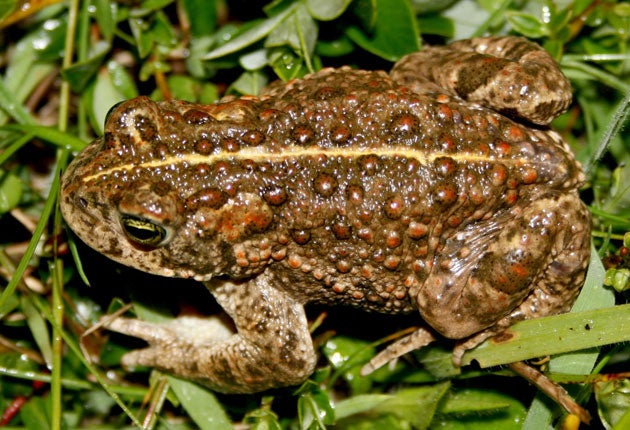
Natterjack toad Now extinct in Wales, and restricted to 50 sites in Britain.
Wryneck The destruction of its woodland habitat has threatened this relative of the woodpecker.
Join our commenting forum
Join thought-provoking conversations, follow other Independent readers and see their replies
Comments
Bookmark popover
Removed from bookmarks